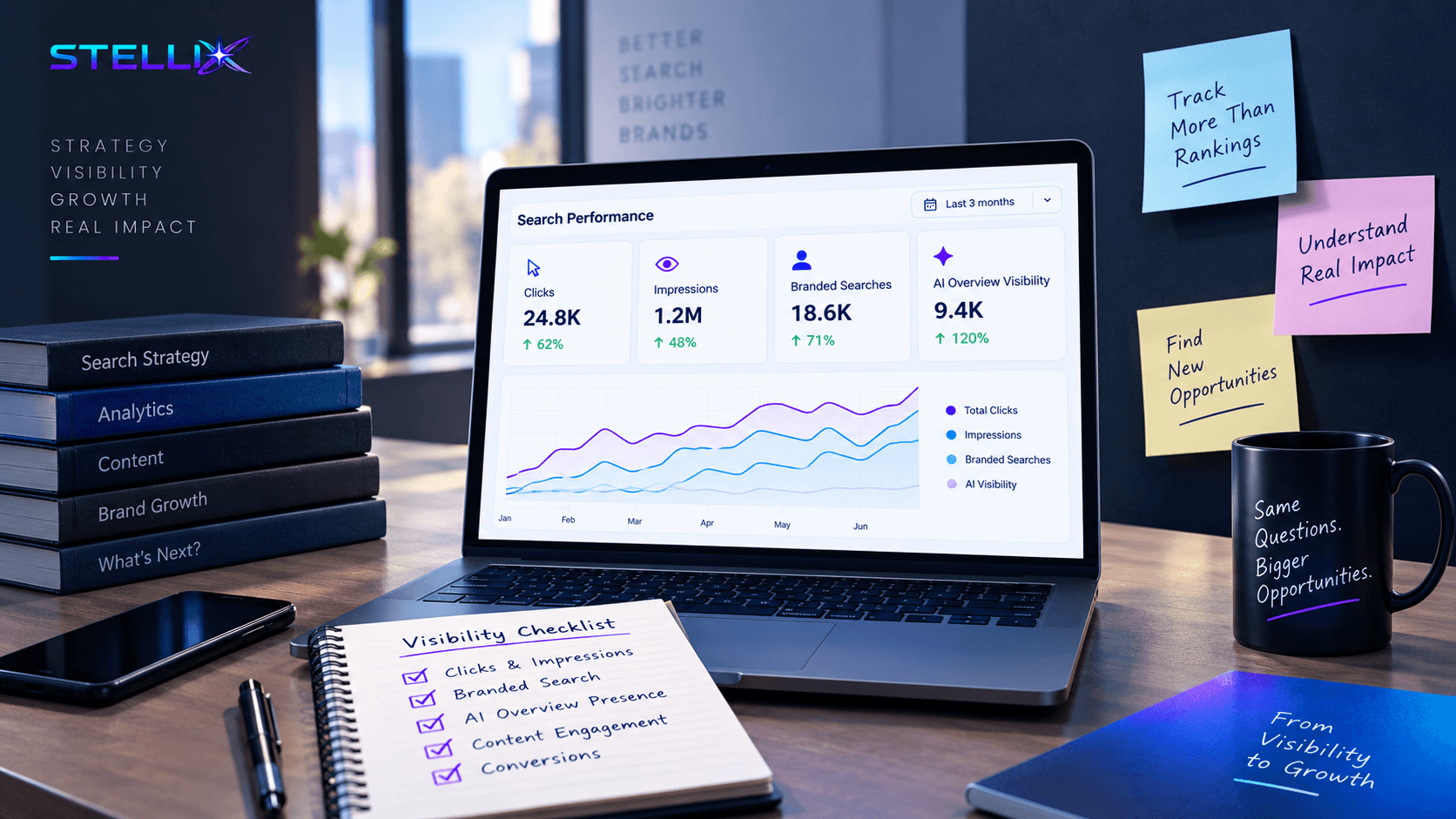
A page can rank well and still contribute very little to the business. That sounds strange until you look at what happens after the ranking.
Does anyone see the result? Do they click? Do they stay? Do they explore another page? Do they remember the brand? Do they eventually become a lead? That is why modern SEO reporting needs to look beyond position.
Rankings remain useful, but they are only one part of the picture. Google Search Console gives marketers access to metrics such as impressions, clicks, CTR, and position, while GA4 adds sessions, engagement, key events, and other website behavior signals. For businesses investing in B2B Digital Marketing Services, the more useful question is not simply, “Where do we rank?”
It is:
“What happens because we are visible?”
Why Rankings Alone Tell Only Part of the Story
Imagine two B2B companies.
Company A ranks in position three for a valuable search but receives very few clicks.
Company B appears lower for several relevant searches, earns strong CTR, brings qualified visitors to its website, and generates enquiries.
Looking only at position makes Company A look impressive.
Looking at the full journey tells a different story. This is where search visibility metrics become valuable. They connect search exposure with user behavior and business outcomes.
A useful SEO measurement journey looks like this:
Impression → Click → Session → Engagement → Brand interaction → Conversion
Each stage answers a different question.
1. Impressions: Are People Seeing Your Brand?
An impression tells you that your page appeared in Google Search. It is the first signal of visibility.
A growing impression count can indicate that your content is appearing for more searches, reaching more searchers, or gaining exposure for existing queries. But impressions need context.
Suppose a B2B software company receives 100,000 impressions for broad searches but attracts very few relevant visitors.
Another company receives 20,000 impressions for searches closely related to its services.
The second pattern may create stronger commercial opportunities. That is why the quality and relevance of search impressions matter alongside volume. Look at which queries generate impressions, which pages receive them, and whether those searches match your target audience.
2. Clicks: Does Visibility Create Interest?
An impression creates an opportunity.
A click shows interest.
Google Search Console reports clicks from organic Google Search, making this metric an important bridge between visibility and website traffic.
Clicks become more useful when you connect them with the search query and landing page. For example, a page receiving clicks for “B2B SEO strategy” tells you something different from a page receiving clicks for a broad query such as “SEO meaning.”
The first may indicate stronger business relevance. This is where professional SEO services can move beyond basic rank tracking by connecting search queries, content, intent, and landing-page performance. The goal is not simply to generate more clicks. It is to generate clicks from people who have a reason to continue the journey.
3. CTR: Are Your Search Results Compelling?
Click-through rate, or CTR, shows how often people click after seeing a search result.
A page can have thousands of impressions and a modest CTR. That creates an opportunity to review the search result itself.
The title may need to communicate the benefit more clearly.
The description may need stronger context.
The page may be appearing for searches where the result does not fully match what people want.
CTR is therefore more than a reporting number. It can provide editorial feedback. For example, a title such as “B2B SEO Guide” may be clear but broad. A more specific title such as “B2B SEO Strategy: Build Visibility Across the Buyer Journey” gives the searcher a clearer reason to click. Small improvements in relevance can make search visibility more useful without chasing rankings alone.
4. Search Position: Useful, But Put It in Context
Position still matters.
A higher position can place a page closer to the searcher's attention, but position should be read alongside impressions, clicks, CTR, query intent, and landing-page performance.
Average position also represents an aggregate view across searches and can vary by query, page, device, location, and other factors. That makes it useful as a directional metric rather than the entire definition of SEO success.
Think of position as the location of your storefront. It matters. But knowing the storefront's location does not tell you how many people walk inside, what they do once there, or how many become customers.
5. Organic Sessions: What Happens After the Click?
This is where SEO moves from search visibility into website behavior. GA4 defines a session as a period of user interaction with a website or app, and its Traffic Acquisition report includes metrics such as sessions, engaged sessions, engagement rate, key events, and average engagement time per session.
Organic sessions show whether search visibility is actually bringing people onto your website. But session volume alone does not tell the whole story.
A B2B website might receive 5,000 organic sessions in a month. If most visitors leave without exploring the site, that traffic may have limited business value. Another site might receive 2,000 organic sessions and generate strong engagement and qualified enquiries. The second result deserves a closer look.
6. Engagement Rate: Are Visitors Finding Value?
Once someone reaches your website, engagement becomes important.
GA4 defines an engaged session as one that lasts longer than 10 seconds, includes a key event, or contains at least two page or screen views. Engagement rate is the percentage of sessions that meet those criteria. This gives SEO teams a useful way to connect search traffic with actual website interaction.
For content, engagement can show whether the page gives visitors a reason to continue reading.
For service pages, it can help reveal whether visitors are exploring the offer.
For B2B websites, strong engagement may include reading another article, viewing a service page, visiting a case study, or starting an enquiry. That is why content should not end at the first paragraph. Every useful section should naturally answer the question that comes next.
7. Landing-Page Performance: Does the Page Match the Search?
Search visibility brings people to a page. The page then has to deliver on the promise made in the search result. This is one of the most practical metrics to review.
Suppose a visitor searches for “performance marketing services in Mumbai” and lands on a general digital marketing blog. The traffic may be relevant, but the page may not provide the clearest next step.
A dedicated service page could be a better match. This is where Performance Marketing Services in Mumbai can become a natural commercial journey rather than simply a keyword target. The same principle applies across SEO.
Match the landing page to the search intent. When the expectation and page experience align, visitors have a clearer reason to continue.
8. Pages per Session and Content Paths
One useful question is:
What does an organic visitor read next?
A strong content strategy creates natural paths.
A visitor reads a guide about B2B SEO.
They explore a related article about search intent.
Then they visit a service page.
Then they view the contact page.
That path tells you much more than a ranking position. It shows that content is helping move a visitor through the website.
For B2B brands, this is especially useful because buying decisions often involve several research steps. Your content should make those steps easy to follow.
9. Branded Search: Is Visibility Building Recognition?
Not every SEO interaction ends with an immediate click. Someone may discover your company through an organic result, social post, AI answer, referral, or industry article. Later, they may search for the brand directly.
Branded search can therefore act as a useful supporting signal of growing brand awareness. It should not be treated as proof that one specific channel caused the search.
Instead, look at broader patterns.
Are branded queries growing?
Are more people searching for your company alongside a service?
Are branded visitors engaging with commercial pages?
This helps connect SEO with brand-building rather than viewing organic search as an isolated acquisition channel.
10. Key Events and Leads: Where SEO Meets Business
Eventually, SEO needs to connect with an outcome that matters to the business. For a B2B company, that could be a consultation request, enquiry form, demo request, phone call, newsletter signup, or another meaningful action.
GA4 allows businesses to mark relevant events as key events and report on metrics such as key events and session key event rate. This changes the conversation.
Instead of saying:
“Our blog received 10,000 organic visits.”
You can ask:
“How many engaged visitors reached commercial pages?”
“How many completed a key event?”
“Which organic landing pages contributed to qualified enquiries?”
Those questions connect SEO with business growth.
11. Assisted Conversions and the Longer B2B Journey
B2B journeys rarely follow a straight line.
A prospect may first discover an article through Google.
Weeks later, they may return through LinkedIn.
Then they search the company name.
Then they visit a service page.
Then they contact the business.
SEO may have played an early role even if the final interaction came through another channel. This is why SEO should be evaluated alongside paid media, social, email, direct traffic, and other acquisition sources. A connected measurement approach gives marketing teams a clearer picture of how different channels contribute to demand.
The Metrics That Matter Most Depend on the Business Goal
There is no universal SEO dashboard that works perfectly for every business.
An e-commerce company may focus heavily on revenue and product-page performance.
A publisher may care more about engaged sessions, returning users, and content depth.
A B2B company may prioritize qualified leads, key events, service-page engagement, branded search, and assisted conversions. The important step is to connect the metrics to the business goal.
For Stellix clients focused on growth, the measurement chain can be viewed as:
Visibility → Interest → Website engagement → Brand interaction → Lead → Business opportunity. That creates a much more useful SEO conversation than simply reporting rankings every month.
How to Build a Better SEO Measurement Dashboard
Start with the search data.
Use impressions, clicks, CTR, position, queries, and landing pages to understand visibility. Then move into analytics.
Review organic sessions, engagement rate, average engagement time, engaged sessions, landing-page behavior, and key events. Google Analytics provides these metrics through its reporting and exploration tools.
Finally, connect the data to business outcomes.
Track leads.
Track qualified enquiries.
Track service-page activity.
Track branded searches.
Track returning visitors.
Track the content paths that lead toward meaningful actions.
The result is a dashboard that explains not only what happened, but also where the next improvement opportunity sits.
What Should You Stop Treating as the Main SEO KPI?
Rankings deserve a place in the dashboard. They simply do not deserve the entire dashboard.
A ranking can change while impressions grow.
CTR can improve while position stays similar.
Organic traffic can rise while engagement changes.
A page can generate modest traffic but produce highly relevant leads. That is why experienced SEO teams look at patterns rather than one isolated number. The best metric is often the one that answers the business question currently on the table.
Where Professional SEO Support Adds Value
As websites grow, SEO measurement becomes more connected to content, paid media, analytics, social channels, and conversion strategy. A business may have strong traffic data but limited visibility into which pages influence leads. Another may have plenty of impressions but need a clearer connection between search demand and commercial pages.
This is where Search Engine Marketing Consulting Services can help bring search strategy, measurement, landing pages, paid campaigns, and business goals into the same conversation. For B2B brands, B2B Digital Marketing Services can provide an even broader framework by connecting SEO with content, performance marketing, social media, website experience, and lead generation. The focus should remain practical: measure what matters, understand why it changes, and use the findings to improve the next stage of the buyer journey.
Search Visibility Is Bigger Than a Ranking
A ranking tells you where a page appeared.
A stronger measurement system tells you what happened because it appeared.
Did people see it?
Did they click?
Did they reach the right page?
Did they engage?
Did they explore the brand?
Did they return?
Did they enquire?
That is the difference between tracking SEO activity and understanding SEO impact.
For brands investing in organic growth, the most useful approach is to connect every stage:
Impression → Click → Session → Engagement → Brand interaction → Conversion
When those signals work together, SEO reporting becomes easier to understand and much more useful for decision-making. And that is where Performance Marketing Services in Mumbai and organic search can work together: one captures demand across paid channels while SEO builds a broader foundation for people already researching solutions.
Frequently Asked Questions
Are rankings still important for SEO?
Yes. Rankings remain useful for understanding search visibility. They work best when reviewed alongside impressions, clicks, CTR, traffic, engagement, and conversions.
What is the most important SEO metric?
There is no single metric that fits every business. The right metrics depend on the goal. For many B2B companies, qualified leads, key events, organic traffic quality, engagement, and commercial-page activity can be more useful than rankings alone.
Why are impressions important?
Impressions show how often your pages appeared in Google Search. They provide an early view of search visibility and can help identify opportunities in queries, topics, and pages.
How does CTR help SEO teams?
CTR shows how often people click after seeing a search result. It can help teams assess whether titles and search-result messaging match the intent behind the query.
What should I track in GA4 for organic traffic?
Useful metrics include organic sessions, engagement rate, engaged sessions, average engagement time, key events, session key event rate, and landing-page behavior.
How can SEO metrics support lead generation?
Connect organic landing pages with engagement, service-page visits, key events, enquiries, and qualified leads. This helps show how search visibility contributes to the wider buyer journey.
Key Takeaways
Search rankings are useful, but they are only one part of SEO measurement.
Impressions show visibility. Clicks and CTR show search interest. Sessions show traffic. Engagement shows what visitors do next. Branded search can provide a supporting view of brand recognition. Key events and leads connect SEO with business outcomes.
For B2B companies, the strongest SEO dashboard usually connects these signals instead of reporting each one separately.
The goal is simple:
Get seen → earn the click → create a useful session → encourage engagement → build brand interaction → generate meaningful business action.
Conclusion
SEO reporting becomes much more valuable when the conversation moves from “Where did we rank?” to “What did that visibility create?”
A strong search strategy should help you understand the complete journey, from the first impression to the eventual business interaction. That means looking at impressions, clicks, CTR, organic sessions, engagement, landing-page performance, branded search, key events, leads, and conversion paths together. For businesses investing in professional SEO services, this approach also creates a clearer way to decide where the next investment should go.
Perhaps a page needs a stronger title.
Perhaps a valuable query needs better content.
Perhaps a landing page needs a clearer next step.
Perhaps organic traffic is already working well and deserves stronger support from paid and social channels.
The data can help answer those questions. If you want to connect search visibility with traffic quality, engagement, brand growth, and lead generation, Stellix can help build a measurement-led SEO and digital growth strategy around your business goals.
Ready to look beyond rankings? Let’s connect with the Stellix team and turn search visibility into a clearer growth journey.
Suggested related articles
For readers who want to continue the topic, these Stellix resources fit naturally with the article: