Introduction
Your next win for organic traffic could already be sitting on your website. A page that gets clicks can frequently become even more valuable with better search intent alignment, new information, stronger internal links, and a better title. That’s where an SEO content refresh comes into play.
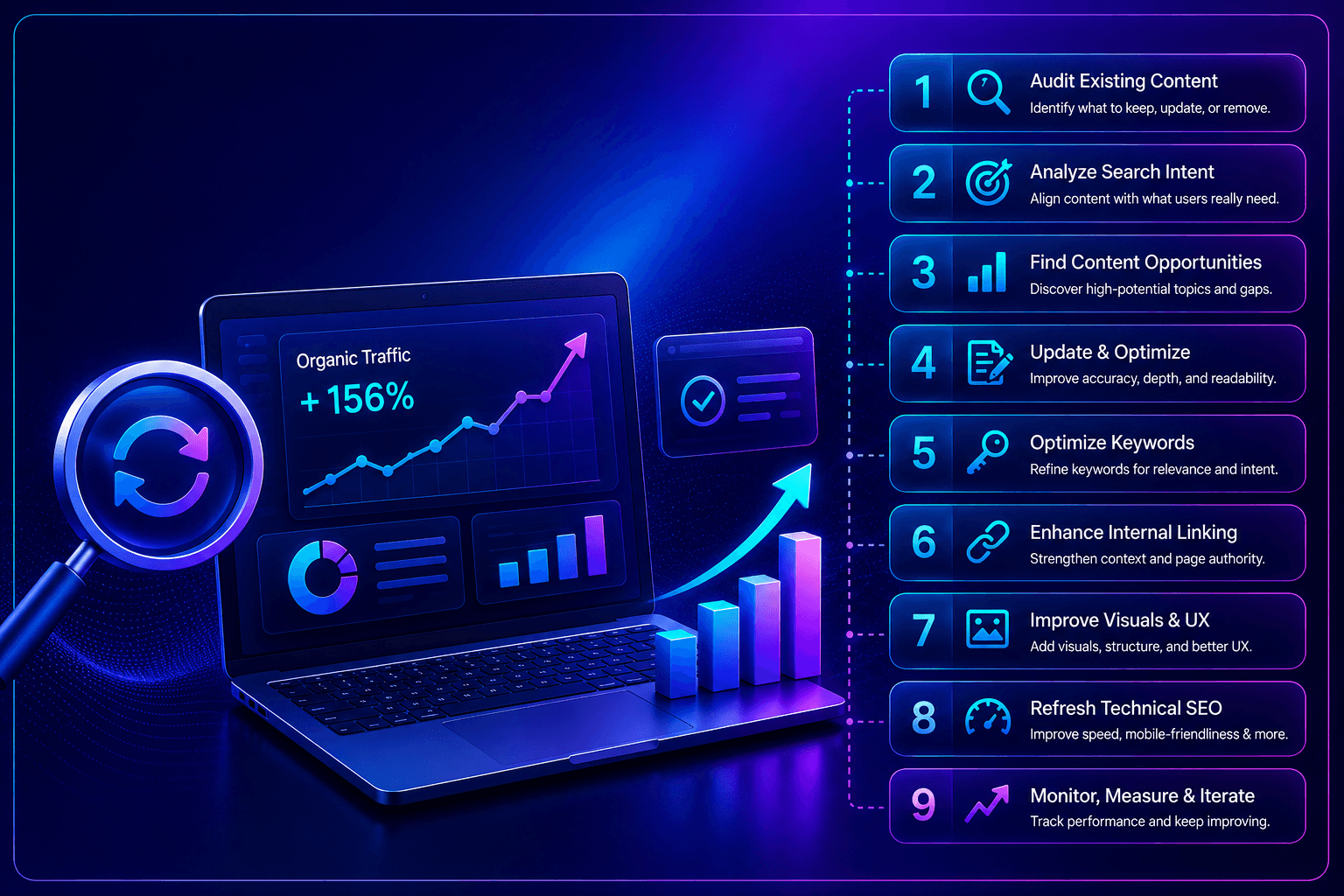
Instead of starting from the beginning with a new post, you are enhancing an existing asset that already has search exposure, indexed content, backlinks, or audience interaction. It’s a surprisingly down-to-earth process. See what the page ranks for today, learn what people are searching for, find content gaps, refresh old sections, optimise on-page SEO, add internal links, and monitor outcomes. In such a case, it can make existing content a more productive organic development channel for firms who invest in professional SEO services.
Here’s a nine-step do-it-yourself guide.
Key Takeaways
An SEO content refresh focuses on improving existing pages rather than automatically creating new ones.
Search intent should guide every meaningful content update.
Google Search Console can reveal queries, impressions, clicks, CTR, and ranking opportunities worth investigating.
Refreshing statistics, examples, headings, FAQs, and supporting information can make an established page more useful.
Internal links can connect refreshed content with relevant service pages and supporting resources.
Titles and introductions deserve special attention because they influence both search visibility and the decision to click.
The best refresh strategy connects SEO improvements with engagement, conversions, and business outcomes.
Table of Contents
What Is an SEO Content Refresh?
Step 1: Identify Pages With Growth Potential
Step 2: Verify Search Intent Double
Step 3: Update the Core Information
Step 4: Add More Topical Depth
Step 5: Fine-tune titles and on-page SEO
Step 6: Improve Internal Linking
Step 7: Boost Engagement After Click
Step 8. Insert Conversion Opportunities
Step 9: Measure, Learn, and Refresh (again)
Frequently Asked Questions
Summary
Conclusion
Get in Touch
What Is an SEO Content Refresh?
An SEO content refresh is when you update an existing webpage to better match search intent, include current information, show your expertise, and create a better user experience. The key term is 'existence. You don't always need another 2,000-word piece sitting next to the 14 other papers you've already published on the same subject. Sometimes your best opportunity is an existing page that has impressions but requires a strategic improvement. It’s like a renovation of a high-potential digital asset. The URL, the past signals, the current content, and the accumulated visibility are a good beginning point. Your duty is to make the page more useful and relevant.
Step 1: Identify Pages With Growth Potential
First, use Google Search Console.
Find pages with impressions but not enough clicks relative to their prominence. Also review pages on the first page that are located in the centre or towards the end of the page, and articles that previously received significant organic traffic.
Pages like these might be great refresh chances. For example, let’s say a post gets 20,000 impressions each month, ranks for hundreds of related queries, and gets a handful of clicks. That means a lot.
Google already has enough understanding of the page to show it. Now, take a look at what you can do to make the page more interesting.
Check the queries that are getting impressions. Look at the pages above your rank. Compare info, structure, depth, examples, and search intent alignment. This provides a data-led entry point for your refresh. This gives your refresh a data-led starting point.
Step 2: Re-verify Search Intent
Search intent should be at the core of every content refresh.
A page that was developed two years ago could have been written around one interpretation of a query. Search conduct might change, and so can the search results.
Let’s take a sample query, “SEO content strategy.”
Somebody can be searching for a concept, structure, examples, templates, or a practical implementation approach. Check current search results and ask:
What does the searcher currently seem to want?
Then your page provides that experience rapidly. Where a wider SEO strategy also becomes beneficial. Businesses that partner with SEO Consulting Services may utilise search intent research to identify which existing pages should be enhanced, merged, repositioned, or approached with a different content slant.
Step 3: Update Core Information
Now enhance it.
Update statistics as appropriate. Update old examples. Add industry advancements, expert observations, images, methods, and current tools.
Search for claims that were true at the time of publication of the article, but which can now be made more precise. The point is not to put different words only for the purpose of changing words. Each update should make the page more useful.
Imagine an article about technical SEO that mentions an old search feature, an outdated reporting interface, and a process your team no longer recommends. By refreshing those sections, the resource immediately becomes more useful.
Add what readers need now.
Delete anything not contributing to the answer.
Save what still has value. That’s a deliberate refresh of the content.
Step 4: Increase Topical Relevance
A strong refresh goes beyond adding more words. It adds the right context.
Review related questions people ask around your primary topic. Consider supporting concepts, subtopics, examples, comparisons, processes, and decision-making information. For a page about local SEO, for example, relevant supporting themes might include Google Business Profile optimization, local citations, reviews, location pages, local search intent, NAP consistency, and local ranking signals
You don't need to squeeze all of these concepts into one giant article. Instead, cover the most relevant subjects clearly and connect deeper topics through internal links. This creates a stronger topical ecosystem across your website.
Step 5: Optimise Titles & On-Page SEO
Your content may be great, but it may be a little stronger with a better first impression. The title must tell the searcher what the page is about and offer them a cause to click.
Compare the following.
Guide to Refreshing SEO Content with
or
9 Steps to Increase Organic Traffic with SEO Content Refresh
The second version gets to the subject, format, and benefit much faster.
Your H1, title tag, intro, H2s, meta description, image alt text, and URL should all be in harmony.
Don’t stuff keywords into every nook and cranny. Search engines have gotten considerably better at recognising context. Write for humans first, then make the page structure crystal obvious for search systems.
Step 6: Optimise Internal Linking
A refreshed article should not be an island.
Include contextual links to related supporting content, service pages, case studies, and additional in-depth content. For instance, if you’re writing an article about refreshing material, you may naturally link to a guide on search intent, an article on content gaps, and a relevant SEO services page. Use descriptive anchor language to let readers know where the link is going.
Internal linking also helps disperse authority throughout your site and provide better paths from instructional content to commercial sites. This might be especially effective for a Digital Marketing Consulting Agency in Mumbai where educational content supports high-intent service sites.
A reader might come across your blog looking for a solution to an issue and then easily transition to a consultation page once they learn of the solution. This is a lot more helpful journey than a blog post that ends with “Thanks for reading.”
Step 7: Boost Engagement After the Click
There’s more to organic development than the click. You have to earn the next move too.
Go to the first screen
Does the introduction immediately make the reader feel they are at the proper place?
Are the paragraphs too short for mobile readers?
Can someone scan the H2s and give a brief read of the article?
Are examples put where they help?
Does the page answer the core question quickly? These details impact how comfortable a person is moving through the material.
You can also increase engagement by using comparison tables, short examples, relevant graphics, FAQs, pull quotes, calculators, templates, or downloadable resources when they bring real value.
The premise is straightforward: “Make the next useful piece of information findable.
Step 8: Introduce Conversion Opportunities
A content refresh is also a way to tie organic visibility to business progress. CTA must align with the reader’s intent.
If someone is reading an intro to SEO tutorial, they might like a similar post.
If someone is looking for an SEO audit, they may be willing to consider expert help.
Someone comparing SEO agencies might be closer to contacting a service. It should feel like the CTA is the natural next step.
For example, after discussing how to find content opportunities, a relevant message such as “Want to find out which pages could drive more organic traffic? Let’s take a look at your content portfolio together.” It’s a natural transition from education to action.
That’s where SEO fits into the larger marketing funnel.
Step 9: Measure, learn and refresh again
Give your changes time to produce useful data.
Track impressions, clicks, CTR, avg. position, organic sessions, engagement, conversions and aided conversions if applicable.
See which enquiries have grown in visibility.
Did new types appear?
CTR get better?
Did visitors look at more pages?
Did queries, or other meaningful activity, increase?
These insights can help you plan your next content update.
SEO works especially well as a cycle of learning and development. A page is published, acquires data, strategic updates, and becomes a stronger asset. When you view your content collection as a living resource rather than a publishing archive, it can grow in value.
Frequently Asked Questions
What is an SEO content refresh?
So what is an SEO content refresh? An SEO content refresh is the process of improving an existing webpage by updating information, boosting search intent alignment, improving on-page SEO, expanding valuable context, and improving user satisfaction.
How often should you refresh SEO content?
There isn't one size-that-fits-all timetable. Update material when its information, search intent, rankings, traffic patterns, or business relevance indicate an update might yield more value.
Can updating old content help rankings?
A refresh can boost search results when those updates make the page more valuable, relevant, thorough, and suited to what searchers desire now.
What should I check before reloading an article?
Review the organic traffic, impressions, clicks, CTR, ranking queries, search intent, competitor pages, backlinks, internal links, and the accuracy of the current information.
Do I need to rewrite the whole article?
Not always, no. Keep the parts that are already working well. Make the parts that may be clearer, new, deeper, or relevant to add more value.
Which pages should I refresh first?
Target pages that have valuable impressions, existing organic traffic, valuable ranking enquiries, significant business relevance or clear potential to boost clicks and engagement.
Do SEO agencies assist with content updates?
Yes. An experienced SEO team may use search analytics, content analysis, technical SEO, competitive research and conversion strategy to discover and prioritise high-value refresh opportunities.
Conclusion
More often than not, organic development doesn’t begin with a blank document.
Your current content may already have search visibility, historical signals, important information and an audience waiting to find it. A smart SEO content refresh updates such assets to reflect current search intent, stronger on-page SEO, deeper subject relevance, and improved user experiences.
The nine-step method is simple: Find the proper page, know the searcher, refresh the substance, strengthen context, improve the click, connect internal links, and enhance engagement
Create a relevant conversion route. Measure what occurs next. If you want to turn existing content into a better organic acquisition channel, Stellix can assist you in finding the pages with the most growth potential.
Get in touch
Have a content library with unexploited organic potential?
Let’s chat. Stellix uses search analytics, content strategy, technical SEO and conversion thinking to create a pragmatic refresh path for your website.
Turn more of your existing content into verifiable organic growth with professional SEO services from Stellix
Stellix Overview
Stellix is a digital marketing agency that specialises in SEO, AI search visibility, performance marketing, website building, content planning and measurable business growth. We are performance-driven. They employ data, strategy, technology and creative thinking to help organisations develop higher digital exposure and create engaging consumer journeys.