Introduction
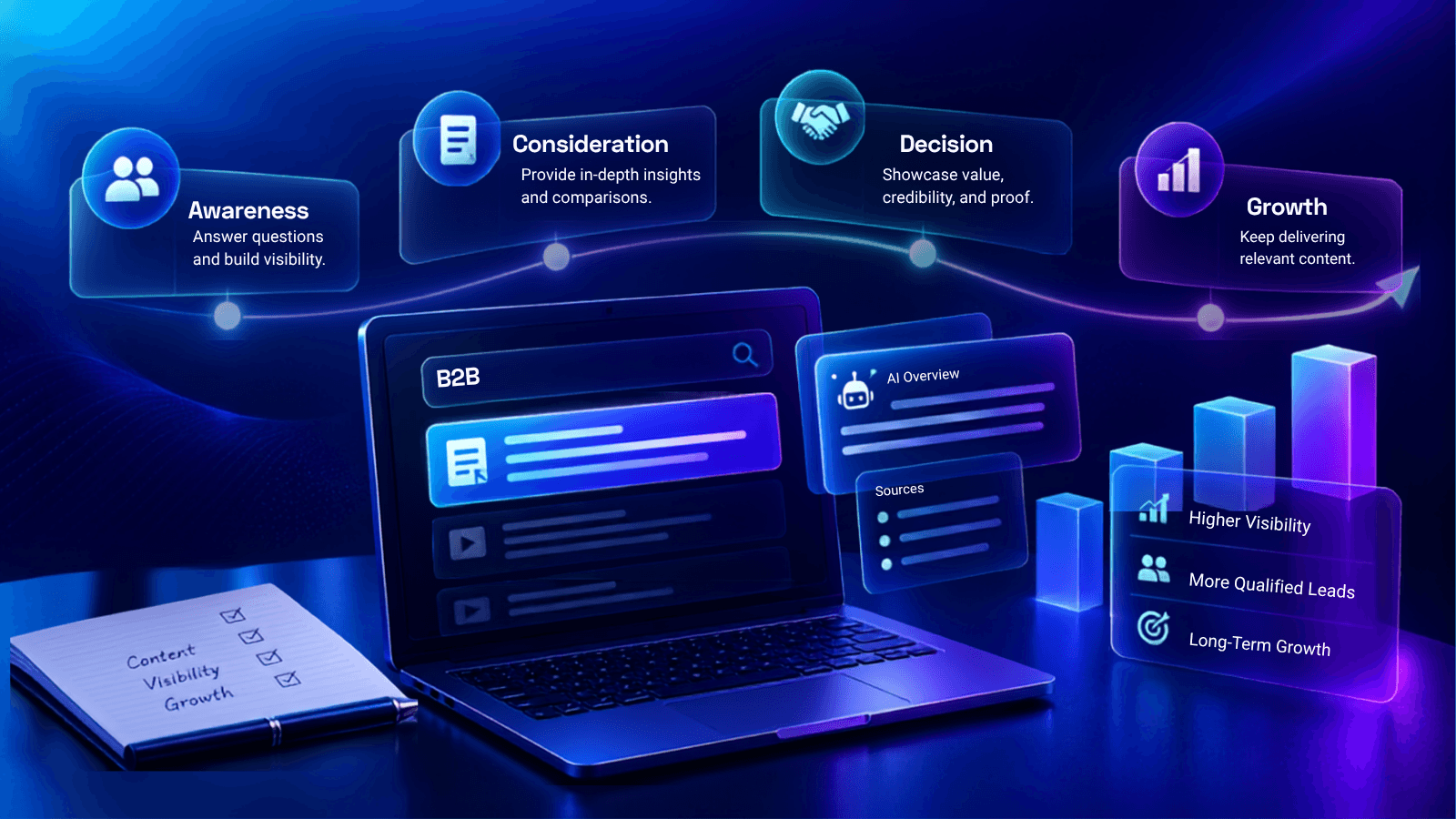
Your B2B buyer could find your brand long before they’re ready to reach out to your sales staff. They might look for an industry problem, read a guide, compare solutions, visit your website, read a case study, and come back weeks later with a much clearer vision of what they want. That is why a strong B2B SEO Strategy should do more than help one page rank. It should make your brand visible throughout the buyer journey.
A well-planned strategy connects B2B SEO services, search intent, useful content, technical SEO, service pages, internal links, and conversion paths. The result is a website that supports buyers from their first search through to the point where they are ready to speak with your team.
This article explains how to build that system, what content works at each buyer stage, and how SEO can contribute to meaningful B2B growth.
Table of Contents
Why B2B SEO Requires a Buyer-Journey Approach
The B2B Buyer Journey and Search Intent
Build Visibility at the Awareness Stage
Create Content for the Consideration Stage
Support the Decision Stage With High-Intent Pages
Connect Every Stage With Internal Links
Build a B2B SEO Content Ecosystem
Measure What Matters
Common B2B SEO Mistakes to Avoid
Frequently Asked Questions
Key Takeaways
Conclusion
Contact Stellix
Related Article
Why B2B SEO Requires a Buyer-Journey Approach
Rarely will a B2B buyer search once and decide on the spot. The process normally involves investigation, debate, comparison, validation, and approval. A marketing manager can start with a query like “how to generate B2B leads.” Weeks later, the same person could search for “B2B performance marketing agency,” evaluate suppliers, study case studies, and finally seek a consultation. Every search has a different level of purpose. And that’s where a lot of SEO techniques come up short. They focus so much on generic keywords and rankings but less on what the buyer really needs next. A more effective strategy is to map SEO to the whole experience. This content will enable you to answer the initial query, aid you in the research phase, help you in evaluation, and make the final decision easier.
The B2B Buyer Journey and Search Intent
Search intent is the bridge between SEO and the buyer experience. People are generally learning at the awareness level. They want to hear about an issue, a trend, a procedure, or an opportunity. In the consideration stage, they begin searching for solutions. They become more specific in their searches. At the decision stage, they’re analyzing providers, products, services, pricing, expertise, and fit. The purpose is not to send every visitor to a sales page. The idea is to help them take the next step when they are ready.
Build Visibility at the Awareness Stage
The awareness stage is where many B2B relationships begin.
A prospect may not know your company yet. They are simply looking for an answer. This creates an opportunity to publish content around real customer questions. For example, a B2B technology company could create content around SEO strategy, lead generation, website performance, content marketing, AI search, or demand generation.
The content should answer the question quickly, then provide enough depth to keep the reader engaged. This is where topic selection matters more than simply chasing keywords with large search volumes. A phrase with modest search volume can be extremely valuable if it closely matches the problems your ideal customers care about. Strong awareness content can also introduce related resources. An article about B2B SEO, for example, could naturally connect to content about search intent, technical SEO, content refreshes, AI search, and conversion optimization. One useful article becomes an entry point into a larger content journey.
Create Content for the Consideration Stage
Once prospects understand the problem, their questions change.
They start asking:
Which solution should we choose?
What approach fits our business?
What should we look for in a provider?
How much expertise do we need?
What results can this strategy support? This is where consideration-stage content becomes valuable.
Detailed guides, comparison articles, implementation frameworks, industry-specific resources, and case studies can help prospects evaluate their options. Imagine a company has already learned why SEO matters for B2B growth. Its next search might be “B2B SEO agency vs in-house SEO team.”
A useful comparison article can explain the differences, outline when each model makes sense, and help the reader assess their own situation. That content creates value without pushing the reader toward a sales conversation too early. It also creates another opportunity for internal links. The comparison page could connect to a relevant SEO service page, while the service page could link back to supporting educational resources. The journey starts to feel connected rather than fragmented.
Support the Decision Stage With High-Intent Pages
Eventually, the buyer moves from learning to evaluation. This is where your commercial pages become important. A strong service page should explain the problem it solves, who the service is designed for, what the process involves, and what makes the approach valuable. For example, someone reading an article about creating an SEO roadmap may reach a point where they want expert guidance.
A contextual link to SEO Consulting Services can provide that next step. The connection works because the reader has already shown interest in SEO strategy. It feels useful rather than promotional. The same principle applies to professional SEO services. An article discussing SEO execution can naturally point readers toward professional support when the topic calls for it. This is how content can bridge the gap between research and action.
Connect Content With Internal Linking
Pages that assist each other make SEO content work harder. An awareness article can lead to more detailed guidance.
The guide can locate a resource for comparison.
The comparison page could link to a service page.
The service page can link out to a case study.
The case study may result in a consultation.
That gives a simple path:
SEARCH » LEARN » EXPLORE » COMPARE » TRUST » CONTACT
Internal links also help search engines understand the connection between your sites.
Google recommends using descriptive anchor text. This helps users and search engines understand what the link is pointing to. For example, a sentence about improving website structure could link through on-page SEO to a relevant resource. That means keywords like B2B SEO strategy, technical SEO guide, or SEO consulting services are way more valuable than generic anchors like “click here.” The trick is relevance. Every link should provide the reader with a reason to keep going.
Build a B2B SEO Content Ecosystem
A strong B2B SEO strategy is rarely built around one article. It is built around subjects that are connected.
Say your main topic is B2B SEO. Supporting content could involve keyword research, search intent, technical SEO, content strategy, internal linking, local SEO, AI search, conversion optimization, SEO measurement, and content refreshes. Together, these provide wider topical
coverage.
Your website starts answering questions that show up before, during, and after the main search. This approach also makes it easier to plan content.
Rather than asking, “What blog should we publish this week?”
Question:
‘What’s the next question our buyer asks?’
That one change can create much more powerful content ideas.
Measure What Matters
Rankings and impressions are good, but B2B SEO needs a broader measurement methodology.
Review organic clicks, engaged sessions, conversion rates, qualified prospects, consultation requests, helped conversions, and pipeline contribution. For instance, an article might get approximately 10,000 impressions and 500 clicks. Another article might get approximately 2,000 impressions and 120 clicks but only generate eight quality inquiries.
The second article may be far more valuable to the business. That’s why B2B SEO reporting has to tie search visibility to actual client journeys. We’re not looking for more traffic. It is more relevant traffic moving toward meaningful business outcomes.
How B2B SEO Works With Broader Digital Marketing
SEO becomes even more valuable when it works alongside other digital channels.
A prospect might first discover your brand through organic search, return through a paid campaign, watch a social media video, read a case study, and later search for your company by name. That means SEO does not operate in isolation.
For companies investing in B2B Digital Marketing Services, search can become the foundation that supports content, paid media, social campaigns, website experiences, and conversion activity.
The same principle applies when working with an seo and digital marketing company. The strongest strategy connects channels around the same audience, message, and business goals.
Performance marketing can capture demand, while SEO can build an asset that continues attracting relevant searches over time. A broader Performance marketing strategy can then use insights from search behavior to improve campaigns, landing pages, messaging, and audience targeting. The result is a connected digital growth system rather than a collection of separate marketing activities.
Frequently Asked Questions
What is a B2B SEO strategy?
A B2B SEO strategy is a search-focused approach designed to attract business buyers, answer their questions, build visibility across the buying journey, and guide qualified prospects toward meaningful actions.
Why is SEO important for B2B companies?
B2B buyers often research extensively before speaking with sales teams. SEO helps businesses appear when prospects are researching problems, exploring solutions, comparing options, and evaluating providers.
What content should B2B companies create for SEO?
A balanced strategy can include educational articles, detailed guides, comparison content, industry resources, case studies, service pages, FAQs, and conversion-focused landing pages.
How does search intent affect B2B SEO?
Search intent reveals what the buyer wants at a particular moment. Matching content to that intent creates a more useful experience and helps each page serve a clear role in the buyer journey.
Should B2B blogs link to service pages?
Yes, when the service directly relates to the topic. A contextual service link gives readers an easy way to move from learning to exploring professional support.
How long does B2B SEO take to produce results?
SEO results vary based on competition, website strength, content quality, search demand, technical foundations, and the market. A consistent strategy can build stronger visibility and business value over time.
Key Takeaways
A successful B2B SEO Strategy covers the complete buyer journey.
Search intent should guide content creation, keyword selection, page structure, and conversion paths.
A strong B2B content strategy combines awareness, consideration, and decision-stage content.
Internal linking connects different stages and gives prospects a natural path through your website.
SEO performance should be measured through business outcomes such as qualified leads, engagement, conversions, and pipeline contribution.
Conclusion
B2B SEO works best when you stop thinking of rankings as the finish line. A ranking is an opportunity to begin a relationship.
Someone sees your page in search. They click. They read. They explore another resource. They learn about your expertise. Eventually, they reach a service page when they are ready to take the next step. That is the real value of a buyer-journey-focused B2B SEO strategy.
Build content around real questions. Match each page to search intent. Connect related resources. Give commercial pages the support they deserve. Then measure what happens after the click. For businesses looking to strengthen organic visibility across every stage of the B2B buying journey, the right SEO strategy can turn search traffic into a much more valuable growth channel.
Contact Stellix
Want your SEO strategy to attract prospects at the research stage and guide them toward the right solution? Stellix can help you map buyer intent, build connected content journeys, strengthen commercial pages, and create an SEO strategy focused on measurable business growth. Book a strategy call with Stellix and build a B2B SEO strategy designed around how your customers actually search, research, and decide.
About Stellix
Stellix is a performance-driven digital marketing agency helping ambitious brands grow through SEO, paid media, content marketing, website development, performance marketing, and AI-focused search strategies. By combining data-backed insights, technical expertise, and creative thinking, Stellix develops customized marketing solutions designed to increase visibility, attract high-intent audiences, and deliver measurable business results. Whether you're expanding locally, growing nationally, or building a global digital presence, Stellix creates strategies designed for sustainable growth.