Introduction
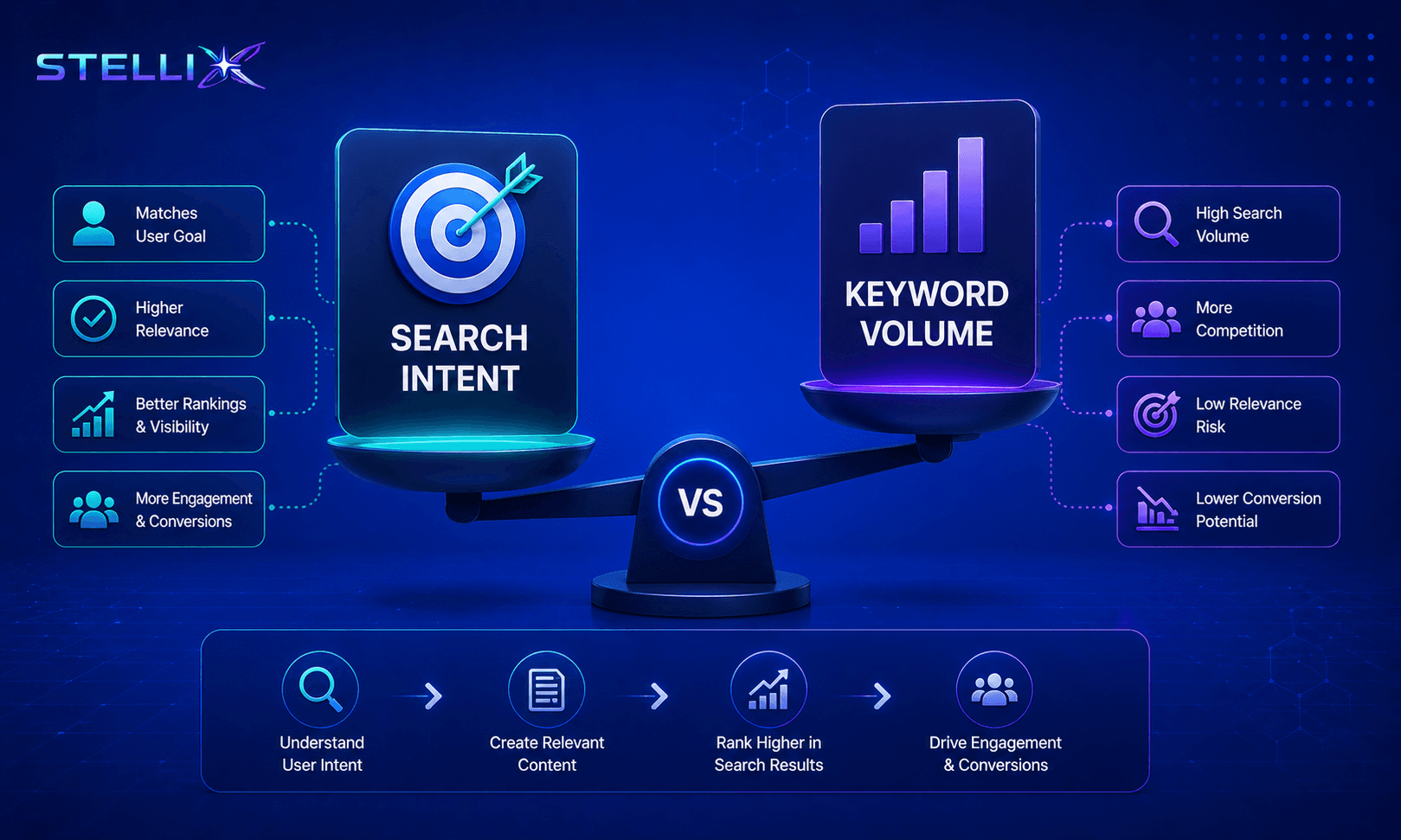
Search intent matters more than keyword volume because the right searcher is more valuable than the biggest search number. A keyword with thousands of monthly searches can attract broad audiences, while a highly specific query with a smaller audience can bring people who are much closer to taking action. That distinction is becoming increasingly important as Google and AI-powered search experiences become better at understanding context, meaning, and user needs.
For businesses investing in Local SEO Services Mumbai, B2B Digital Marketing Companies, or an SEO Agency for SaaS Companies, the opportunity is to create content around what people actually want to accomplish when they search.
Think of keyword volume as the size of the audience outside your store.
Search intent tells you how many people are actually looking for what you sell. And that difference can completely change an SEO strategy.
Table of Contents
What Is Search Intent?
Why Keyword Volume Alone Isn't Enough
The Four Types of Search Intent
How Search Intent Influences SEO Performance
Search Intent and Content Strategy
How to Find High-Intent Keywords
Why Search Intent Matters for B2B SEO
Search Intent for Local SEO
Search Intent for SaaS Companies
How to Build an Intent-Led SEO Strategy
Frequently Asked Questions
Conclusion
What Is Search Intent?
Search intent is the reason behind a search query.
Someone searching “what is technical SEO” is looking for information.
Someone searching “technical SEO agency for SaaS” is exploring a service.
Someone searching “Stellix digital marketing agency” is looking for a specific brand.
Someone searching “buy CRM software” has a much stronger commercial objective.
The words may look similar from an SEO perspective, but the underlying goals are very different. Understanding that goal helps marketers create pages that provide the right answer, at the right depth, for the right stage of the customer journey. This is why modern keyword research should begin with a question beyond volume:
What does the searcher want to accomplish?
Why Keyword Volume Alone Isn't Enough
Keyword volume is useful. It gives marketers an indication of how frequently people search for a phrase and can help estimate potential demand. But volume alone doesn't tell you whether those searches are relevant to your business.
Consider two keywords.
“SEO” may have enormous search volume.
“SEO agency for SaaS companies” may have considerably less.
Yet the second phrase gives you much more information about the searcher's needs.
They are identifying a specific type of provider and a specific business context.
That makes the keyword highly valuable for an SEO Agency for SaaS Companies.
The same principle applies to B2B marketing.
A broad search such as “digital marketing” can attract a huge range of audiences.
A more specific search such as “B2B digital marketing services for technology companies” communicates considerably more intent.
The audience is smaller.
The opportunity can be much stronger.
The Four Types of Search Intent
1. Informational Intent
Informational searches happen when people want to understand something.
Queries such as “how does technical SEO work?” or “what is search intent?” belong to this category. These searches are ideal for educational content, guides, explainers, research articles, and tutorials. The objective is to provide useful information while establishing expertise.
2. Navigational Intent
Navigational searches happen when someone is looking for a particular website, brand, or destination. Examples include branded searches such as “Stellix SEO services” or “Google Search Console.” These searches often indicate existing brand awareness.
Strong brand architecture, optimized pages, and clear website navigation can help users reach the right destination efficiently.
3. Commercial Investigation
Commercial searches happen when someone is evaluating options.
Queries such as “best SEO agency for SaaS companies,” “SEO services comparison,” or “B2B digital marketing companies” suggest that the searcher is exploring potential solutions. Comparison pages, service pages, case studies, expert guides, and detailed resources can work particularly well here.
4. Transactional Intent
Transactional searches indicate a stronger readiness to take action.
Examples include “book SEO consultation,” “SEO services Mumbai,” or “buy marketing software.” These searches deserve pages that make the next step clear. The content should communicate value, answer important questions, establish credibility, and make conversion easy.
How Search Intent Influences SEO Performance
When content aligns with search intent, the entire user journey can become more relevant.
Imagine someone searching for “local SEO services Mumbai.” They likely want information about providers, services, locations, expertise, pricing considerations, or outcomes. Sending that searcher to a generic SEO definition page creates a mismatch.
A dedicated local SEO service page is much more aligned with the query. That alignment can influence engagement, page exploration, conversions, and the overall usefulness of the website.
Search engines are also increasingly sophisticated at interpreting the relationship between queries and content. This means SEO is moving further toward meaning and relevance, rather than simply repeating exact-match keywords.
Search Intent and Content Strategy
Intent should influence what you publish and how you structure it.
An informational query may deserve a concise answer followed by deeper context.
A commercial query may benefit from comparisons, use cases, testimonials, examples, and service information.
A transactional query may require a conversion-focused page with clear benefits, trust signals, and an easy next step. This creates a more useful content ecosystem. For example, a B2B marketing website could create an educational article about demand generation, a deeper guide about B2B performance marketing, a comparison resource for evaluating agencies, and a dedicated service page.
Each asset serves a different intent. Together, they support the customer's journey from discovery to decision.
How to Find High-Intent Keywords
Start with your customer's questions. Look at the phrases customers use during sales conversations, emails, product research, support discussions, and website interactions.
Then examine search results for those queries.
The search results themselves provide useful clues.
Look at the types of pages Google presents.
Are they guides?
Service pages?
Product pages?
Comparisons?
Local businesses?
Videos? That pattern helps reveal what Google believes users want.
Keyword tools can then provide additional information about volume, competition, related queries, and variations. The important step is connecting that data with business relevance.
A keyword with modest volume and strong commercial intent can deserve a higher priority than a high-volume keyword with broad informational intent.
Why Search Intent Matters for B2B SEO
B2B buying journeys are often research-heavy.
A decision-maker may search for a concept, explore solutions, compare providers, evaluate expertise, and eventually request a consultation. This creates multiple intent opportunities.
Developing targeted content across every key phase of the buyer journey is highly advantageous for any strategy focused on B2B digital marketing companies.
Educational content can build awareness.
Expert guides can demonstrate knowledge.
Comparison content can support evaluation.
Service pages can capture high-intent demand.
Case studies can reinforce credibility.
When these pages are connected through thoughtful internal linking, the website becomes easier to explore and more useful throughout the decision-making process.
Search Intent for Local SEO
Local SEO provides an excellent example of why specificity matters.
A search for “SEO” has broad intent.
A search for “Local SEO Services Mumbai” contains much more context.
The searcher has identified the service and geographic market. That makes the query especially valuable for a business offering local SEO services.
A strong local SEO page should therefore address the actual questions behind that search, including services, target businesses, local expertise, process, relevant examples, and ways to get started. The goal is to make the page feel like the natural destination for the query.
Search Intent for SaaS Companies
SaaS SEO often involves complex customer journeys.
A prospect might begin with “CRM automation,” move toward “CRM software for startups,” then search for “best CRM platform,” and eventually search for a specific product. Each query reflects a different stage of research.
An SEO Agency for SaaS Companies can use this journey to develop topic clusters that connect educational, commercial, comparison, and product-focused content. This approach can create stronger topical coverage while giving prospects useful information at every stage.
How to Build an Intent-Led SEO Strategy
An intent-led SEO strategy starts with the customer rather than the keyword tool.
Identify your audience.
Understand their questions.
Map those questions to search intent.
Group related queries into meaningful topics.
Create content that directly satisfies each intent.
Connect related pages through internal links.
Then measure what happens after the click.
Look at organic traffic, engagement, conversions, assisted conversions, qualified leads, and revenue contribution. This creates a more complete picture than keyword rankings alone.
The best SEO strategy isn't necessarily the one that ranks for the largest number of keywords. It is the one that connects relevant searches with useful experiences and meaningful business outcomes.
Key Takeaways
Search intent should guide keyword selection. Search volume shows potential demand, while intent reveals what the searcher expects to find.
High-intent keywords can create stronger business value. A smaller, highly relevant audience can generate qualified traffic, enquiries, trials, and purchases.
Content should match the searcher's goal. Informational, commercial, navigational, and transactional searches require different content experiences.
Intent improves content quality. When an article answers the exact question behind a search, visitors have a clearer reason to continue exploring.
Modern SEO is increasingly contextual. Semantic relevance, topical authority, helpful content, and customer journeys all contribute to stronger search visibility.
Frequently Asked Questions
Why is search intent more important than keyword volume?
Keyword volume shows how frequently a term is searched, while search intent reveals what the searcher wants. High-intent queries can attract more commercially relevant visitors even when their search volume is smaller.
How do I identify search intent?
Review the query, understand the wording, study the current search results, and identify the type of content Google presents. This helps determine whether the search is informational, navigational, commercial, or transactional.
Does keyword volume still matter for SEO?
Yes. Search volume remains useful for estimating potential demand. It works best when considered alongside relevance, intent, competition, business value, and the customer's journey.
What is the best keyword for SEO?
There isn't one universal best keyword. The strongest keyword is one that closely matches your audience's needs, business objectives, content capabilities, and search intent.
Why does search intent matter for B2B SEO?
B2B customers often conduct extensive research before making decisions. Matching content to each stage of that research journey can help businesses attract relevant visitors and guide them toward meaningful actions.
How does search intent help local SEO?
Local intent adds geographic context to a query. A phrase such as B2B SEO Services Mumbai communicates a specific service and location, making it highly relevant for businesses targeting customers in Mumbai.
Can AI search understand search intent?
AI-powered search systems are designed to interpret natural-language questions and context. Creating clear, authoritative, well-structured content can help businesses provide useful information across both traditional and AI-powered discovery experiences.
Conclusion
Search intent gives SEO a sharper sense of direction.
Keyword volume tells you how many people may be searching. Intent tells you why they are searching and what they expect to find. That distinction can transform content planning.
For B2B Digital Marketing Companies, Local SEO Services Mumbai, and an SEO Agency for SaaS Companies, an intent-led strategy can create stronger connections between search queries, content, customer journeys, and business outcomes.
The smartest approach is to combine keyword data with customer insight. Find the questions that matter, understand the intent behind them, create genuinely useful content, and connect each page to the next logical step.
Want to turn search intent into a stronger SEO growth strategy?
Stellix combines SEO, content marketing, performance marketing, and AI-focused search strategies to help brands attract high-intent audiences and convert search visibility into measurable growth. Ready to align your SEO with user intent? Reach out to Stellix to discuss your goals and craft a targeted, high-performing search strategy.
About Stellix
Stellix is a performance-driven digital marketing agency helping ambitious brands grow through SEO, paid media, content marketing, website development, performance marketing, and AI-focused search strategies. By combining data-backed insights, technical expertise, and creative thinking, Stellix develops customized marketing solutions designed to increase visibility, attract high-intent audiences, and deliver measurable business results.