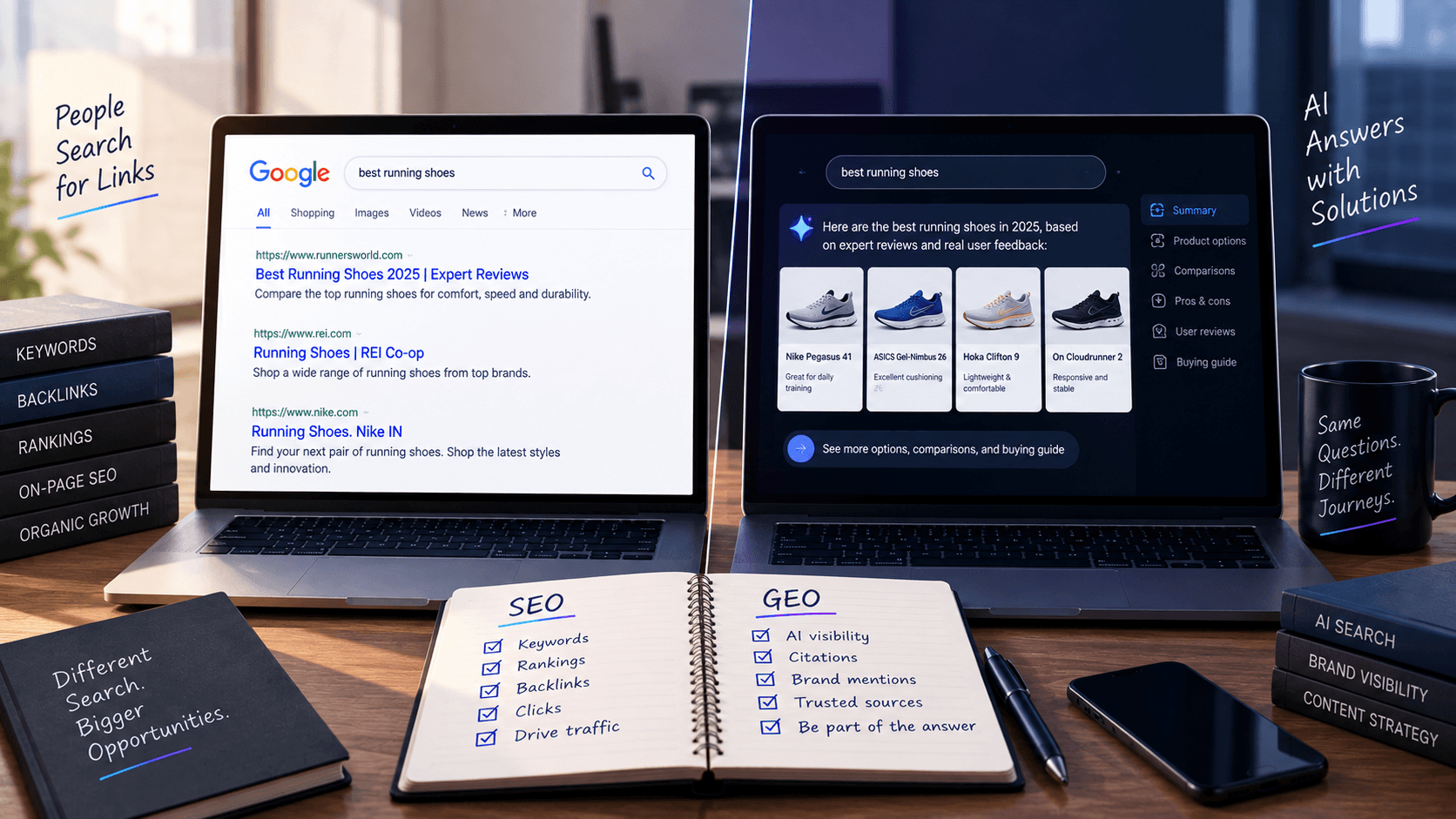
Your SEO strategy may bring pages into Google Search, but buyers increasingly ask AI systems to summarize options, compare vendors, and recommend solutions.
That raises a practical question: Do you need GEO as well as SEO?
The short answer is yes, but probably not in the way many articles suggest.
GEO, or Generative Engine Optimization, is focused on improving a brand’s visibility within AI-generated answers and generative search experiences. SEO remains the broader foundation for making websites accessible, relevant, useful, and visible in search. For B2B companies, the smarter approach is not choosing SEO or GEO. It is understanding where they overlap, where GEO adds new considerations, and how both can support the same buyer journey.
What Is SEO?
Search Engine Optimization, or SEO, is the practice of improving a website and its content so search engines can understand, index, and present relevant pages to people searching for information, products, or services.
A strong B2B SEO Strategy can include technical improvements, keyword research, search intent analysis, content creation, internal linking, digital PR, and measurement. The objective is broader than ranking for individual keywords.
A B2B company might use SEO to appear when buyers search for:
“B2B marketing strategy”
“enterprise SEO services”
“performance marketing agency”
“SEO agency for SaaS”
The strategy connects those searches with useful pages that help buyers move from research toward evaluation and action.
What Is GEO?
Generative Engine Optimization, or GEO, is an emerging approach focused on improving the likelihood that a brand or its content is represented within responses generated by AI-powered search and answer systems. The term was formalized in academic research describing how generative engines synthesize information from multiple sources to answer user questions.
Instead of only asking:
“Can my page rank for this query?”
GEO encourages another question:
“Can my content provide useful information that an AI system can retrieve, understand, reference, or cite when answering this question?”
That changes the measurement surface.
A brand might appear as a traditional search result, a cited source, a recommendation, or part of an AI-generated explanation. These are different visibility opportunities.
SEO vs GEO: What Is the Real Difference?
The biggest difference is the environment where visibility is evaluated.
SEO traditionally focuses on search engines and the pages they return.
GEO focuses more specifically on generative systems that retrieve information and synthesize answers.
But the two disciplines share a large foundation.
Clear website architecture helps both.
Useful content helps both.
Strong topic coverage helps both.
Relevant internal links help both.
Good technical foundations help both.
Clear information about products, services, companies, and expertise helps both. That is why treating SEO and GEO as completely separate strategies can create unnecessary work.
Does GEO Replace SEO?
No.
Google's current guidance on optimizing for generative AI features emphasizes that SEO best practices continue to matter. Google has also published guidance addressing common misconceptions around AEO and GEO. This matters for businesses deciding where to invest.
You do not need to abandon your SEO strategy because AI search is growing. Instead, strengthen the fundamentals and extend the strategy to account for generative search behavior. This is part of the wider shift from SEO to AEO, where search experiences increasingly provide direct answers, summaries, recommendations, and AI-generated responses alongside traditional results.
Think of it this way:
SEO helps build the foundation for search visibility.
GEO adds a focus on how that content can appear within generative answers.
The exact systems, signals, and outputs can change, so businesses should avoid treating GEO as a fixed checklist.
Where SEO and GEO Overlap
The strongest GEO strategy usually begins with work that already belongs in good SEO.
Search Intent
AI systems are designed to respond to questions and tasks, not just isolated keywords. That makes search intent even more important.
A B2B buyer might ask:
“Which marketing channels work best for SaaS lead generation?” That question contains a business problem. A useful page should address the problem directly rather than simply repeat a keyword.
Topic Depth
A single article rarely answers every meaningful question around a complex B2B topic. A stronger content ecosystem might include pages covering strategy, implementation, measurement, examples, common mistakes, and related services. This creates clearer relationships between subjects.
Clear Information
AI-generated answers need useful source material. Content that explains concepts clearly, supports claims with evidence, uses descriptive headings, and gives readers practical information creates a stronger foundation than thin pages built mainly around keywords.
Internal Linking
Internal links help connect related information across your website. A page about professional SEO services could naturally connect to resources about technical SEO, search intent, content strategy, AI search, and measurement. This helps readers move through related topics while giving search systems more context about the relationships between pages.
What Changes When You Add GEO to Your Strategy?
The biggest change is the question you ask about content.
Traditional SEO often asks:
“How can we rank for this search?”
A GEO-aware strategy also asks:
“If an AI system needs to answer this question, what information would make our content useful as a source?”
That encourages several practical improvements.
Make important answers easy to find.
Use clear explanations instead of vague marketing language.
Support claims with credible evidence.
Include original examples and useful observations.
Explain products and services in specific terms.
Create content around real buyer questions.
Keep important business information consistent across the website and other relevant sources.
The goal is not to write content for AI while forgetting people.
The goal is to create content that works well for people and provides strong source material for modern search systems.
How B2B Companies Can Build an SEO + GEO Strategy
Start with your existing B2B SEO Strategy rather than creating an entirely new program. Review the questions your buyers ask at each stage. At the awareness stage, buyers may ask broad questions about a problem.
During research, they may compare approaches.
During evaluation, they may compare vendors, services, tools, or pricing.
At the decision stage, they may search for specific companies.
Map these questions to useful website content. Then identify where your current content is too broad, too thin, outdated, or disconnected from related pages.
The next step is to strengthen the content itself. For example, a B2B SaaS company targeting “customer acquisition strategy” could create a central guide supported by pages covering paid acquisition, organic search, conversion optimization, attribution, and measurement. The result is not simply more content. It is a clearer information system.
Should You Create Separate GEO Content?
Usually, no.
Creating hundreds of pages specifically labeled as “GEO content” can create duplication and dilute your editorial strategy. Instead, improve content that already serves valuable search questions.
A strong article should be useful whether the reader finds it through Google, an AI-generated answer, LinkedIn, a referral, or a direct visit. There may be situations where a new format makes sense, for example, a detailed comparison, original research piece, data resource, or comprehensive question-led guide. But the reason should be the audience need, not simply the desire to create another GEO page.
What About Structured Data, Links, and Technical SEO?
Technical SEO still matters.
Google's documentation continues to emphasize indexing, structured data where relevant, and standard Search requirements for its AI search experiences. Google also states that structured data should accurately represent visible page content. That means businesses should continue to maintain:
Clear site architecture.
Useful internal links.
Indexable pages.
Accurate structured data where appropriate.
Descriptive titles and headings.
Accessible text content.
Good page experience.
Fast, functional websites.
These are not “GEO tricks.”
They are sound website practices that support search visibility more broadly.
Google has also clarified that files such as llms.txt are not required for Google Search and do not provide a ranking or visibility boost there.
How Should You Measure SEO and GEO?
Do not rely on one GEO score. Measure the business outcomes and visibility signals that you can actually observe. For SEO, this can include organic impressions, clicks, CTR, rankings, organic sessions, engagement, leads, and conversions.
For AI search, monitor brand mentions, citations, linked sources, referral traffic where identifiable, visibility across relevant prompts, and branded-search activity.
For teams that need a more structured way to monitor these signals, AI search citations can be tracked alongside the pages, topics, and sources that appear in AI responses. Then connect those signals to business outcomes. For example, suppose your brand appears in AI responses for several high-value B2B questions. That is useful.
But the next question is more important:
Are those visibility opportunities reaching the right buyers and contributing to meaningful website activity or demand?
This keeps the strategy grounded in business value.
Measuring AI Search Traffic
Visibility is only one part of the picture. When AI platforms send identifiable referral traffic, analytics can help show what happens after someone clicks through to your website. That can include landing-page engagement, commercial-page visits, form submissions, qualified leads, and conversions.
For marketers who want to connect this activity with measurable website behavior, AI search traffic in GA4 is a useful area to monitor. The important distinction is between visibility and traffic.
A brand can appear in an AI response without receiving a click. That visibility can still matter, particularly when the query is part of a high-value research or evaluation journey.
How AI-Ready Websites Support Both SEO and GEO
Your website remains the foundation underneath both strategies. It needs useful content, clear service pages, strong internal linking, accessible information, and a straightforward path toward conversion. This is why an AI-ready website should not be treated as a separate technical project that exists only for AI platforms. It should be a website that works well for people while making important information easy for modern search systems to understand. For example, a B2B company could improve its service architecture, connect related educational resources, explain its expertise clearly, and make key company information consistent across important pages. That supports a wider search strategy rather than a single optimization tactic.
Common SEO vs GEO Mistakes
The first mistake is treating GEO as a replacement for SEO.
It is better viewed as an additional consideration within a broader search strategy.
The second mistake is chasing every new AI tactic.
The generative search environment is changing quickly. A tactic that appears useful on one platform may not produce the same result elsewhere.
The third mistake is producing large amounts of generic AI-generated content.
Google's spam policies specifically address scaled content created primarily to manipulate Search rather than provide value to users.
The fourth mistake is measuring mentions without intent.
A brand mention for a broad educational question may have less commercial value than appearing for a specific provider-comparison query.
The fifth mistake is separating SEO, content, paid media, social, and website strategy.
B2B buyers rarely move through a perfectly linear journey. Your measurement and content strategy should reflect that.
When Should You Invest in Professional SEO and AI Search Support?
If your internal team already has strong SEO capabilities, GEO considerations can often be incorporated into the existing workflow.
Professional support becomes more useful when your business needs to connect several areas at once. For example, a B2B company may need technical SEO, content strategy, AI Search optimization, paid media, social distribution, analytics, and website improvements working toward the same buyer journey. That is where SEO and digital marketing services can provide broader strategic value than isolated SEO activity.
For businesses operating across India or Mumbai, the same principle applies. Local market signals, B2B search behavior, content, paid campaigns, and AI discovery can all contribute to how prospects evaluate a company. The right approach depends on your current website, audience, market, content library, and commercial goals.
Where Performance Marketing and Social Fit
SEO and GEO should also connect with the channels that reinforce brand demand.
A buyer might discover a company through search, see its content on LinkedIn, interact with a paid campaign, and later return through a branded search. That makes Performance Marketing Services relevant when businesses want to connect visibility with measurable acquisition and conversion activity.
Likewise, Social Media Marketing Services can support brand recognition and content distribution across the buyer journey. The objective is not to force every channel into one attribution model. Instead, understand how each channel contributes to different stages of discovery, research, evaluation, and decision-making.
SEO + GEO: The Better Way to Think About Search
The SEO vs GEO debate can sound like a choice between two competing strategies. For most B2B brands, it is more useful to think about them as connected layers.
SEO provides the foundation.
GEO adds a stronger focus on generative search experiences.
Content connects the two.
Analytics tells you what is happening.
Your website turns visibility into the next step.
Paid and social channels can reinforce demand and brand recognition.
The result is a broader search strategy built around how buyers actually research and evaluate solutions. If your business is already investing in B2B Digital Marketing Services, you do not need to throw away your existing SEO program.
You need to understand where search is expanding and make your content useful across those environments. The goal is not to optimize for an acronym. It is to build a brand that can be found, understood, referenced, and trusted wherever your buyers are looking for answers.
Frequently Asked Questions
What is the difference between SEO and GEO?
SEO focuses on improving visibility in traditional search engines, while GEO focuses on visibility within generative AI responses. The two overlap heavily, and SEO remains an important foundation for AI search visibility.
Does GEO replace SEO?
No. GEO should generally complement SEO rather than replace it. Google’s current guidance states that SEO best practices remain relevant for its generative AI search features.
Does GEO require separate content?
Usually not. Existing high-quality content can often be improved to answer buyer questions more clearly, provide stronger evidence, cover related topics, and make important information easier to understand.
What should B2B companies optimize for GEO?
Start with real buyer questions. Improve content clarity, topic coverage, evidence, internal linking, technical foundations, and the consistency of important business information across relevant sources.
How do you measure GEO?
Track relevant AI prompts, brand mentions, citations, linked sources, identifiable AI referral traffic, branded searches, engagement, leads, and conversions. Avoid relying on one universal GEO score.
Is structured data important for GEO?
Structured data can help search systems understand eligible content and entities, but it should be used correctly and should match visible page content. It should not be treated as a special GEO shortcut.
Should every company invest in GEO?
Companies whose buyers increasingly use AI-powered search and recommendation experiences should consider GEO as part of their wider search strategy. The level of investment should depend on audience behavior, existing SEO maturity, content quality, and business goals.
Key Takeaways
SEO and GEO are better viewed as connected strategies than competing ones.
SEO provides the technical and content foundation for search visibility.
GEO adds a focus on how brands and content can appear within generative search experiences.
Strong search intent, useful content, topic coverage, internal linking, and technical SEO support both.
B2B companies should improve existing content before creating separate GEO content at scale.
Measure AI visibility alongside traditional SEO, analytics, branded search, paid media, social activity, leads, and conversions.
The strongest strategy focuses on buyer questions and business outcomes rather than chasing individual AI tactics.
Conclusion
SEO and GEO are not two roads leading in opposite directions. They are two ways of looking at a search environment that is becoming broader.
Traditional search still matters.
AI-generated answers are becoming another part of how people research and evaluate information.
For B2B brands, the practical response is to build a strong SEO foundation and extend that strategy into generative search experiences. That means creating useful content, answering real buyer questions, connecting related topics, maintaining a strong website, measuring visibility across multiple surfaces, and connecting those signals with business outcomes.
If your business needs help bringing SEO, AI Search, paid media, social media, content, analytics, and website strategy together, Stellix can help build a practical approach around your buyer journey. The goal is not simply to rank or appear in an AI answer. It is to build a brand that buyers can find, understand, evaluate, and choose across the search experiences they use.
Contact Stellix
Stellix helps businesses connect SEO, AI search, performance marketing, content, social media, website experience, and analytics into a measurable digital growth strategy. If you want to understand how your brand appears across AI search and how that visibility connects with clicks, engagement, and qualified business opportunities, let's talk about building a measurement framework around your buyer journey.
About Stellix
Stellix is a performance-driven digital marketing agency helping businesses grow through SEO, PPC, website development, content marketing, and social media marketing. We combine data-backed strategies with creative execution to increase visibility and generate qualified leads.