Introduction
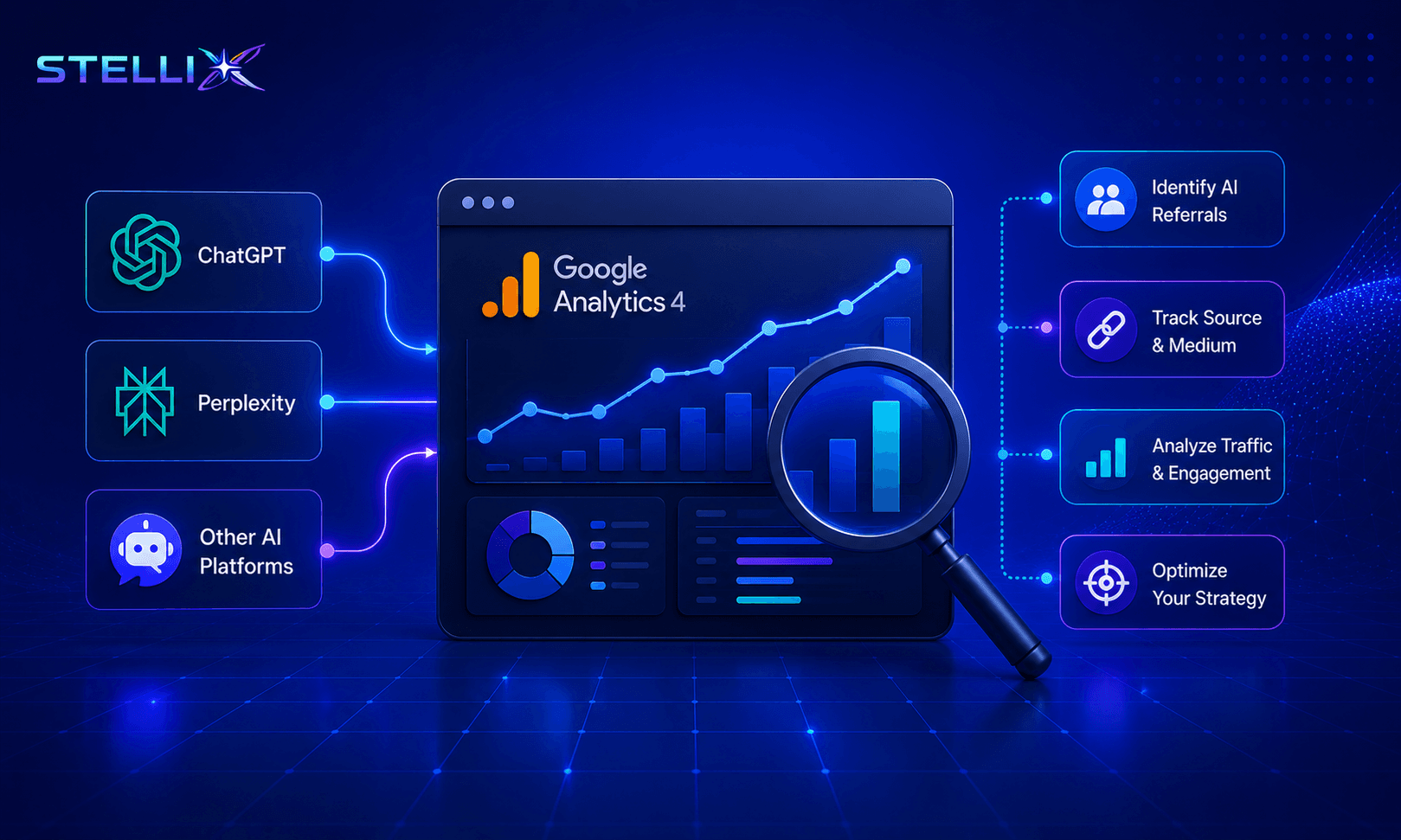
How do you track ChatGPT, Perplexity, and AI traffic in GA4? The practical approach is to monitor AI-related referral sources through GA4's Session source, Session medium, and Traffic acquisition reporting, then analyze engagement and key events from those sessions. AI referrals may appear as referral traffic when users click links from AI platforms to your website, although attribution can vary depending on how the visit reaches your site. Tracking this traffic gives marketers a clearer view of how AI-powered discovery contributes to website activity. For businesses investing in AI Search Optimization Services, working with the Best Digital Marketing Company in Mumbai, or building visibility with a Best Local SEO Company, this data can reveal which content attracts visitors from emerging AI discovery channels.
Table of Contents
What Does AI Referral Traffic Mean in GA4?
Why Track ChatGPT, Perplexity, and AI Traffic?
How GA4 Identifies Referral Traffic
Finding AI Traffic in GA4
Measuring AI Traffic Quality
Building an AI Traffic Reporting Workflow
Frequently Asked Questions
Conclusion
What Does AI Referral Traffic Mean in GA4?
AI referral traffic refers to visitors who reach your website after interacting with an AI-powered platform and clicking through to your site. For example, someone may ask an AI assistant for recommendations about digital marketing agencies, read the response, and click a website link included in that answer. When that visitor arrives on your website, GA4 can use traffic-source information to help identify where the session originated.
Google Analytics defines Source as the platform, website, app, or online location from which traffic originated, while Medium describes the method used to reach your property. Referral is one of the standard traffic mediums. That makes GA4 particularly useful for understanding emerging AI-driven discovery. However, AI traffic doesn't always arrive with perfectly preserved referral information. Google notes that visits can be classified as (direct)/(none) when referral information isn't available, including situations involving missing tracking information or certain browser and technical conditions. So the goal isn't simply to search for one magic "AI traffic" number. It's to build a reliable view of AI-related sources and understand how those visitors behave after arriving.
Why Track ChatGPT, Perplexity, and AI Traffic?
AI-powered discovery is creating another pathway between a customer's question and your website.
Traditional SEO reporting might show that a page received organic visits from Google. AI referral analysis can add another layer: which AI platforms are sending visitors, which pages attract those visitors, and whether those sessions lead to meaningful engagement or key events. For a business investing in AI Search Optimization Services, this distinction matters. A page may become highly visible within AI-generated answers before its impact becomes obvious through traditional keyword reporting.
Consider a B2B service page that receives visitors from ChatGPT and Perplexity. If those visitors explore multiple pages, spend time reading service information, and complete a consultation form, AI visibility becomes a measurable part of the acquisition journey. This is also valuable for a Best Digital Marketing Company in Mumbai evaluating the performance of an AI-focused content strategy. Instead of judging visibility solely through rankings, marketers can connect AI discovery with website behavior and business outcomes. The same principle applies to local search. A Best Local SEO Company can monitor whether locally relevant service pages attract visitors through AI recommendations and whether those visitors engage with location-specific content.
How GA4 Identifies Referral Traffic
GA4 uses traffic-source dimensions to organize information about how users arrive at a website. The Traffic acquisition report includes dimensions such as Session source, Session medium, Session source/medium, and Session default channel grouping. These dimensions describe the source associated with a user's session and help marketers evaluate acquisition across channels.
For an AI referral, you might see a source associated with an AI platform and a medium such as referral, depending on how the visit's source information is passed to Analytics.
GA4 also supports manual campaign tagging with UTM parameters. Google explains that parameters such as utm_source, utm_medium, and utm_campaign can be added to destination URLs so campaign information appears in Analytics reporting. This is especially useful when you control the links being shared. For naturally occurring AI referrals, however, you generally cannot add UTMs to links generated by an AI platform. In those cases, GA4's existing source and referral information becomes particularly important. The smarter approach is to treat AI traffic as part of a broader acquisition picture. Look beyond the source itself and examine landing pages, engagement, key events, conversions, and user journeys. That turns an interesting traffic trend into actionable marketing intelligence.
How to Identify ChatGPT Traffic in GA4
The simplest starting point is GA4's Traffic acquisition report. Open Reports → Acquisition → Traffic acquisition, then examine the Session source, Session medium, and Session source / medium dimensions. GA4 uses these session-level dimensions to show where each session originated. Search the source dimension for ChatGPT-related referral values and review the associated sessions. Depending on how the visit is passed to Analytics, an AI platform may appear as a referral source. The exact source value can vary, so it's better to analyze the actual data in your property rather than assume a single naming convention. You can then add Landing page + query string as a secondary dimension to discover which pages attract visitors from that source. Google specifically recommends combining traffic-source and landing-page dimensions when analyzing where visitors originate and which pages they reach. For an AI Search Optimization Services strategy, this report becomes particularly useful because it connects AI discovery with the content users actually visit.
How to Track Perplexity Referral Traffic
The same GA4 workflow applies to Perplexity. Start with Traffic acquisition and set Session source/medium as your primary dimension. Search for Perplexity-related source values, then compare sessions, engagement, landing pages, and key events.
GA4's Source dimension identifies the specific platform or website associated with a session, while Medium describes how the visitor arrived, such as referral, organic, or email. This distinction matters because AI traffic shouldn't automatically be treated as organic search traffic. If a visitor clicks a link from an AI platform and GA4 receives referral information, the session can be represented as referral traffic rather than traditional organic search. For example, imagine a service page receives 150 sessions from an AI referral source during a month. If those visitors generate consultation enquiries at a strong rate, that source deserves attention even if its overall traffic volume remains smaller than Google organic traffic. That kind of insight can help the Best Digital Marketing Company in Mumbai identify which content earns visibility beyond conventional search results.
Creating AI Traffic Segments and Explorations
Once you identify the relevant AI sources, GA4 Explorations can turn individual referral sources into a repeatable analysis framework. Create an Exploration using Session source/medium as a dimension and metrics such as Sessions, Engaged sessions, Average engagement time, Event count, and Key events. You can then filter the exploration to the AI sources you want to study. GA4 supports traffic-source dimensions within reports, explorations, audience builders, and segment builders, making them useful for building more detailed acquisition analyses.
A useful AI traffic segment could combine known AI referral sources into one analysis group. Another exploration could compare AI-referred sessions against Organic Search sessions to understand differences in landing pages, engagement, and conversions. For businesses working with a Best Local SEO Company, this comparison can reveal whether locally focused service pages attract AI-referred visitors alongside conventional organic traffic.
UTM Tracking and Referral-Source Analysis
UTM parameters are particularly valuable when you control the links being shared. Google Analytics supports parameters such as utm_source, utm_medium, utm_campaign, utm_content, and utm_term. These values allow marketers to identify the source, medium, campaign, and content associated with tagged links.
For example, a link intentionally distributed through an AI-focused campaign could use a consistent naming structure such as: utm_source=ai&utm_medium=referral&utm_campaign=ai-content
The important distinction is that UTMs work when you control the destination URL. You cannot retroactively add UTM parameters to a naturally generated link inside an AI platform. For naturally occurring ChatGPT or Perplexity referrals, use GA4's existing source and medium information. Also remember that missing referral information can result in (direct) / (none) traffic, so AI-originated visits may not always be perfectly identifiable. Consistent UTM naming is therefore essential for campaigns you can control, while source analysis remains essential for organic AI referrals.
Key GA4 Metrics to Monitor
AI traffic becomes much more useful when you evaluate what visitors do after arriving. Start with Sessions to understand traffic volume. Then examine Engaged sessions and Average engagement time to understand whether visitors interact meaningfully with your content. Next, look at Key events and conversion-related actions. A smaller AI referral source that generates consultation requests, form submissions, purchases, or other important actions may be more valuable than a much larger traffic source.
Landing pages also deserve close attention. If several AI referrals consistently lead users to one detailed guide or service page, that content may be particularly effective at answering questions that users ask AI platforms. This gives an AI Search Optimization Services strategy a measurable feedback loop: identify the pages attracting AI traffic, study user behavior, improve those resources, and expand related content.
How AI Traffic Differs From Traditional Organic Traffic
Traditional organic search traffic generally begins with a user entering a query into a search engine and clicking an organic result.
AI referral traffic can follow a different path. A user may ask a conversational question, receive a synthesized answer, review several cited sources, and then choose one website to explore. That difference changes how marketers interpret attribution.
Organic search reporting can tell you which search engine generated the session. AI referral reporting can reveal when an AI platform becomes part of the discovery journey. Neither channel should be viewed in isolation. A strong measurement strategy compares AI referrals, organic search, direct traffic, social traffic, and other acquisition channels while examining engagement and key events across each. For SEO Services in Mumbai, this broader perspective can reveal whether local service content is being discovered through emerging AI experiences as well as traditional search. The bigger opportunity is not simply counting AI traffic. It's understanding which content earns AI-driven discovery, what visitors do afterward, and how those insights can shape the next generation of your SEO and content strategy.
Frequently Asked Questions
1. Can GA4 track ChatGPT traffic?
Yes. When a visitor clicks a link from ChatGPT and referral information is passed to your website, GA4 can record the session's source and medium. You can review these details through the Traffic acquisition report using dimensions such as Session source and Session source/medium.
2. How can I find Perplexity traffic in GA4?
Open the GA4 Traffic acquisition report and examine the Session source or Session source/medium dimension. Search for Perplexity-related referral sources and then review the sessions, landing pages, engagement, and key events associated with that traffic.
3. Can GA4 identify all AI-generated traffic?
Not necessarily. Attribution depends on how referral information is passed to your website. Some AI-originated visits may appear under referral sources, while visits without available referral information can be categorized as direct traffic.
4. What GA4 metrics are most useful for AI traffic?
Sessions, engaged sessions, average engagement time, landing pages, event activity, and key events are useful starting points. Conversion-focused metrics are especially valuable because they show whether AI-referred visitors contribute to meaningful business actions.
5. Should AI traffic be treated as organic search traffic?
AI referrals and traditional organic search represent different acquisition paths. Traditional organic traffic generally comes through search engine results, while AI referral traffic can originate from links presented within AI-powered answers. Comparing both channels provides a clearer picture of how users discover your brand.
6. Can I use UTM parameters to track AI traffic?
Yes, when you control the destination URL. UTM parameters such as utm_source, utm_medium, and utm_campaign can help organize campaign attribution. Naturally generated links from AI platforms cannot generally be retroactively tagged with your own UTMs.
7. Why is AI traffic important for SEO?
AI traffic provides another way to understand how content performs beyond conventional search rankings. Analyzing AI referrals can reveal which pages attract AI-driven discovery and which topics encourage visitors to explore your website.
8. How can AI traffic data improve content strategy?
Review the pages receiving AI referrals, study engagement and key events, and identify the topics attracting qualified visitors. These insights can guide new content, internal linking, content updates, and broader AI Visibility Optimization strategies.
Key Takeaways
GA4's traffic-source dimensions help identify where website sessions originate.
AI platforms can appear as referral sources when users click through to your website.
Session source and Session medium are useful starting points for analyzing AI traffic.
Some AI-originated visits may appear as direct traffic when referral information isn't available.
Engagement and key-event data help reveal the business value of AI-referred visitors.
AI traffic measurement works best alongside SEO, content, and conversion analysis.
Conclusion
Tracking ChatGPT, Perplexity, and other AI traffic in GA4 gives marketers a clearer view of how AI-powered discovery contributes to website growth. Start with Session source and Session medium, analyze landing pages and engagement, and connect AI referrals with key events and conversions. Remember that attribution can vary, so AI traffic works best as part of a broader measurement framework alongside organic search, social, direct, and referral channels. For businesses investing in AI Search Optimization Services, these insights can reveal which content earns AI-driven discovery and where new opportunities exist. The goal is simple: turn emerging AI traffic data into smarter content, SEO, and digital marketing decisions.
Contact Us
Ready to Measure and Grow Your AI Search Visibility?
AI search is creating discovery paths, and GA4 can help you understand what happens after users reach your website. Whether you want to track AI referrals, strengthen your content strategy, improve organic visibility, or build a comprehensive AI Search Optimization Services strategy, Stellix can help connect your analytics with actionable marketing decisions. Book a Strategy Call with Stellix to explore how AI search optimization, SEO, content marketing, and performance analytics can work together to increase qualified traffic, engagement, and conversions.
About Stellix
Stellix is a performance-driven digital marketing agency dedicated to helping ambitious brands grow through SEO, paid media, content marketing, website development, performance marketing, and AI-focused search strategies. By combining data-backed insights, technical expertise, and creative thinking, Stellix develops customized marketing solutions designed to increase visibility, attract high-intent audiences, and deliver measurable business results.