Introduction
Your website is no longer built only for people who type a keyword into Google and click a blue link. People now ask ChatGPT, Gemini, Perplexity, Google AI Overviews, and other AI-powered search experiences for recommendations, comparisons, explanations, and solutions. That means your website needs to do more than rank. It needs to be easy to understand, trustworthy, technically accessible, and rich enough in context for AI systems to recognize what your business knows.
So, how do you build a website ready for AI search?
Start with the fundamentals: clear content, strong technical SEO, structured information, topical authority, useful internal links, fast performance, and genuine expertise. Then bring these elements together through AI Visibility Optimization, so your website can support discovery across traditional search and AI-powered experiences. The good news? A website prepared for AI search is usually a better website for humans, too.
Table of Contents
What Makes a Website Ready for AI Search?
Build a Clear Website Architecture
Create Content AI Search Can Understand
Strengthen Semantic SEO and Topical Authority
Use Structured Data to Add Context
Show Real Expertise and Experience
Make Your Website Fast and Accessible
Build Strong Internal Links
Optimize for Conversational Search
Measure AI Search Visibility
How Businesses Can Prepare for AI Search
Frequently Asked Questions
The Future of AI-Ready Websites
What Makes a Website Ready for AI Search?
An AI-search-ready website gives both humans and intelligent systems a clear understanding of its subject, expertise, services, and value. That sounds straightforward, but it changes how websites should be planned. A traditional SEO approach may begin with keywords and search volume. An AI-ready approach begins with a broader question:
What does someone need to understand before they can confidently choose this business?
That could include service pages, expert guides, comparison content, FAQs, original insights, case studies, process pages, customer questions, and supporting resources. For example, a B2B technology company shouldn't rely on a single service page to explain everything. A stronger website can connect its core service with implementation guides, industry applications, FAQs, technical explanations, use cases, and expert commentary. This creates context. And context is extremely valuable in AI-powered search.
Build a Clear Website Architecture
AI systems need to interpret relationships between pages. Your website architecture should therefore make those relationships obvious. A strong structure might connect a main service page to supporting educational articles, relevant FAQs, case studies, industry pages, and related services. Think of the website as a knowledge network rather than a collection of individual pages. If your homepage explains what you do, your service pages explain how you help, and your resource content demonstrates what you know, the relationship becomes much easier to understand. This is particularly important for companies investing in Website Development Services for B2B Companies.
B2B websites often contain multiple services, industries, solutions, and audience segments. A carefully planned information architecture can make the entire ecosystem easier for users and search systems to navigate.
Create Content AI Search Can Understand
AI search has made one thing especially valuable: clarity.
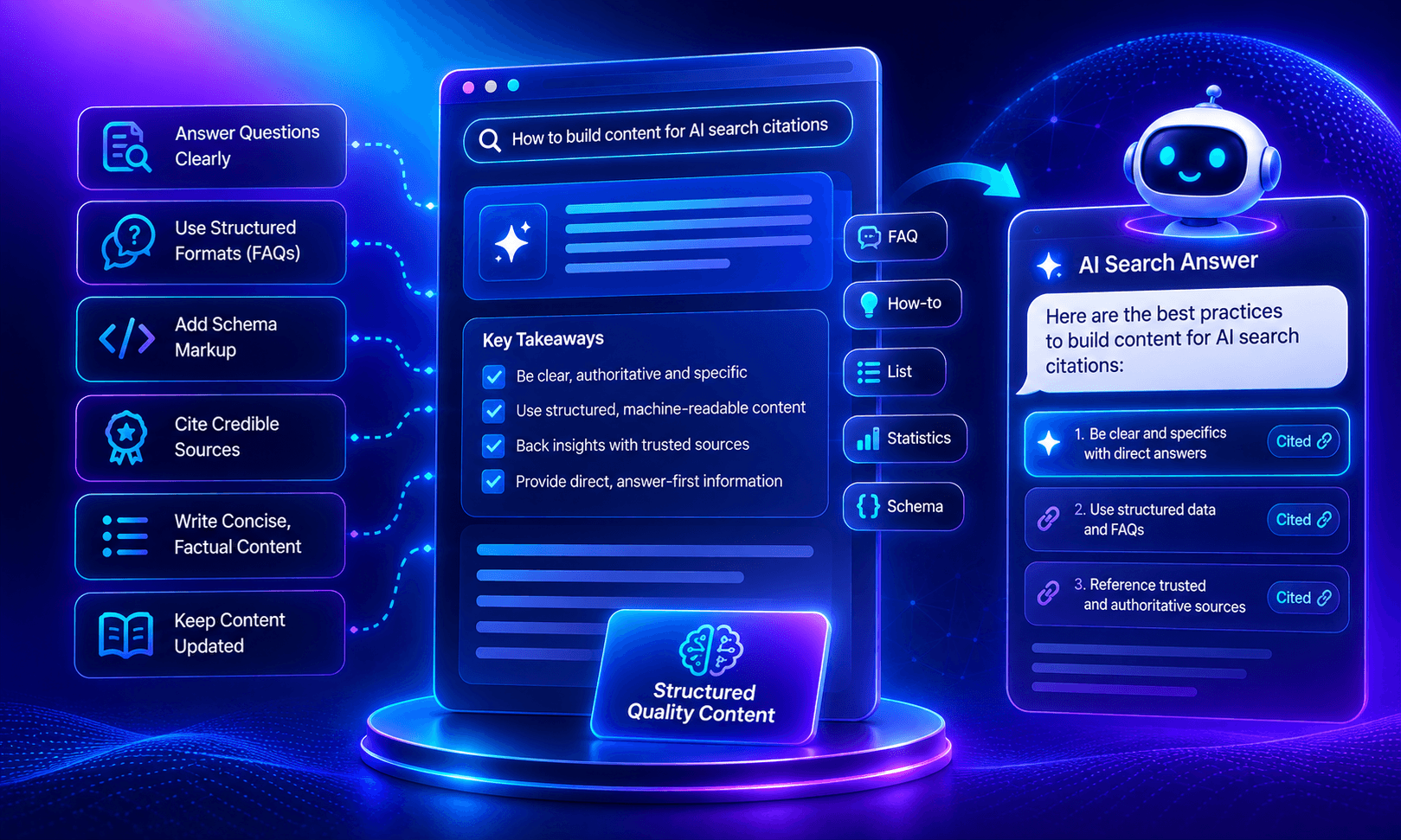
A page should make its primary subject obvious. Use descriptive H1s and H2s. Answer important questions directly. Explain terminology naturally. Provide examples. Add supporting context where it genuinely helps the reader. Avoid making every paragraph sound like it was written for a search engine.
Write the way an experienced professional would explain the subject to a smart client. For example, instead of writing five paragraphs around a keyword such as "AI search optimization," explain what the service does, who benefits from it, how the process works, what outcomes businesses can pursue, and how it connects with broader SEO strategy. That approach creates content with substance. It also gives AI systems more useful information to interpret.
Strengthen Semantic SEO and Topical Authority
AI-powered search experiences interpret relationships between concepts. That makes semantic SEO increasingly valuable. If your website discusses AI search, the surrounding content could naturally cover conversational search, AI Overviews, answer engines, entity optimization, search intent, structured data, topical authority, E-E-A-T, content quality, and user experience. You don't need to force every related phrase onto one page. Instead, build a connected content ecosystem.
A page about AI Visibility Optimization can link to an article about AI Overviews. That article can connect to content about AEO. Your AEO content can reference conversational search and structured data. Over time, these relationships create a stronger topical footprint. This is where working with experienced SEO Consulting Services can be particularly valuable. The objective isn't simply to publish more pages. It's to build a logical information system around the subjects your audience actually cares about.
Use Structured Data to Add Context
Structured data gives search engines additional information about the entities and content represented on a webpage.
Depending on the page, schema can help describe an organization, article, product, service, event, FAQ, or other supported content type. It isn't a magic ticket to an AI citation. Think of it more like adding labels to a well-organized filing cabinet.
The clearer the labels, the easier it becomes to understand what belongs where. Structured data works best alongside descriptive content, logical headings, accurate metadata, strong internal linking, and a technically accessible website. Together, these elements create a clearer digital representation of your business.
Show Real Expertise and Experience
AI can generate an explanation about almost anything. Your competitive advantage is showing what your business has actually learned. That could come from original research, campaign insights, customer questions, implementation experience, expert commentary, case studies, industry observations, or first-hand lessons.
A marketing agency can discuss what it has learned from running campaigns.
A SaaS company can explain implementation challenges and workflows.
A B2B manufacturer can share technical expertise gathered from years of serving customers. These details create distinction. They also strengthen the experience and expertise signals that support modern search visibility. For businesses aiming to become the Best Digital Marketing Company in Mumbai, publishing generic marketing advice isn't enough to establish a distinctive digital presence. Demonstrating actual knowledge, perspectives, processes, and results gives the website far more depth.
Make Your Website Fast and Accessible
AI search optimization begins with a website that search engines can access and understand.
Technical SEO still matters. Make sure important pages can be crawled and indexed. Keep navigation logical. Use clean URLs, descriptive metadata, canonicalization where appropriate, XML sitemaps, mobile-friendly layouts, and strong Core Web Vitals.
Website performance also matters to people. A visitor shouldn't need a coffee break before the hero section appears. Fast-loading pages, responsive interfaces, stable layouts, accessible content, and mobile-friendly design create a smoother experience across the entire customer journey. AI search doesn't replace technical SEO. It builds on it.
Build Strong Internal Links
Internal linking is one of the simplest ways to strengthen website context. When one page naturally references another relevant resource, you're helping users discover additional information while creating relationships between related topics. For example, a page about AI search optimization could link to content covering AEO, AI Overviews, semantic SEO, and conversational search.
The anchor text should clearly communicate what the linked page covers. This creates a more useful browsing experience and helps search systems understand the structure of your content. The result is a website that behaves more like a connected knowledge base than a set of isolated landing pages.
Optimize for Conversational Search
People often phrase AI searches differently from traditional Google queries. Instead of searching for "best CRM software," someone might ask:
"Which CRM is best for a growing B2B sales team with a long buying cycle?"
That difference matters.
Your content should anticipate the questions customers naturally ask.
Create sections that address comparisons, use cases, implementation questions, costs, processes, benefits, alternatives, and decision criteria where relevant.
Conversational content doesn't mean filling pages with questions. It means understanding the way your audience thinks. The more closely your content matches genuine customer conversations, the more useful it becomes.
Measure AI Search Visibility
AI search visibility requires a broader measurement mindset. Traditional SEO metrics such as organic clicks, impressions, rankings, and conversions remain important. You can also monitor referral traffic from AI platforms where identifiable, brand mentions, citations, assisted conversions, branded search growth, and visibility across AI-powered search experiences. This gives businesses a more complete picture of how their digital presence is being discovered. The goal isn't to replace SEO reporting. It's to expand it.
Your website can generate value even when an AI-generated answer satisfies part of a user's query before they visit your site. Brand recognition, citations, subsequent branded searches, and qualified visits can all become meaningful parts of the wider discovery journey.
How Businesses Can Prepare for AI Search
The strongest approach is to treat AI search as an evolution of your existing digital strategy rather than a separate project.
Review your website architecture.
Identify the topics your business should own.
Map the questions your customers ask before making a decision.
Strengthen important service pages.
Build supporting content around high-value topics.
Improve internal linking.
Add appropriate structured data.
Showcase genuine expertise.
Keep technical SEO and website performance strong. Then connect everything through a consistent AI Visibility Optimization strategy.
For businesses working with a Best Local SEO Company, this also means expanding beyond location-based keywords. Local authority can be strengthened through detailed service information, location relevance, reviews, business details, expert content, and useful resources that clearly establish what the company does and where it operates.
AI search rewards context. Your website should provide it generously.
Frequently Asked Questions
What is an AI-search-ready website?
An AI-search-ready website is technically accessible, clearly structured, context-rich, authoritative, and designed to provide useful answers that both people and AI-powered search systems can understand.
Does AI search replace traditional SEO?
No. Traditional SEO remains an important foundation. AI search adds another discovery layer where content can be interpreted, summarized, referenced, and recommended through conversational experiences.
How does structured data help AI search?
Structured data provides additional context about webpages and entities. While it doesn't guarantee AI citations, it can make information easier for search systems to interpret.
Does website speed matter for AI search?
Website performance remains important because technical accessibility and user experience are foundational to a strong search presence. Fast, responsive, mobile-friendly websites create better experiences for visitors and provide a stronger technical foundation.
What type of content works well for AI search?
Clear, useful, experience-led content that directly answers customer questions and provides supporting context is a strong foundation. Comprehensive service pages, expert articles, FAQs, case studies, comparisons, and practical guides can all contribute.
How can a B2B website prepare for AI search?
B2B websites can strengthen AI visibility by creating detailed service pages, industry-specific resources, expert content, case studies, FAQs, comparison content, and interconnected topic clusters supported by strong technical SEO.
What is AI Visibility Optimization?
AI Visibility Optimization focuses on improving how a brand, website, expertise, and content can be discovered and understood across AI-powered search and conversational discovery experiences while maintaining strong traditional SEO foundations.
Key Takeaways
AI-ready websites combine traditional SEO with clear, structured, experience-led content.
Technical accessibility, semantic SEO, structured data, internal linking, and strong site architecture help search systems understand your website.
AI search rewards useful information that answers questions directly while providing meaningful context.
Topical authority matters because AI systems need to understand not only what your business sells, but what your business knows.
A strong AI Visibility Optimization strategy should work alongside SEO, content, website development, and conversion optimization.
The Future of AI-Ready Websites
Search is becoming more conversational, contextual, and answer-oriented. That creates a major opportunity for businesses willing to make their websites more useful, more structured, and more authoritative.
The brands that earn attention won't simply have pages optimized around keywords. They'll have digital ecosystems that clearly communicate what they know, who they help, how they create value, and why their expertise matters. That's the real purpose of AI Visibility Optimization. If you're planning a new website or upgrading an existing one, now is the right time to connect website development, SEO, content, and AI search strategy from the start.
Contact Stellix
Want to build a website designed for Google search, AI-powered discovery, and real customer journeys? Stellix brings together SEO, website development, content strategy, performance marketing, and AI-focused search optimization to create digital experiences built for measurable growth. Let's build a website that is ready for where search is heading. Explore Stellix and connect with the team to discuss your AI-search-ready website strategy.
About Stellix
Stellix is a performance-driven digital marketing agency helping ambitious businesses strengthen visibility, attract qualified audiences, and create measurable growth. From SEO and performance marketing to website development, content strategy, and AI-focused search, Stellix combines strategy, technology, creativity, and data to build connected digital growth systems.
Related Article
From SEO to AEO: How to Stay Visible in the Age of AI Search