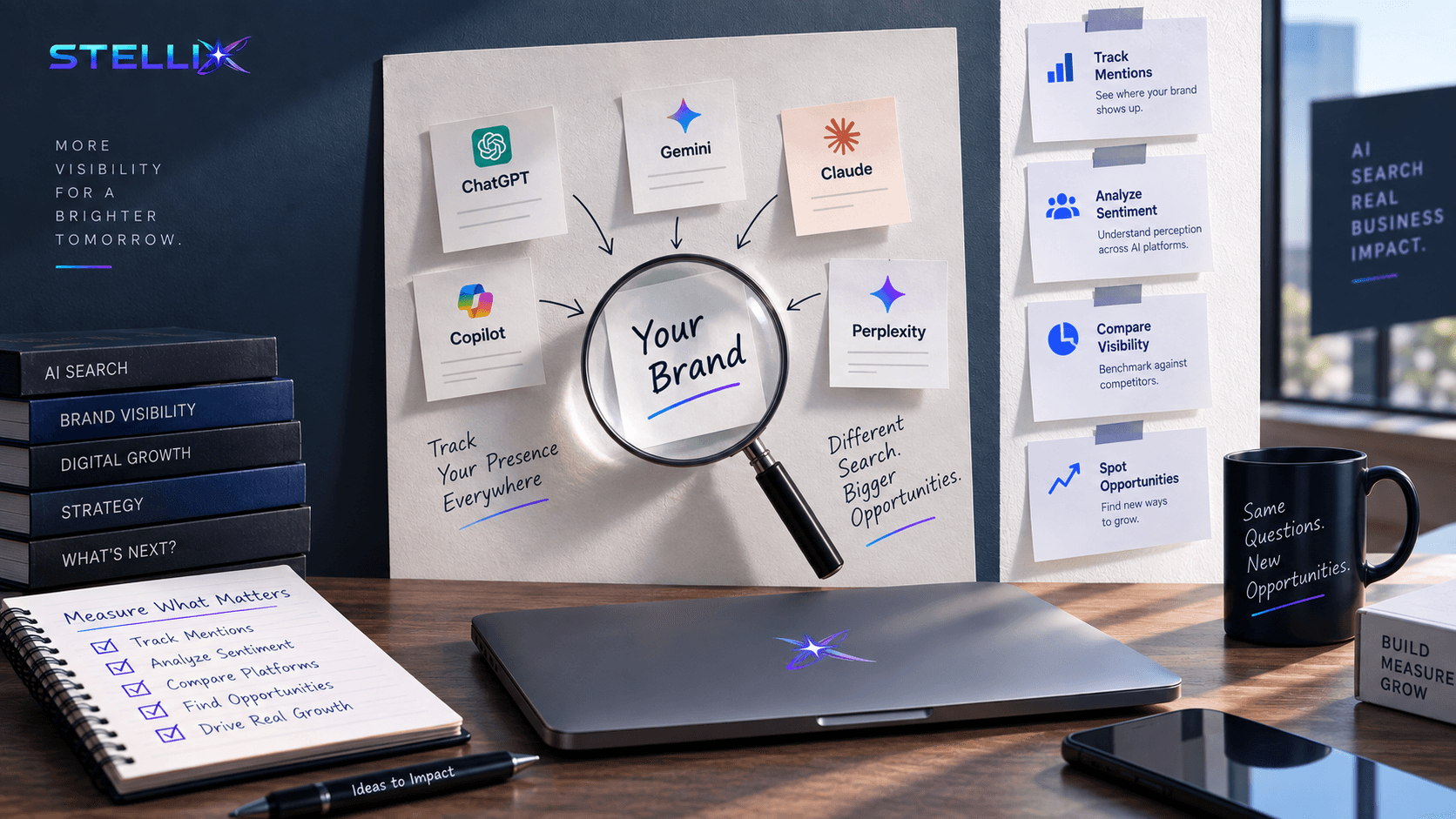
A brand can rank on Google, generate impressions, receive clicks, and still have very little idea how often AI systems mention it. That is the measurement gap marketers are starting to face.
A buyer can ask ChatGPT for B2B marketing agencies. Another might use Google AI Mode to compare SEO strategies. Someone else could ask Perplexity which companies specialize in performance marketing.
Your website may appear in the answer.
Your brand may be mentioned.
Your content may be cited.
Or another company may be recommended instead.
Traditional SEO dashboards do not always make these moments easy to see.
That does not mean you need a completely separate marketing measurement system. It means the definition of brand visibility is getting broader. For B2B companies investing in B2B Digital Marketing Services, the goal is to understand where the brand appears, what questions trigger that visibility, whether the right audience sees it, and whether those interactions eventually contribute to meaningful business activity.
What Does Brand Visibility Across AI Search Actually Mean?
AI search visibility is the presence of your brand, website, products, services, experts, or content within AI-powered search experiences. That presence can take several forms.
An AI system may mention your company in an answer.
It may cite one of your articles.
It may recommend your service.
It may link to your website.
It may use information from your site while answering a broader category question.
These are different signals.
That distinction matters.
Suppose a software company is mentioned when someone asks:
“What are the best CRM platforms for enterprise sales teams?”
That is very different from appearing for:
“What is CRM software?”
The first query has stronger commercial relevance.
The second may generate broad awareness.
Both are visibility. They simply have different business value.
Why Traditional SEO Metrics Are No Longer Enough
SEO teams have spent years watching rankings, impressions, clicks, CTR, organic sessions, and conversions.
Those metrics remain useful.
They should not be abandoned.
The measurement challenge is that AI search can influence the journey before a traditional website session happens.
A buyer might ask an AI system for advice.
They may see your brand.
Later, they search your company name on Google.
Then they visit your website directly.
Then they return through a paid campaign.
Finally, they submit an enquiry.
If you evaluate every channel separately, the original AI interaction can disappear from the story. This is why AI visibility should be measured as part of the wider buyer journey rather than treated as a vanity metric. This broader shift also connects with SEO to AEO, as search moves beyond traditional results toward answers, recommendations, and AI-powered discovery.
Start With the Questions, Not the Platforms
One of the easiest mistakes is opening an AI visibility tool and immediately tracking hundreds of prompts.
More data does not automatically create better insight.
Start with the questions your buyers actually ask.
For a B2B digital marketing agency, these might include:
“What should a B2B company look for in a digital marketing agency?”
“Which services help SaaS companies generate qualified leads?”
“How should B2B companies combine SEO and paid advertising?”
“What should I consider when choosing a digital marketing agency in Mumbai?”
“Which agencies specialize in B2B performance marketing?”
These questions reveal different stages of intent.
Some are educational.
Some are comparative.
Some are local.
Some are commercial.
Some are close to a buying decision.
Your AI visibility measurement should reflect those differences.
Build an AI Visibility Prompt Set
A practical starting point is to create a fixed prompt set around your business.
Think of it as your AI-search measurement panel.
Start with category questions.
Then add problem-based questions.
Then add solution comparisons.
Then add provider or agency searches.
Finally, include branded questions.
For example, a B2B agency could monitor:
Category: “What does a B2B digital marketing strategy include?”
Problem: “How can a B2B company improve qualified lead generation?”
Comparison: “SEO vs PPC for B2B lead generation: which works better?”
Commercial: “What should I look for in a B2B Performance Marketing Agency?”
Local: “Who provides B2B digital marketing services in Mumbai?”
Branded: “What is Stellix known for?”
This creates a much more useful picture than simply asking an AI system whether it “knows” your company.
Measure Four Layers of AI Brand Visibility
A useful framework is:
Presence → Position → Proof → Performance
Presence
First, ask whether the brand appears at all.
Is Stellix mentioned when relevant questions are asked?
Does the website appear as a cited source?
Is the brand included among recommendations?
Presence gives you the basic visibility signal.
Position
Next, look at where the brand appears.
Is it the first recommendation?
Is it mentioned halfway through a long answer?
Is it included only when the prompt explicitly names the company?
Position gives the visibility more context.
A brand that appears naturally for non-branded category questions has a different signal from a brand that appears only after someone asks about that company directly.
Proof
Now examine why the brand appears.
Which page was cited?
What information was used?
Was the source a service page, blog article, case study, research report, or company page?
This is where content strategy becomes part of AI visibility measurement. If AI systems repeatedly reference one particular topic area from your website, that can reveal where your content has strong relevance.
Performance
Finally, connect visibility to business activity.
Did AI referrals reach the website?
Did those visitors engage?
Did branded searches increase?
Did visitors reach commercial pages?
Did qualified leads appear?
Did assisted conversions change?
This is the layer that turns AI visibility from an interesting report into a marketing decision. For businesses looking to move from measurement into implementation, AI visibility tools can also help monitor brand mentions, citations, prompts, competitors, and visibility changes across AI search platforms.
Don't Treat Every AI Mention as Equal
This is one of the most important points.
A brand mention is not automatically a valuable mention.
Imagine two prompts.
The first asks:
“What is digital marketing?”
Your brand appears.
The second asks:
“Which B2B digital marketing companies should a SaaS business consider for SEO, paid media, and conversion optimization?”
Your brand appears again.
The second visibility opportunity is much closer to a business outcome. This is why AI visibility measurement needs a relevance score.
You can classify prompts as:
Low intent: broad education.
Medium intent: problem research and solution exploration.
High intent: comparisons, providers, pricing, services, and recommendations. Then give more attention to visibility across high-intent prompts. This simple change can dramatically improve how the data is interpreted.
Track Citations Separately From Mentions
A mention tells you that your brand appeared.
A citation tells you that a specific source was used or linked.
Those are related but different.
Suppose an AI response says:
“Stellix provides digital marketing services.”
That is a brand mention.
If the response links to a Stellix article explaining B2B SEO strategy, you have an additional source-level signal.
Track both.
Then ask:
Which pages are being cited?
Which topics generate citations?
Are the same pages appearing repeatedly?
Are service pages being referenced?
Are educational resources being referenced more often?
This can reveal content opportunities that traditional ranking reports may not show clearly.
Stellix already has content focused specifically on AI search citations, including practical guidance on structured content, site architecture, internal links, and making website information easier for AI systems to understand.
Measure AI Search Traffic Separately
When AI platforms send identifiable referral traffic, track it. For example, OpenAI states that ChatGPT referrals can be identified in analytics because ChatGPT search referral URLs include utm_source=chatgpt.com. That means marketers can move beyond simply asking whether a brand appeared.
They can examine what happens after a person clicks.
Look at landing pages.
Engagement.
Session quality.
Commercial-page visits.
Form submissions.
Qualified leads.
If AI referral traffic is small but highly engaged, that may be more valuable than a large volume of low-intent visits. The same principle applies to other identifiable AI referral sources. For marketers who want to connect this activity directly with analytics, tracking AI search traffic in GA4 provides a practical next step.
Use Google Search Console as Part of the Picture
Google has expanded Search Console to provide visibility insights for generative AI Search features.
Google announced that these insights include impressions and information about which pages appear in AI responses and in which countries. Google later confirmed that the rollout reached all websites worldwide by August 31, 2026.
Google's documentation also clarifies that AI Overviews are included in Search Console's Performance reporting, and AI Mode data now contributes to overall Search traffic totals. This matters because AI Search does not need to sit in a completely separate reporting universe.
Search Console can remain part of the measurement foundation.
The smarter approach is to combine it with analytics, brand monitoring, prompt testing, and conversion data.
Connect AI Visibility With Branded Search
One of the most interesting signals is what happens after exposure.
A person sees your brand in an AI response.
They do not click.
Later, they search for your company name.
That branded search may lead to your website.
This connects closely with zero-click SEO, where a brand can earn attention and influence a buyer even when the interaction does not produce an immediate website visit.
This is difficult to attribute perfectly to one AI interaction, so avoid claiming causation without evidence.
Instead, look for patterns.
Are branded impressions growing?
Are branded queries increasing?
Are direct visits changing?
Are more people reaching your service pages through branded searches?
These signals can help you understand whether brand visibility is expanding beyond individual search sessions.
Google has also introduced broader measurement capabilities around branded-search activity in its advertising ecosystem, showing how the industry is increasingly treating brand demand as a measurable outcome rather than only a creative metric.
Where Social Media Fits Into AI Brand Visibility
AI visibility does not exist in isolation.
A buyer may see your LinkedIn content, visit your website, find your brand on Google, and later ask an AI system about your company.
Social content can therefore contribute to the wider brand footprint. For a Social Media Marketing Agency Services strategy, this creates an interesting measurement question:
Are social channels simply generating engagement, or are they helping create broader brand recognition that appears across search and AI discovery?
Do not force a direct connection where the data does not support one.
Instead, track the signals together.
Social reach.
Profile visits.
Branded search.
Website visits.
AI mentions.
AI referrals.
Lead activity.
The value is in seeing the wider pattern.
Connect AI Visibility With Paid Search
Paid search adds another layer.
A prospect may discover your brand through AI search and later see a paid advertisement for the same service. That means PPC Management Services in Mumbai can sit alongside SEO and AI visibility rather than operating as an entirely separate strategy.
The useful question becomes:
“How many channels helped this buyer move toward a decision?”
Not:
“Which single channel deserves all the credit?”
Stellix's performance marketing approach combines paid media, analytics, conversion optimization, and customer-journey insights, making it a natural complement to AI search and organic visibility measurement.
Your Website Is Still the Measurement Hub
AI search may change how people discover brands. The website still needs to explain what the company does.
It needs useful content.
It needs clear service pages.
It needs conversion paths.
It needs strong technical foundations.
It needs consistent information.
This is why Website Design and Development Services can become part of the AI visibility conversation. If an AI system sends someone to your website and the page is confusing, slow, vague, or disconnected from the question that brought them there, the visibility opportunity loses momentum.
Stellix's existing AI-ready website guidance focuses on clear architecture, useful content, internal linking, structured information, performance, and conversational content. AI visibility and website experience therefore belong in the same conversation.
A Practical AI Visibility Measurement Workflow
Start with your highest-value buyer questions.
Create a fixed prompt set.
Run those prompts consistently across the AI platforms relevant to your audience.
Record whether your brand appears.
Record whether your website is cited.
Record the page or source referenced.
Classify the prompt by intent.
Track changes over time.
Then connect the visibility data with Google Search Console, analytics, branded search, paid media, social activity, and conversions.
The final report should answer five simple questions:
Are we appearing?
Where are we appearing?
Why are we appearing?
Are the right buyers seeing us?
Is that visibility contributing to business activity?
Those questions are much more useful than simply reporting an “AI visibility score.”
Common Measurement Mistakes
The first mistake is tracking only branded prompts.
If you ask an AI system about your own company, it is unsurprising when the company appears. Non-branded category and problem prompts provide a better view of competitive visibility.
The second mistake is counting every mention equally.
A low-intent mention and a high-intent recommendation should not receive the same weight.
The third mistake is focusing entirely on citations.
Citations are useful, but they are one part of visibility.
The fourth mistake is measuring visibility without checking the website experience.
An AI recommendation that leads to a weak landing page has limited practical value.
The fifth mistake is chasing a single score.
AI responses can vary by prompt, context, model, geography, and time. Treat AI visibility as a set of signals rather than one permanent number.
When Should a Business Invest in Professional Support?
AI visibility becomes easier to manage when the underlying digital strategy is already connected. If your SEO team, content team, paid media team, social team, analytics setup, and website are working from separate priorities, measurement becomes fragmented. Professional support can help when you need to connect these areas.
For a company evaluating a Best Digital Marketing Company in Mumbai, the important question should not simply be whether an agency offers AI SEO.
Ask whether it can connect AI search visibility with SEO, content, paid media, social, website experience, analytics, and lead generation. That broader view is more useful because buyers rarely experience a brand through one channel.
The Future of Brand Visibility Is Multi-Surface
Search visibility used to be easier to describe.
A page ranked.
Someone clicked.
A visit happened.
Now the journey can involve Google Search, AI Overviews, AI Mode, ChatGPT, Perplexity, social media, paid search, branded searches, and direct website visits. That creates more measurement work. It also creates more opportunities to understand how buyers discover and evaluate brands.
For a B2B Performance Marketing Agency, the opportunity is to bring these signals together rather than reporting each channel as a separate story.
For brands investing in B2B Digital Marketing Services, the goal should be simple:
Know where your buyers are asking questions.
Know whether your brand appears.
Know what content supports that appearance.
Know what happens after visibility. And keep improving the journey.
AI search measurement is still developing. The smartest strategy is therefore not to chase a perfect score. It is to build a measurement system that becomes more useful as the search journey changes.
Frequently Asked Questions
What is AI search brand visibility?
AI search brand visibility refers to how often and how prominently a brand appears in AI-generated answers, recommendations, citations, links, and other AI-powered discovery experiences.
How can I measure my brand's visibility in AI search?
Create a consistent set of relevant prompts, test them across the AI platforms your audience uses, record mentions and citations, track identifiable referral traffic, and connect those signals with Search Console, analytics, branded search, and conversions.
Should I track AI mentions or AI citations?
Track both. Mentions show that the brand appears in an AI response, while citations can show which website content is being referenced or linked. Their business value can differ depending on the query and buyer intent.
Can Google Search Console measure AI search visibility?
Google has introduced generative-AI Search visibility insights in Search Console, including impressions and information about pages appearing in AI responses. Google has also clarified how AI Overviews and AI Mode are represented in Search Console reporting.
How do I track ChatGPT traffic?
Identifiable ChatGPT referral traffic can be monitored through analytics. OpenAI states that ChatGPT automatically includes utm_source=chatgpt.com in referral URLs, allowing publishers to track and analyze that traffic.
Is AI visibility more important than Google rankings?
It is better to treat them as complementary signals. Traditional Google visibility still matters, while AI search introduces additional ways for buyers to discover and evaluate brands.
What should B2B companies measure first?
Start with high-value buyer questions. Track brand presence, citations, source pages, referral traffic, branded search, engagement, qualified leads, and conversions. This creates a clearer link between AI visibility and business value.
When should a company use an AI visibility tool?
A dedicated tool can become useful when manual prompt tracking becomes difficult or when the business needs broader monitoring across many prompts, competitors, platforms, locations, or time periods. Tools should support your measurement strategy rather than become the strategy themselves.
Key Takeaways
AI search visibility is broader than rankings.
Measure presence, position, proof, and performance rather than relying on a single visibility score.
Track non-branded buyer questions alongside branded prompts.
Separate high-intent visibility from broad awareness.
Measure citations and mentions separately.
Connect AI referrals with website engagement and conversions.
Use Google Search Console, analytics, brand monitoring, prompt testing, and paid/social data together.
Most importantly, measure whether the right buyers are seeing the brand in the places where they research and make decisions.
Conclusion
Brand visibility used to have a relatively simple home: the search results page. Now it can appear in an AI-generated answer, a cited source, a Google AI Overview, a traditional organic result, a social post, a paid advertisement, or a branded search that happens several days after the first interaction. That makes measurement more complex. It also makes it more meaningful.
The goal is not to collect the biggest possible number of mentions.
The goal is to understand which questions create visibility, which sources support that visibility, which audiences see it, and what happens afterward.
For Stellix, that means connecting AI search with SEO, content, performance marketing, social media, website experience, and analytics rather than treating AI visibility as a standalone metric. If your brand is already investing in B2B Digital Marketing Services, this is the next measurement question worth asking:
When your ideal buyer asks AI where to find a solution, does your brand appear, and can you prove what that visibility contributes to growth?
That is where AI search measurement becomes more than reporting. It becomes strategy.
Contact Stellix
Stellix helps businesses connect SEO, AI search, performance marketing, content, social media, website experience, and analytics into a measurable digital growth strategy. If you want to understand how your brand appears across AI search and how that visibility connects with clicks, engagement, and qualified business opportunities, let's talk about building a measurement framework around your buyer journey.
About Stellix
Stellix is a performance-driven digital marketing agency helping businesses grow through SEO, PPC, website development, content marketing, and social media marketing. We combine data-backed strategies with creative execution to increase visibility and generate qualified leads.