Introduction
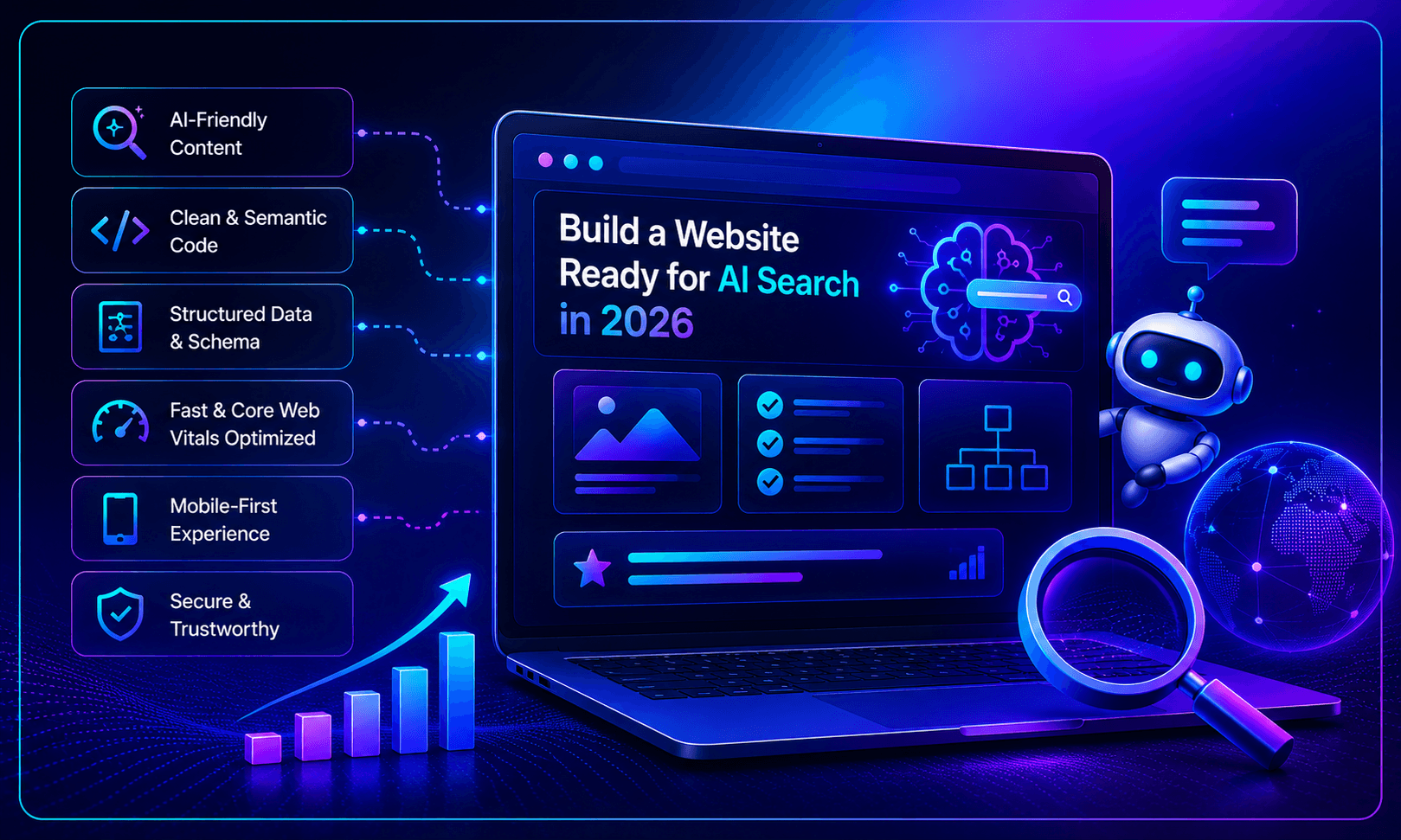
Search is becoming more conversational, contextual, and answer-focused. People increasingly ask AI-powered search experiences for recommendations, comparisons, explanations, and solutions rather than simply typing a few keywords into a search box. So, how do you build a website ready for AI search? Start with a technically strong, easy-to-understand website that gives people and search systems clear information, demonstrates expertise, uses structured data appropriately, and creates genuinely useful content. Your website architecture, page speed, internal linking, entity information, content depth, and overall user experience all contribute to this foundation. AI search rewards clarity because clear information is easier to understand, connect, summarize, and reference. That makes AI readiness less about chasing a special ranking trick and more about building a website that communicates expertise exceptionally well.
Table of Contents
What Makes a Website AI-Search Ready?
Build Clear Website Architecture
Create Content AI Search Can Understand
Strengthen E-E-A-T and Topical Authority
Use Structured Data Strategically
Make Your Website Fast and Mobile-Friendly
Build Strong Internal Linking and Entity Signals
Optimize Content for Conversational Search
Measure AI Search Visibility
The Future of AI-Ready Websites
Frequently Asked Questions
Contact Stellix
What Makes a Website AI-Search Ready?
AI search changes the way information is discovered and presented. Instead of simply returning ten blue links, AI-powered experiences can combine information from multiple sources and provide a synthesized response. That means your website needs to communicate clearly at several levels.
A service page should explain what you offer. A company page should establish who you are. An article should answer a specific question thoroughly. Supporting pages should reinforce the same subject from different useful angles.
Think of your website as a well-organized knowledge base rather than a collection of pages. This is where the work of a Best Local SEO Company goes beyond local rankings. Strong location signals, consistent business information, service relevance, customer-focused content, and authoritative mentions help search systems understand the relationship between your brand, services, audience, and location. For B2B organizations, this becomes even more valuable. A technology company, SaaS provider, consultancy, or professional-services brand needs content that communicates expertise across the entire buyer journey.
Build Clear Website Architecture
AI systems need context. Your website architecture provides that context by showing how pages relate to one another. A logical hierarchy makes it easier to understand your business, services, industries, locations, resources, and expertise. Your primary navigation should reflect how customers naturally explore your offering. For example, a B2B technology company might organize its website around solutions, industries, resources, case studies, and company expertise.
Each section can then connect naturally to supporting pages. This structure creates a clearer semantic relationship between topics and strengthens the overall relevance of the site. For brands investing in Website Development Services for B2B Companies, AI search readiness should therefore be considered during information architecture rather than added after launch.
Create Content AI Search Can Understand
AI search favors information that is clear, specific, useful, and contextually rich. That doesn't mean writing content specifically for machines.
Write for the person asking the question.
If your business provides cybersecurity software, for example, a useful article could answer, “How does zero-trust security work for mid-sized businesses?” The article can explain the concept, provide practical examples, describe implementation considerations, and connect readers to relevant solutions. This creates multiple signals of relevance.
Strong AI-search content also benefits from concise answers within deeper articles. A page can begin with a direct explanation before expanding into examples, supporting details, and expert commentary. That format works beautifully on mobile too.
Short paragraphs. Descriptive H2s. Clear definitions. Specific examples. Easy navigation.
Readers appreciate it, and search systems can interpret it more efficiently.
Strengthen E-E-A-T and Topical Authority
AI search increasingly depends on understanding which sources provide useful and credible information. That makes experience and expertise valuable parts of your content strategy. Show who created the content. Explain relevant experience. Reference original research where appropriate. Include case studies, examples, expert perspectives, and practical observations.
A B2B marketing website, for example, can build topical authority through connected resources covering SEO, demand generation, paid media, conversion optimization, analytics, and AI search. Each useful resource adds another piece to the broader subject. This is where Best Digital Marketing Company in Mumbai positioning should be supported by substance rather than a repeated phrase. Demonstrating expertise through valuable resources, strong service pages, client-focused insights, and original perspectives creates a more convincing digital footprint.
Use Structured Data Strategically
Structured data gives search engines additional context about your pages. Depending on the page, relevant Schema.org markup can help clarify information such as an organization, person, article, product, service, event, or breadcrumb relationship. The key is accuracy.
Your structured data should represent information genuinely present on the page. When markup and visible content work together, your website communicates a cleaner information structure. Structured data is one part of AI search readiness rather than a standalone visibility strategy. Your content still needs relevance, expertise, useful information, and strong technical foundations.
Make Your Website Fast and Mobile-Friendly
AI search may introduce someone to your brand, but your website becomes the destination where the relationship continues. That experience matters.
Pages should load efficiently, respond smoothly, remain visually stable, and work comfortably across smartphones, tablets, and desktops.
Core Web Vitals provide useful performance signals around loading, responsiveness, and visual stability.
A technically polished website also makes content easier to consume. For example, imagine someone discovering your company through an AI-generated recommendation and landing on a service page. They should immediately understand what the company offers, who it serves, why it matters, and what action they can take next.
Speed supports that journey.
Clarity completes it.
Build Strong Internal Linking and Entity Signals
Internal links help connect related ideas across your website. An article about B2B SEO could naturally link to a technical SEO guide, a page about content strategy, a relevant service page, and a case study. This creates a connected knowledge environment. Entity signals matter too. Make your organization's name, services, locations, leadership information, and areas of expertise consistent across your website and relevant external profiles. The clearer the connections, the easier it becomes for search systems to understand what your brand represents.
Optimize Content for Conversational Search
People ask AI systems complete questions.
“Which SEO strategy works best for SaaS companies?”
“How can a B2B website improve organic visibility?”
“What should a company include on a service page?”
Your content should naturally address these conversational patterns.
That doesn't mean filling pages with awkward question-and-answer phrases. Instead, understand the questions your audience genuinely asks and build useful sections around them. For example, an SEO guide can include a section titled “How Does Technical SEO Support AI Search Visibility?” and provide a direct, practical answer before exploring the details. This approach creates content that works for readers, traditional search, and emerging answer engines.
Measure AI Search Visibility
AI search introduces new measurement questions.
Website teams should monitor organic traffic, branded searches, referral sources, engagement, conversions, assisted conversions, and visibility across relevant search experiences.
Analytics can also help reveal whether visitors arriving through search are engaging with key pages and taking meaningful actions. The goal is to connect visibility with business outcomes.
A mention in an AI-generated answer can create brand awareness. A click to your website can create a session. A useful service page can create an enquiry. Those stages belong to the same customer journey.
The Future of AI-Ready Websites
Building a website for AI search isn't about rebuilding everything around a new algorithm. It's about improving the fundamentals that make a website useful, understandable, credible, and technically strong.
Clear architecture gives information context.
Helpful content demonstrates expertise.
Structured data adds meaning.
Internal linking connects ideas.
Fast mobile performance improves usability.
Strong entity signals clarify who you are.
Together, these elements create a website prepared for a search environment where answers, conversations, and recommendations increasingly shape discovery. The smartest approach is simple: build for people first, then make it exceptionally easy for search systems to understand the value you've created.
Frequently Asked Questions
What is an AI-search-ready website?
An AI-search-ready website has clear architecture, useful content, strong technical SEO, structured data, authoritative information, strong internal linking, and an excellent user experience.
Does traditional SEO still matter for AI search?
Yes. Technical SEO, content relevance, crawlability, authority, internal linking, and user experience continue to provide important foundations for search visibility.
How does structured data help AI search?
Structured data provides machine-readable context about entities and page content. It can help search systems interpret information more precisely when the markup accurately reflects visible page content.
Should every website create content for conversational queries?
Content should reflect genuine audience questions. Conversational formats can make complex subjects easier to explore while creating useful opportunities to answer specific search needs.
Is AI search optimization different from SEO?
AI search optimization expands the traditional SEO mindset toward conversational discovery, answer engines, entity understanding, citations, and synthesized search experiences while retaining strong SEO fundamentals.
How can B2B websites prepare for AI search?
B2B websites can focus on strong information architecture, expert-led content, detailed service pages, case studies, structured data, internal linking, technical performance, and content that answers specific buyer questions.
Key Takeaways
An AI-ready website starts with strong fundamentals and extends them into a more contextual, conversational search experience.
Clear information architecture, expert content, semantic SEO, structured data, fast performance, mobile usability, internal links, and consistent entity signals all contribute to stronger discoverability.
The most valuable investment is content that genuinely helps people make decisions.
When your website consistently demonstrates expertise and explains complex subjects clearly, it becomes a stronger destination for both traditional search and AI-powered discovery.
Conclusion
AI search is changing how people discover brands, research solutions, and compare providers. Your website can be ready for that shift by becoming clearer, faster, more authoritative, and easier to understand. From technical architecture and structured data to expert content and semantic SEO, every element contributes to a stronger digital presence. If you're planning a new website or upgrading an existing one, Website Development Services for B2B Companies should bring SEO, UX, content, performance, and AI search considerations together from the start. Want to build a website designed for modern search? Contact Stellix and book a strategy conversation with our team to create an AI-ready digital growth plan.
About Stellix
Stellix helps ambitious businesses connect SEO, website development, digital marketing, AI search, content, and performance strategy into a unified growth ecosystem. Our approach combines strategic thinking with practical execution to create digital experiences built for visibility, engagement, and measurable business growth. Explore Stellix