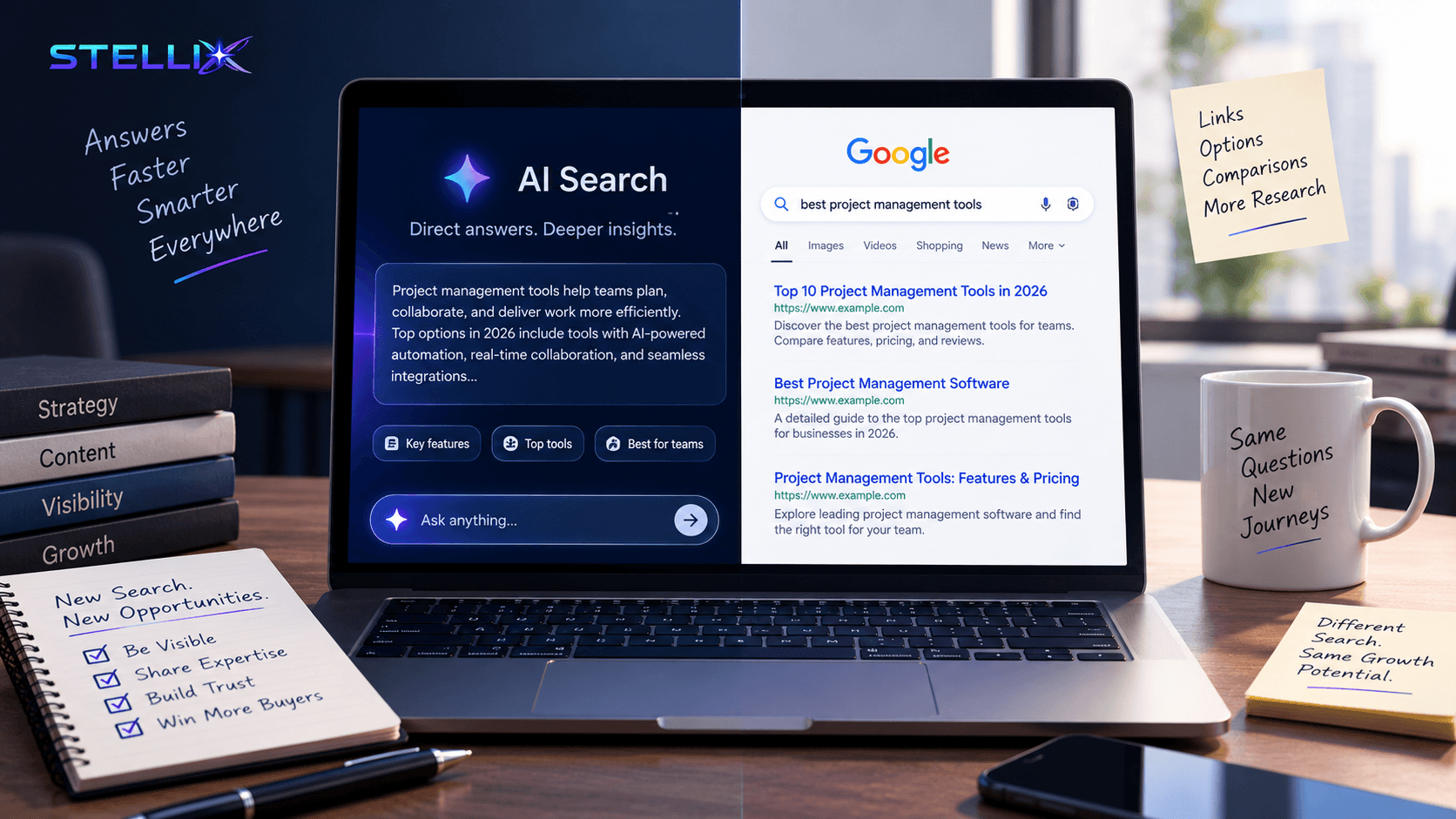
A buyer used to search for a few keywords, scan the results, open several websites, compare what they found, and make a decision. Now the journey can start with a conversation.
A B2B buyer might ask an AI-powered search experience to explain a problem, compare solutions, identify suitable providers, narrow down options, and suggest the next step. They may then use Google to validate a company, check reviews, find its website, or look for a local office.
The search journey is becoming less like a straight line and more like a series of connected questions. That does not make Google Search less important. It changes how the two experiences can work together.
For marketers, the bigger question is no longer simply, “How do we rank for this keyword?”
It is:
“How do we stay useful and visible while the buyer moves from a question to a decision?”
AI Search vs Google Search: What Has Actually Changed?
Traditional Google Search is built around queries and results.
You enter a phrase such as “B2B performance marketing agency Mumbai,” and Google returns a mix of relevant pages, ads, local results, videos, images, and other search features.
AI Search makes the interaction more conversational.
A buyer might instead ask:
“I run a B2B SaaS company in Mumbai and want to generate more qualified leads. Should I invest more in SEO, paid search, or both?”
The second query contains far more context.
The buyer has described the business type, location, objective, and decision they are trying to make.
Google's AI Mode is designed for this kind of deeper interaction. Google says users can ask longer, more complex, and nuanced questions, and AI Mode can support follow-up questions and links to the web. Google also says AI Mode queries have been more than doubling every quarter since launch. This changes the role of search from simply finding pages to helping people work through decisions.
The Buyer Journey Is Becoming More Conversational
Consider a B2B marketing manager looking for an agency.
The traditional journey might start with:
“best SEO agency in Mumbai”
The buyer reviews websites, compares services, checks case studies, and returns to Google with more specific searches.
An AI-assisted journey could begin differently.
The buyer might ask:
“What should I look for in an SEO agency if my company sells software to other businesses?”
Then:
“How should I compare an SEO agency with a B2B performance marketing agency?”
Then:
“What questions should I ask before choosing one?”
The buyer is not simply changing keywords.
They are refining their decision.
That distinction matters because each question reveals another layer of intent.
The first question is about the market.
The second is about the solution.
The third is about evaluation.
The fourth may be about action.
A strong digital strategy needs content for all four moments.
The New Framework: Search → Explore → Compare → Validate → Act
A useful way to understand the changing journey is to think of it as five stages.
Search is where the problem first appears. The buyer may use Google, an AI assistant, social media, or another platform to understand the issue.
Explore is where the buyer asks broader questions. They want explanations, examples, frameworks, and possible solutions.
Compare is where alternatives start to matter. The buyer may compare agencies, platforms, services, strategies, pricing models, or approaches.
Validate is where trust becomes important. The buyer checks websites, reviews, case studies, expertise, client examples, team information, location, and third-party signals.
Act is where the buyer contacts a provider, requests a proposal, books a consultation, signs up, or makes a purchase. This framework is useful because it prevents marketers from treating every search as the same type of interaction.
Your content should change as intent changes.
Why Traditional Google SEO Still Matters
The rise of AI Search does not remove the need for Google SEO.
Google Search remains a major place where buyers validate information.
AI Search also depends on the wider web.
Google has stated that its AI Search experiences continue to provide links that help users explore websites and original content. Its current guidance also emphasizes established SEO foundations rather than a separate technical system designed only for AI Search. That means the basics still matter.
A technically sound website matters.
Clear page structure matters.
Useful content matters.
Internal links matter.
Relevant business information matters.
Strong service pages matter.
The difference is that these assets now have more jobs to do.
An article may attract a traditional Google searcher while also providing context that supports an AI-assisted research journey.
A service page may capture a high-intent Google query while also giving a buyer information they use to validate your company after discovering it elsewhere. The website becomes part of a wider information journey.
Local SEO Is Becoming More Contextual
The primary keyword local seo consultant Mumbai is a useful example of this shift.
Someone searching that exact phrase has already provided several pieces of information.
They want local SEO.
They are looking for a consultant.
They are interested in Mumbai. That is a very different intent from someone searching simply for “SEO.”
Google says local results are primarily influenced by relevance, distance, and prominence. It also recommends keeping Business Profile information complete and accurate so that businesses can appear for relevant local searches.
Now imagine the same buyer using AI Search.
They might ask:
“I need a local SEO consultant in Mumbai for a B2B services company. What should I check before choosing one?”
That question contains the same local intent but adds business context. This means local SEO is moving beyond inserting a city name into a page. Businesses need to make their location, services, expertise, business information, and customer value clear across their digital presence.
Google also notes that local listing information can come from multiple sources, including a business's website, third-party data, user contributions, and other sources. Consistency matters because the buyer and the search system both need a clear picture of the business. For businesses working on local visibility, local SEO citations are another useful part of keeping business information consistent across relevant platforms.
B2B Buyers Need More Than a Service Page
A service page can explain what you offer. It rarely answers every question a serious B2B buyer has.
A technology company considering B2B Digital Marketing Services may also want to know:
How does the strategy work?
Which channels should we use?
How long should we expect the process to take?
What should we measure?
How does SEO work with paid media?
How do we reach different decision-makers?
What happens after someone becomes a lead?
These questions create opportunities for supporting content.
A guide can explain the strategy.
A comparison can help with evaluation.
A case study can show how the approach works.
An FAQ can answer practical questions.
A service page can bring the pieces together.
This is why a modern B2B SEO strategy should be built around the buyer journey rather than a collection of disconnected keywords.
Stellix's existing B2B SEO Strategy: Build Visibility Across the Buyer Journey follows this broader approach, connecting search intent, content, service pages, internal links, and conversion paths.
AI Search Makes Content Depth More Important
There is a common assumption that AI Search means businesses should create shorter answers. That is only part of the picture.
A direct answer can help someone understand a question quickly. But buyers often need context before they can make a decision.
Imagine a company asking:
“Should we hire an SEO agency or build an in-house team?”
A one-paragraph answer will rarely be enough. They need to understand cost factors, skills, management effort, strategic needs, reporting, implementation, and business stage. This is where strong content becomes useful.
The goal is not to make every article longer. The goal is to make every important page complete enough for the question it is trying to answer.
Stellix's recent work on AI-search-ready websites makes a similar point: clear architecture, useful content, internal linking, structured information, and strong user experience help create a website that communicates its subject clearly. For businesses that want to go deeper, AI search citations provide a useful next area to explore.
AI Search and Google Search Should Work Together
The strongest strategy is rarely “Google or AI.” It is both.
As search becomes more answer-focused, the shift from SEO to AEO also becomes part of the conversation. It is less about replacing SEO and more about making useful content easier to understand and surface across changing search experiences.
Google can capture high-intent searches.
AI Search can support deeper research.
Your website can provide the detailed information behind both. That makes the website itself an important part of the search journey, from content structure and technical performance to landing pages and conversion paths. For businesses reviewing that foundation, Website Design & Development Services can become a logical part of the wider search strategy.
Paid search can capture immediate demand.
Content can build familiarity.
Local SEO can strengthen location-based discovery.
Social content can create another entry point.
Performance marketing can help move qualified audiences toward conversion. This is where a B2B Performance Marketing Agency can bring multiple channels into one customer journey instead of optimizing each channel in isolation.
Stellix's performance marketing offering combines paid media, analytics, conversion optimization, and customer-journey insights, with campaigns designed around measurable business outcomes.
What Should Marketers Measure Now?
The changing search journey also changes measurement.
Rankings still provide useful context.
So do impressions, clicks, CTR, engaged sessions, conversions, and leads. But B2B marketers should also pay attention to what happens between those points.
A buyer might discover an article through Google. Later, they may search the brand name. Then they may visit a service page directly.
A week later, they may return through a paid campaign and submit an enquiry.
If every channel is judged separately, the journey looks fragmented.
If the journey is viewed as a whole, each interaction has context.
Google has also introduced new Search Console controls and performance insights to help website owners understand how generative AI is changing Search.
The practical measurement model becomes:
Visibility → Engagement → Brand recognition → Qualified visit → Enquiry → Revenue opportunity. That is a more useful model for B2B decision-making than treating one keyword position as the outcome.
A Practical AI Search + Google Search Strategy
Start with the questions your buyers ask before they know exactly what service they need. Then map those questions to different intent stages.
Create educational content for early research.
Build comparison and evaluation content for the middle of the journey.
Create detailed service pages for commercial intent.
Strengthen local business information where location matters.
Connect the pages through relevant internal links.
Use paid campaigns where immediate demand matters.
Then measure how these touchpoints work together.
A company looking for the best seo agency in Mumbai, for example, may first discover an educational article, compare agencies through several searches, check a Business Profile, review the website, and eventually contact a shortlisted provider. The journey can cross search, AI, website, local results, and paid media. Your strategy should be ready for that.
When Should a Business Consider Professional SEO Support?
Professional support becomes useful when search has become too important to manage through isolated tasks.
Perhaps your website has strong content but weak connections between pages.
Perhaps local visibility matters but your business information is inconsistent.
Perhaps organic traffic is growing, but qualified enquiries are not.
Perhaps your team understands traditional SEO but wants to build an AI Search strategy.
Or perhaps marketing channels are operating separately, and the buyer journey is difficult to measure.
A local seo consultant Mumbai can be useful when the primary challenge is local visibility, location signals, and local search intent.
A broader SEO team becomes more relevant when the business needs technical SEO, content strategy, internal linking, search intent research, AI-search optimization, and conversion-focused website improvements working together. The right choice depends on the problem.
What AI Search Does Not Change
For all the excitement around AI Search, some fundamentals remain remarkably steady.
People still want accurate information.
They still want clear answers.
They still want evidence.
They still want to know who they are dealing with.
They still compare alternatives.
And when money, reputation, or business performance is involved, trust matters. That means marketers do not need to abandon everything they have built around SEO. They need to make it more connected.
Google Search and AI Search are becoming different interfaces to a wider information ecosystem. Your website remains one of the most important places where that ecosystem comes together.
Frequently Asked Questions
Is AI Search replacing Google Search?
No. AI Search is changing how people interact with search, but traditional Google Search remains important for discovery, validation, navigation, local results, and high-intent queries. The two experiences can work together.
Does SEO still matter with AI Search?
Yes. Google continues to emphasize established SEO foundations for its AI-powered Search experiences. Useful content, strong website structure, relevant information, internal links, and technical quality remain important.
How is AI Search changing B2B buyer journeys?
AI Search allows buyers to ask longer and more contextual questions, explore follow-ups, compare options, and refine their thinking within the same interaction. This can make the research stage more conversational and less dependent on individual keyword searches.
Does local SEO still matter in AI Search?
Yes. Local relevance remains important when a buyer needs a business in a specific area. Google says local results consider relevance, distance, and prominence, while complete and accurate Business Profile information helps Google understand the business.
What should a B2B company do first?
Start by mapping the questions buyers ask across awareness, research, comparison, validation, and decision stages. Then review whether your website has useful content and relevant pages for each stage.
Should businesses invest in AI Search separately from SEO?
AI Search should generally be considered as part of the wider SEO and content strategy rather than as a completely separate activity. Strong technical foundations, useful content, clear site architecture, and relevant internal links support both traditional and AI-powered search experiences.
What does a local SEO consultant do?
A local SEO consultant helps businesses improve their visibility for location-based searches by working on areas such as business information, local relevance, website content, local listings, reviews, and measurement. The exact scope should match the business and its target market.
Conclusion
The biggest change in search is not that people have stopped using Google. It is that the way people ask questions is becoming richer.
A buyer can search a keyword, ask an AI follow-up, compare providers, validate a company on Google, check local information, visit a website, and return through another channel. The journey is no longer a simple line from keyword to click.
For B2B brands, that creates a clear strategic opportunity.
Build content for questions, not just keywords.
Build websites that explain the business clearly.
Make local information accurate and useful.
Connect SEO with performance marketing.
Measure the buyer journey rather than one isolated interaction. And make every digital touchpoint useful enough to move the buyer one step closer to a decision. That is where AI Search vs. Google Search becomes less of a technology comparison and more of a marketing strategy question.
Where is your buyer looking for answers today, and is your brand useful at that exact moment?
Contact Stellix
If your business needs to connect SEO, AI Search, content, paid media, local visibility, and conversion strategy into one buyer journey, Stellix can help build that system around your business goals. Explore Stellix's Performance Marketing Services to connect paid search, analytics, conversion optimization, and customer-journey strategy.
For businesses where local visibility is a key growth channel, the next step is to assess whether your website, Business Profile, content, and local signals are aligned with the searches your customers actually make. Ready to build a search strategy around how your buyers actually research and decide? Let’s talk
About Stellix
Stellix is a performance-driven digital marketing agency helping businesses grow through SEO, PPC, website development, content marketing, and social media marketing. We combine data-backed strategies with creative execution to increase visibility and generate qualified leads.