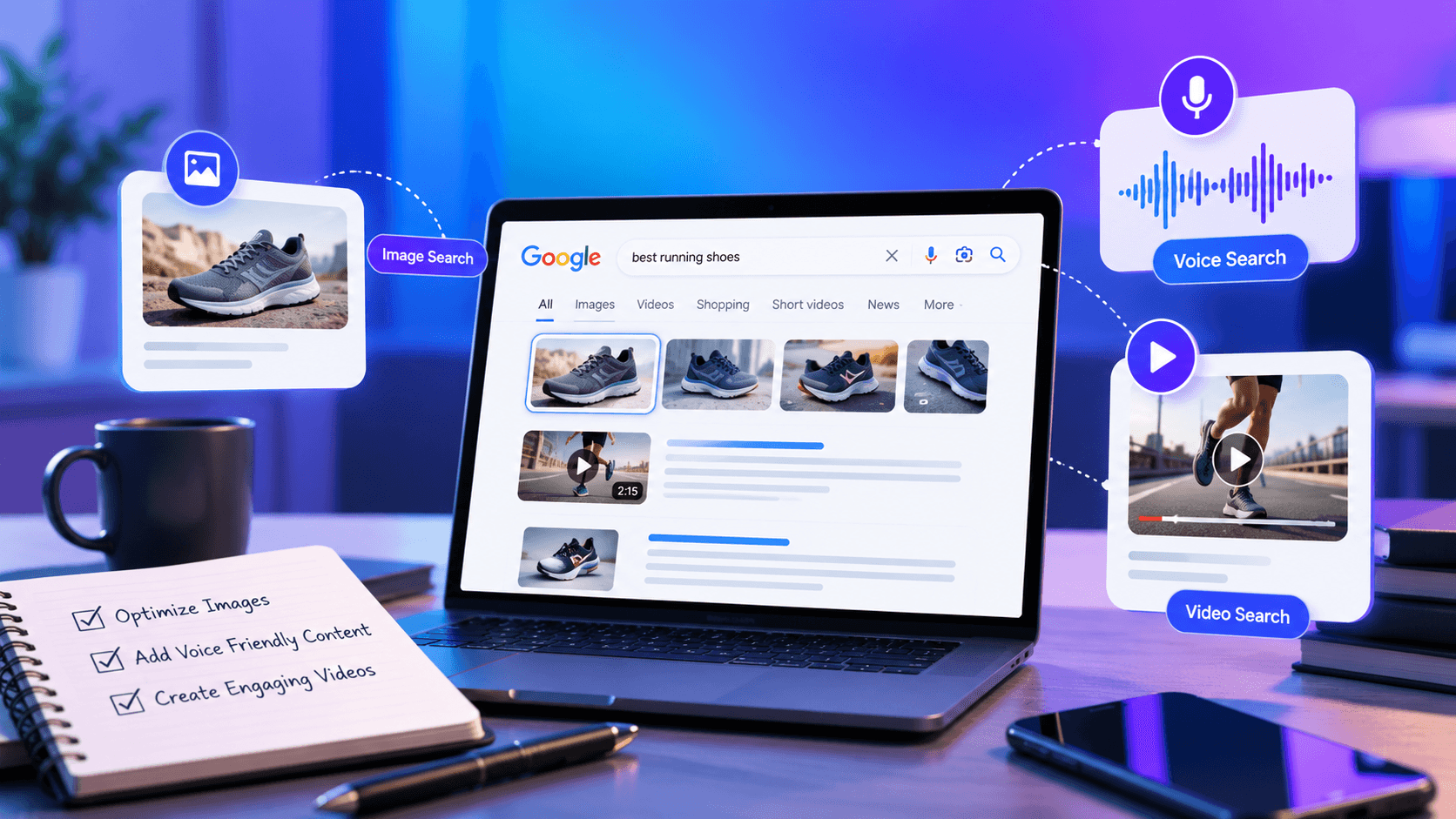
Search is no longer just something people type.
They point a camera at something. Upload an image. Ask a question aloud. Watch a video. Use Google Lens. Tap Circle to Search. And now Google is giving website owners more visibility into some of those behaviours.
On September 24, 2026, Google introduced multimodal Search performance reporting in Search Console. The new reporting covers searches involving Google Lens, Circle to Search on Android, image uploads to Google Search, and Chrome's “Search this image” feature. Google says the reporting is rolling out globally. That makes one SEO question increasingly relevant:
Is your content optimized only for what people type, or for how people actually search?
That is where multimodal SEO comes in. And no, it does not mean turning every blog into a Netflix production. It means making your content easier for search engines and people to understand across text, images, voice, and video.
What Is Multimodal SEO?
Multimodal SEO is the practice of optimizing content so it can be understood and surfaced across different search formats and experiences.
Traditional SEO often starts with a text query:
“How does technical SEO affect rankings?”
Multimodal search can begin differently.
Someone might:
Upload a screenshot and ask what it means.
Use Google Lens to identify something.
Search visually for a product.
Ask a spoken question.
Watch a video explaining the answer.
Combine an image with a written query.
The underlying search need can still be the same.
The input has simply changed.
That is why multimodal SEO should not be treated as a completely separate SEO discipline. It is better understood as an extension of good search strategy.
Understand the question. Create the best answer. Make that answer easy to interpret in different formats.
Why Multimodal SEO Matters Now
Google's new Search Console reporting is important because it gives site owners another way to understand how people reach their content.
Google says the new multimodal filter appears in the Search performance reports and the Generative AI performance report. If a website receives traffic from the supported multimodal experiences, those metrics can appear in the relevant Performance report. That changes the measurement conversation.
For years, marketers have asked:
“How many people found us through Google?”
Now there is an opportunity to ask a more detailed question:
“How are people finding us through Google?”
That distinction matters.
A page can be useful for traditional text search and also contain an image that helps someone searching visually.
A product page can attract traditional organic traffic while its product imagery supports image-led discovery.
A tutorial can earn visits through text while its video becomes another entry point.
The content does not need to choose one format.
The strategy needs to understand the role each format plays.
Image SEO: Make Visual Content Understandable
Images are often treated as decoration.
For SEO, they are content.
Google's image guidance recommends making images understandable through relevant page context, descriptive filenames, and useful alt text. Google has also clarified how image metadata such as structured data and og: image can help it determine image thumbnails.
Start with the basics.
Write useful alt text
Alt text should describe the image accurately and naturally.
It should not become: multimodal SEO services best SEO company SEO agency Mumbai SEO strategy
That is not optimization.
That is a keyword list having a small identity crisis.
Instead, describe what the image actually communicates.
Give images relevant page context
An image makes more sense when the surrounding content explains the subject. If a page discusses visual search, an image illustrating a visual-search workflow has a clear relationship with the topic.
Keep performance in mind
Large images can create a poor page experience.
Google's page experience guidance includes mobile usability, Core Web Vitals, secure pages, and other elements that contribute to a good overall experience.
So image SEO has two jobs:
Help search engines understand the asset.
Help people load and use it comfortably.
Both matter.
Video SEO: Give Search Engines More Context
Video can explain something that would take several paragraphs to describe.
That makes it particularly useful for:
Tutorials
Product demonstrations
Expert explanations
Walkthroughs
Comparisons
Interviews
How-to content
But embedding a video is not the same thing as having a video SEO strategy.
Google says videos can appear across several Search environments, including the main Search results page, Video mode, Google Images, and Google Discover. Google also recommends VideoObject structured data for relevant watch pages.
A useful video SEO setup can include:
A descriptive video title
A useful description
A relevant thumbnail
Captions
A transcript where appropriate
Supporting webpage content
Video structured data
A clear relationship between the video and the page topic.
Think of it this way:
The video demonstrates the idea. The webpage explains why it matters.
That combination is much stronger than dropping a video into a page and hoping Google figures out the rest.
Voice Search SEO Starts With Real Questions
Voice search changes how people phrase queries.
Instead of typing:
SEO services Mumbai
someone might ask:
“What should I look for in an SEO agency in Mumbai?”
That difference matters for content planning.
Voice-friendly content should answer genuine questions clearly.
Useful approaches include:
Question-based headings
Concise definitions
Direct answers
Natural conversational language
Clear page structure
FAQ sections where they genuinely help users
But there is no need to make every paragraph sound like a conversation with a smart speaker.
Your readers are still humans.
Fortunately.
The goal is simply to reflect how people actually ask questions.
Multimodal SEO Starts With Search Intent
This is where the strategy becomes more interesting.
A common mistake is starting with the format.
“We need more video.”
“We need more images.”
“We should create a podcast.”
That approach can quickly produce a content library with plenty of media and very little purpose.
Start with the search intent instead.
Imagine someone searching:
“How does local SEO work?”
A useful content ecosystem might include:
Article: Explain the strategy in detail.
Diagram: Show how local search signals connect.
Image: Illustrate a Google Business Profile example.
Short video: Explain the process visually.
FAQ: Answer common follow-up questions.
Checklist: Give the reader something practical to use.
One search need.
Several useful formats. That is multimodal SEO with a strategy behind it.
A Simple Multimodal SEO Framework
Use this five-part framework when planning content.
1. Identify the search need
What problem is the audience trying to solve?
2. Build the strongest core page
Create one useful page that answers the main question.
3. Choose supporting formats
Decide whether the subject benefits from:
Images
Video
Diagrams
Audio
FAQs
Interactive content
Do not use a format simply because it is fashionable.
4. Optimize each asset
Check:
Filename
Alt text
Captions
Transcript
Metadata
Structured data
Page context
Accessibility
Performance
5. Measure the result
Use Search Console and analytics to understand what is happening.
Google's new multimodal reporting gives site owners another measurement layer for supported visual-search experiences.
That means your content strategy can gradually move from:
“We think visual search matters.”
to:
“We can see where visual search is contributing to our site's performance.”
That is a much more useful conversation.
What Multimodal SEO Means for B2B Brands
B2B companies sometimes assume SEO is mostly about long-form articles.
It is broader than that.
A B2B buyer may:
Search for a problem.
Read an article.
Watch a demonstration.
Compare providers.
Look at a visual explanation.
Search the company again.
Visit the service page.
Contact the business.
The formats change.
The buying journey continues.
This is where B2B Digital Marketing Services and a strong B2B SEO Strategy can work together.
SEO brings the audience into the journey.
Content helps them understand the problem.
Visual and video content can make complex ideas easier to evaluate.
The website provides the next action. And performance marketing can support distribution where appropriate. That is a much more useful model than treating SEO, content, and paid marketing as separate departments that occasionally exchange spreadsheets.
At Stellix, We Look at Multimodal SEO Differently
At Stellix, the question is not:
“Which content format is trending?”
It is:
“Which format makes this particular answer easier to find, understand, and act on?”
A B2B software company may benefit from product demonstrations.
An e-commerce brand may need stronger product imagery.
A professional services company may benefit from diagrams, expert videos and question-led content.
A local business may need accurate visual information alongside its website and Google Business Profile.
The strategy follows the audience.
That is also where professional SEO services should go beyond keywords.
Good SEO connects search intent, content structure, technical implementation, user experience, and measurement.
The keyword is part of the strategy. It is not the strategy.
Common Multimodal SEO Mistakes
Creating media without a clear purpose
A video nobody needs does not become valuable because it has a thumbnail.
Treating alt text as a keyword field
Describe the image.
Do not turn accessibility text into a keyword warehouse.
Embedding videos without supporting context
Give users and search engines enough information to understand what the video is about.
Ignoring accessibility
Captions, transcripts, descriptive imagery, and readable layouts can make content useful to a wider audience.
Measuring views without business context
Views are useful.
But ask what happened after the view.
Did the person visit another page?
Engage with the content?
Search for the brand?
Complete a relevant action?
Your dashboard does not need another number simply because it can display one.
How to Measure Multimodal SEO
Measurement should connect visibility with behaviour.
Monitor:
Search impressions
Organic clicks
Image-related performance
Multimodal Search Console data where available
Video performance
Engagement
Landing-page behaviour
Conversions
Assisted conversions
Branded search activity
Google's new multimodal reporting is especially useful because it separates supported multimodal search activity within Search Console's reporting rather than leaving marketers to treat all web search activity as one bucket.
That makes it easier to ask better questions.
Which pages are being surfaced?
Which content types are involved?
Which topics attract visual discovery?
What happens after people arrive?
Those answers can influence your next content decisions.
How Multimodal SEO Connects With Zero-Click Search
There is another reason this topic matters. Search visibility does not always end with a website click.
Google can answer questions directly through Search features, while visual and multimodal experiences can influence how users discover information.
That makes the traditional:
Ranking → Click
model less complete.
A modern search strategy may need to consider:
Visibility → Understanding → Brand recognition → Click or next action
This connects directly with the growing importance of zero-click SEO strategies.
The objective is not to abandon clicks. It is to understand that visibility can influence the journey before the click happens.
Build Multimodal Content From What You Already Have
You do not need to rebuild your website from scratch.
Start with your strongest existing pages.
Choose five to ten pages and ask:
Does the page answer a clear search need?
Could an image explain the concept faster?
Would a diagram make the process clearer?
Could a short video demonstrate the idea?
Are users asking questions that deserve direct answers?
Are images properly described?
Are important videos supported with useful context?
Can Search Console show how people are finding the content?
Does the page load comfortably on mobile?
This turns multimodal SEO into an improvement process rather than another giant content project.
And that matters.
Because the best SEO strategy is usually the one your team can actually maintain.
What This Means for Your SEO Strategy
Multimodal SEO is not about producing more content simply because more formats exist. It is about matching the right format to the right search need.
Text can explain.
Images can show.
Video can demonstrate.
Voice-friendly content can answer.
Structured data can provide context.
Search Console can help you measure what is happening.
Put those pieces together and your content becomes more adaptable to the way people search.
Google's latest multimodal Search Console reporting is a useful signal that visual search behaviour deserves more attention from SEO teams. But the bigger lesson is not about one new filter. It is about building content that works beyond a single search box.
Final Takeaway
The future of SEO is not about choosing between text, image, voice, or video. It is about understanding when each format is useful.
A strong multimodal SEO strategy starts with the searcher, builds a useful answer, chooses the right supporting formats, and measures what happens next.
The brands that do this well will not necessarily publish the most content.
They will create content that makes sense wherever the search begins.
Start with the question. Choose the right format. Make the answer useful. Then measure what happens.
Need a More Connected SEO Strategy?
If your website already has useful content but needs a stronger connection between SEO, content, website experience, and performance marketing, Stellix can help bring those pieces together.
Need help building an SEO strategy that is ready for how people search today? Let’s talk.
Frequently Asked Questions
What is multimodal SEO?
Multimodal SEO is the practice of optimizing content for search experiences involving different formats, including text, images, voice, and video.
Why is multimodal SEO important in 2026?
Google is expanding the ways people interact with Search and has introduced multimodal reporting in Search Console. The new reporting covers supported experiences such as Lens, Circle to Search on Android, image uploads, and “Search this image.”
How does image SEO support multimodal search?
Descriptive filenames, accurate alt text, relevant page context, and appropriate image metadata can help search engines understand images and their relationship to the page.
How can I optimize video for SEO?
Use descriptive titles and descriptions, relevant thumbnails, supporting page content, captions where appropriate, and VideoObject structured data when applicable. Google says videos can appear across Search, Video mode, Google Images, and Discover.
Does voice search require a separate SEO strategy?
Not necessarily. Strong conversational content, clear answers, question-based headings, and useful page structure can support people who phrase searches naturally.
How do I measure multimodal SEO?
Use Google Search Console and analytics to monitor organic performance, supported multimodal Search data, engagement, landing-page behaviour and conversions. Google's new multimodal filter provides additional reporting for eligible traffic.
Is multimodal SEO only useful for e-commerce?
No. B2B companies, publishers, local businesses, professional services firms and other organizations can use images, video, diagrams and conversational content when those formats genuinely help answer audience questions.
Recommended Related Stellix Reading
1. Zero-Click SEO Strategies: How to Win More Search Visibility
2. Search Visibility Metrics That Matter Beyond Rankings