Introduction
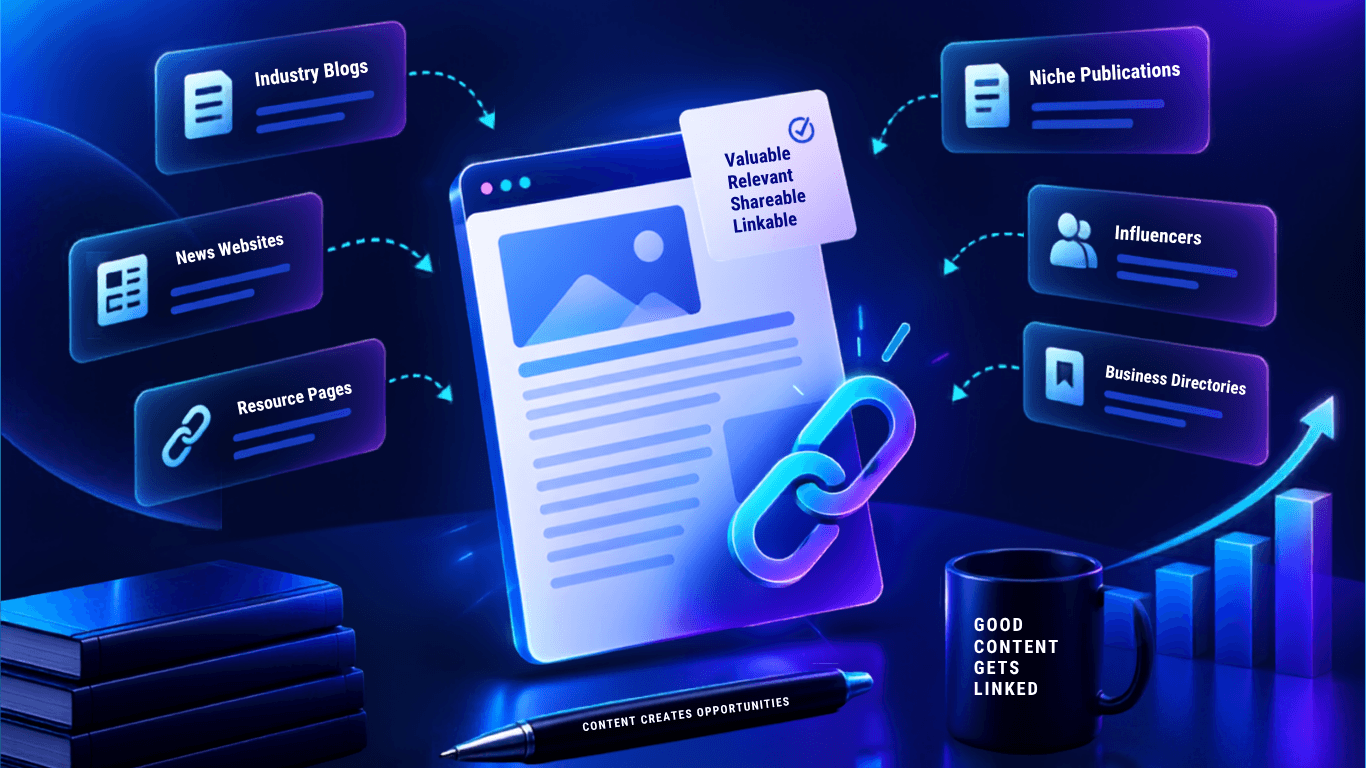
Want more quality backlinks? Start by creating something people genuinely want to reference. The strongest linkable content does more than fill a blog calendar. It gives publishers, marketers, journalists, researchers, and industry professionals a useful reason to link to your website. That could be original research, a practical guide, a useful benchmark, an expert analysis, a visual resource, or a piece of content that explains a complex subject better than anything else available.
The principle is simple: create something worth citing, then make it easy for the right people to find it. This guide explains how to build linkable content, choose topics with backlink potential, create assets that earn attention, and connect link building with a wider SEO strategy.
Table of Contents
What Makes Content Linkable?
Choose Topics With Link Potential
Create Original Research and Data
Build Comprehensive Resources
Use Original Insights and Expert Experience
Make Content Easy to Reference
Add Visual Assets That Earn Attention
Promote Linkable Content Strategically
Connect Link Building With SEO
Measure Backlink Performance
Frequently Asked Questions
Key Takeaways
Conclusion
Contact Stellix
Related Article
What Makes Content Linkable?
A page becomes linkable when another website has a clear reason to reference it. That reason usually comes from usefulness, originality, evidence, expertise, or convenience.
Imagine a marketing publication writing about B2B lead generation. Your website has published a detailed study containing fresh industry data. Linking to that study gives the publisher evidence to support its article.
Now imagine someone writing about B2b SEO strategy. Your comprehensive guide explains a complex process with clear examples and original insights.
Again, there is a reason to link. This is very different from creating an article simply because a keyword has search volume.
Linkable content solves a problem for both the reader and the publisher who may reference it.
That is the mindset to bring into your content strategy.
Choose Topics With Link Potential
Not every topic creates the same number of linking opportunities.
Before writing, consider whether the subject contains information other people may want to reference. Research-heavy topics can work well because publishers often need credible sources.
Original statistics can attract citations.
Industry trends can create discussion.
Practical frameworks can become useful references.
Detailed resources can support articles covering the same subject. For example, a generic article about “SEO Tips” offers limited differentiation.
A research-based article titled “B2B SEO Benchmarks: Organic Traffic and Conversion Trends” gives publishers a much stronger reason to reference the page.
The difference starts with the idea.
When planning content, ask:
“If another marketer wrote about this topic tomorrow, what would they want to cite from my article?”
That question can transform your content planning process.
Create Original Research and Data
Original data is one of the strongest forms of linkable content because it gives other publishers something they cannot simply reproduce from another article.
You could analyse search trends, customer behaviour, campaign performance, industry benchmarks, survey responses, or publicly available datasets. The key is to turn the data into a useful story.
A spreadsheet full of numbers rarely creates much excitement.
A clear finding supported by data can.
For example, a marketing agency could analyse hundreds of B2B landing pages and identify patterns in page structure, calls to action, or conversion elements. That research could then become an industry report.
Other websites may reference the findings when discussing B2B marketing, landing pages, or conversion optimization. The original research becomes a source. And sources attract citations.
Build Comprehensive Resources
Some content earns backlinks because it becomes a convenient reference. Think of an in-depth guide that answers the major questions around a subject in one place. For SEO, that might include keyword research, search intent, content planning, internal linking, technical SEO, on-page optimization, and measurement.
The goal is not simply to make the article longer.
Length alone does not create linkable content.
Depth comes from useful detail.
Use examples. Explain the reasoning behind recommendations. Include practical frameworks. Add original observations. Make complicated subjects easier to understand.
A comprehensive guide should leave the reader thinking, “This is the page I would send to someone who asked me about this.” That is exactly the kind of reaction that can lead to backlinks.
Use Original Insights and Expert Experience
Data is valuable, but experience can make content memorable.
Share observations from real projects.
Explain what tends to work in different situations.
Show how a strategy changes for a startup, enterprise company, SaaS brand, or B2B business.
This is where professional experience adds something that a basic keyword-focused article cannot. For teams offering professional seo services, this creates an opportunity to turn practical knowledge into linkable expertise.
For example, instead of writing another general article about technical SEO, you could explain how technical improvements affected page performance across different website types. Specific experience gives the content a distinct point of view. And distinct content gives publishers something worth referencing.
Make Content Easy to Reference
Even excellent content needs to be easy to use.
Clear headings help readers find specific sections.
Short paragraphs make important findings easier to scan.
Tables can make comparisons simple.
Definitions can help publishers quote or reference key concepts.
Charts can turn complex data into something visually useful.
You can also create concise statements that clearly communicate your main findings.
For example:
“B2B websites with topic-focused content clusters can create more relevant internal pathways between educational and commercial pages.”
A clear insight like this is easy for another writer to understand and reference. Think about the publisher experience as you create the page. If someone needs one statistic, one definition, or one useful framework from your article, can they find it quickly? Make the answer yes.
Add Visual Assets That Earn Attention
Visual content can create another reason to link.
Original charts, diagrams, research graphics, comparison tables, frameworks, templates, and infographics can make an article more useful.
Consider a page explaining the B2B buyer journey.
A simple visual showing:
Awareness → Research → Evaluation → Decision → Conversion can communicate the idea faster than several paragraphs.
A publisher writing about B2B marketing may then reference your framework and link back to the original resource.
The visual becomes the linkable asset. The same principle applies to original screenshots, process diagrams, benchmark charts, and data visualizations. Useful visuals are not decoration. They can become reasons for other websites to reference your work.
Promote Linkable Content Strategically
Publishing linkable content is only half the job.
Relevant people need to see it.
Share the research with industry publications.
Reach out to writers who cover the subject.
Connect with experts who may find the resource useful.
Promote original data through social channels.
Include the asset in newsletters and relevant communities.
The outreach message should focus on usefulness.
Instead of saying, “Please link to our article,” explain what the resource offers and why it may help their audience.
For example:
“We analysed 500 B2B landing pages and identified five conversion patterns that appeared consistently across high-performing pages.” That gives the recipient a reason to look.
A useful resource creates a much stronger opening than a generic link request.
Connect Link Building With SEO
Backlinks work best as part of a broader SEO strategy.
A strong linkable asset can attract referral traffic while supporting the wider topic covered by your website. For example, an original report about B2B SEO could link internally to supporting guides about keyword research, search intent, technical SEO, and content strategy.
Those pages could then connect to relevant commercial resources. This creates a connected content ecosystem.
For businesses combining SEO with wider B2B Digital Marketing Services, linkable assets can also support brand awareness, content distribution, referral traffic, and demand generation. The link becomes more than an SEO signal. It becomes another pathway for people to discover your brand.
Measure Backlink Performance
Backlink quantity tells only part of the story.
Look at the relevance and quality of referring websites, referral traffic, linked pages, anchor text, new referring domains, and the business value created by the content.
A single relevant industry publication can send more useful traffic than dozens of unrelated websites. You can also measure whether linkable content earns new organic impressions and attracts engagement after visitors arrive.
The bigger question is:
“Is this content becoming a useful reference within its topic?”
That is a much stronger measure of linkable content success.
Frequently Asked Questions
What is linkable content?
Linkable content is a useful, original, or valuable resource that gives other websites a natural reason to reference and link to your page.
What type of content earns quality backlinks?
Original research, industry studies, useful data, comprehensive guides, expert analysis, visual resources, tools, templates, and unique frameworks can all create strong linking opportunities.
How do I find linkable content ideas?
Look for subjects where publishers need evidence, data, examples, expert insight, visual resources, or practical references. Competitor backlink research can also reveal topics that attract links within your industry.
Are backlinks still important for SEO?
Backlinks remain an important part of how search engines understand relationships and relevance across the web. Quality and relevance matter more than simply collecting a large number of links.
How can original research earn backlinks?
Original research gives publishers fresh information to reference. When the findings are useful, clearly presented, and promoted to relevant audiences, they can become sources for future articles and reports.
How many backlinks should a page have?
There is no ideal number. A small number of relevant, useful backlinks can be more valuable than a large collection of unrelated links.
Key Takeaways
Linkable content gives other websites a genuine reason to reference your page.
Original research, useful data, expert insights, visual assets, tools, and comprehensive guides can attract quality backlinks.
Topic selection matters because some subjects naturally create more reasons for other publishers to reference them.
Strong content still needs promotion. The right audience needs to see the asset before they can link to it.
Relevant backlinks can strengthen your website's SEO signals, referral traffic, brand reach, and industry presence.
Conclusion
Quality backlinks usually begin with quality ideas.
When you create something original, useful, well-researched, and easy to reference, you give other websites a genuine reason to talk about your work. That could be a research report that becomes a source for industry articles.
A practical guide that becomes a recommended resource.
A chart that gets referenced in a presentation.
A framework that helps marketers explain a complex idea.
The common thread is value.
Build content that people would happily share with a colleague, reference in an article, or bookmark for later. Then promote it where the right audiences already spend their time. That is how link building becomes less about chasing links and more about building content that naturally earns attention.
Contact Stellix
Want to create content that attracts attention, earns relevant backlinks, and supports long-term organic growth? Stellix can help you identify linkable topics, develop original content assets, strengthen SEO strategy, and connect content with broader digital growth goals. Book a strategy call with Stellix and turn your best ideas into content that earns visibility, references, and meaningful business opportunities.
About Stellix
Stellix is a performance-driven digital marketing agency helping businesses grow through SEO, PPC, website development, content marketing, and social media marketing. We combine data-backed strategies with creative execution to increase visibility, generate qualified lea
Related Article
Read: SEO Content Refresh: 9 Steps to Grow Organic Traffic
Read: How to Optimize Google Business Profile for Voice Search