Introduction
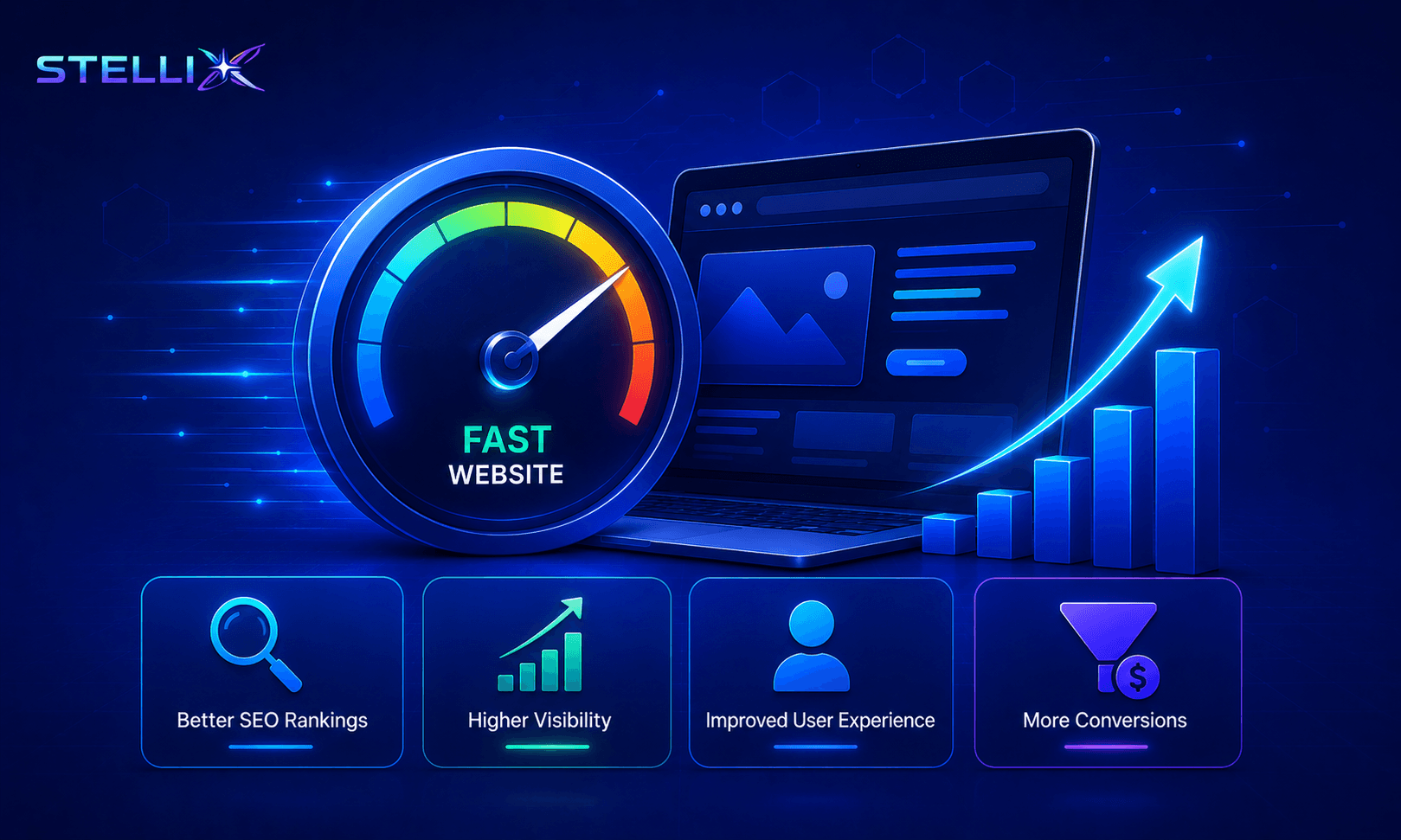
Website speed influences three things every digital marketer cares about: SEO visibility, user experience, and conversions. A fast-loading website helps visitors access information sooner, interact with pages smoothly, and move naturally toward actions such as enquiries, bookings, or purchases.
Google's Core Web Vitals provide a practical way to evaluate this experience through loading performance, responsiveness, and visual stability. But speed is more than a technical score. It is part of the journey between discovering a website and taking action. For businesses investing in Website Development Services for B2B Companies, SEO Consulting Services, and digital marketing, website performance can strengthen the connection between traffic and business results.
The key question isn't simply, "How fast is my website?"
It's "How efficiently does my website help visitors find information and take the next step?"
Key Takeaways
Website speed supports SEO, user experience, engagement, and conversions.
Core Web Vitals measure loading performance, responsiveness, and visual stability.
LCP, INP, and CLS provide practical benchmarks for evaluating website experience.
Mobile performance deserves dedicated attention because users browse across different devices and network conditions.
Optimizing images, JavaScript, CSS, hosting, and third-party resources can improve page performance.
Website speed works best when SEO, website development, content, and conversion strategy are aligned.
Businesses investing in Website Development Services for B2B Companies and SEO Consulting Services can make performance part of a broader digital growth strategy.
Table of Contents
Why Website Speed Matters for SEO
How Website Speed Supports Search Rankings
Core Web Vitals: The Metrics That Matter
Website Speed and User Experience
How Website Speed Influences Conversions
Why Mobile Website Speed Matters
What Affects Website Speed?
How to Improve Website Speed
Connecting SEO With Website Development
Frequently Asked Questions
Conclusion
Why Website Speed Matters for SEO
Imagine clicking a Google result because the page looks exactly like the answer you're searching for. You expect the content to appear quickly.
When it does, you can start reading immediately. When the page responds smoothly, navigation feels natural. When everything stays visually stable, you can interact with the page confidently. That experience matters.
Google evaluates many signals when determining search visibility, and page experience forms part of the broader picture. Core Web Vitals provide measurable indicators for loading, responsiveness, and visual stability. However, website speed should not be treated as a standalone ranking shortcut.
A strong PageSpeed score alone doesn't guarantee a top search position. Content quality, relevance, search intent, technical SEO, internal linking, authority, and many other signals contribute to organic performance. The smarter approach is to treat speed as one part of a complete SEO strategy. For businesses investing in SEO Consulting Services, this means technical performance should work alongside content optimization, search intent, site architecture, internal linking, and authority building.
How Website Speed Influences Google Rankings
Website speed contributes to the overall page experience visitors receive after clicking a search result. A fast and responsive page makes it easier for users to consume content, explore additional pages, interact with forms, and discover important information. Consider a B2B website targeting high-intent searches.
A potential customer searches for a service, visits a landing page, reads the offering, explores a case study, and then moves toward an enquiry.
Every stage depends on the website providing a smooth experience. This is where Website Development Services for B2B Companies and SEO need to work together. Development teams can optimize the technical foundation, while SEO teams ensure the website remains accessible, crawlable, relevant, and aligned with search intent. The objective is not simply to make a website technically faster. It is to make the entire search-to-conversion journey more efficient.
Core Web Vitals Explained
Google's Core Web Vitals turn website performance into measurable indicators.
Largest Contentful Paint (LCP)
LCP measures loading performance, specifically how quickly the main content becomes visible.
Google's recommended good threshold is 2.5 seconds or less at the 75th percentile. For a service page, the main content could include the headline, primary image, service information, or other prominent content.
A strong LCP helps visitors understand the page quickly.
Interaction to Next Paint (INP)
INP measures responsiveness when visitors interact with a page.
Google recommends an INP of 200 milliseconds or less for a good experience. This matters when someone clicks a button, opens a menu, interacts with a form, or uses an interactive website element.
Fast loading creates the first impression. Responsive interactions help maintain it.
Cumulative Layout Shift (CLS)
CLS measures visual stability.
Google recommends a CLS score of 0.1 or less for a good experience.
A stable layout allows visitors to interact with the page without unexpected movement.
Together, these metrics answer three practical questions:
How quickly does the main content appear?
How quickly does the website respond?
Does the page remain visually stable?
Website Speed and User Experience
Technical teams often think about website speed in milliseconds. Customers experience it as momentum.
A fast page lets someone begin reading sooner.
A responsive interface makes interactions feel natural.
A stable layout makes navigation easier. This becomes especially important for B2B businesses.
A decision-maker researching software, consulting, technology, or professional services may compare several providers before starting a conversation.
A website that presents information efficiently gives visitors a smoother research experience. For Website Development Services for B2B Companies, performance should therefore be considered during website architecture, design, development, content publishing, and ongoing optimization.
A website isn't simply a collection of pages. It is a digital journey. Speed helps that journey flow.
How Website Speed Influences Conversions
Traffic is the beginning of the customer journey.
Conversion is where that journey creates measurable business value.
Imagine a business investing in Google Ads.
The campaign has strong targeting, compelling creative, and a clear offer. A potential customer clicks the advertisement and arrives on the landing page. Now the website takes over.
The visitor may want to read the service details, review a case study, explore pricing, complete a form, book a consultation, or make a purchase.
Each interaction needs to feel smooth. This is why website performance should be considered alongside conversion rate optimization.
SEO attracts relevant visitors.
Website performance supports engagement.
Conversion-focused UX guides visitors toward action.
The same principle applies to visitors arriving from paid search, social media, email marketing, referrals, and AI-powered search.
Why Mobile Website Speed Matters
A website can perform beautifully on a powerful desktop and deliver a different experience on a mobile device.
Mobile users browse across different devices, screen sizes, hardware capabilities, and network conditions. That makes mobile performance an essential part of website optimization. Your development laptop isn't your customer's phone.
Google PageSpeed Insights can provide useful performance diagnostics, while real-world data can help teams understand how actual users experience a website.
The objective is straightforward:
The mobile experience should load efficiently, respond smoothly, and remain visually stable.
For businesses investing in SEO Consulting Services, mobile performance should therefore be part of technical SEO reviews and ongoing website optimization.
What Affects Website Speed?
Website performance rarely depends on one element. Large images can increase page weight. Excessive JavaScript can increase browser processing. Unoptimized CSS can add rendering work. Hosting and server response times can influence how quickly resources reach the browser. Third-party scripts can also contribute to page weight and processing requirements.
CMS plugins and page-builder features deserve regular review as a website evolves.
Large Images
Use appropriately sized images, modern formats, compression, responsive sizing, and lazy loading where appropriate. The goal isn't to remove visual content. It is to deliver the right visual quality without unnecessary page weight.
JavaScript
JavaScript enables sophisticated website functionality. The opportunity is to load only the functionality users actually need and reduce unnecessary processing.
CSS
Streamlined CSS can reduce unnecessary rendering work and create a cleaner technical foundation.
Hosting and Server Response
Efficient hosting and server configuration provide the foundation for delivering website resources quickly.
Plugins and Page Builders
Regularly review plugins and page-builder features to maintain a streamlined website environment.
How to Improve Website Speed
Website speed optimization becomes much easier when it follows a structured process.
Measure Performance First
Start with tools such as PageSpeed Insights and Core Web Vitals reporting. Identify the pages that matter most to your business.
Prioritize High-Value Pages
Focus first on pages receiving significant organic traffic, paid traffic, or conversions. A high-traffic service page may create more immediate value than an internal page with minimal visibility.
Identify the Performance Bottleneck
Determine whether images, JavaScript, CSS, server response, third-party resources, or hosting are contributing most to the page experience.
Optimize the Technical Foundation
Compress and resize images, improve caching, streamline scripts, optimize CSS, and address server-level opportunities.
Test Again
After implementation, measure performance again. Compare the results across desktop and mobile and evaluate the experience using both technical metrics and real-world behavior.
Connect Performance With Business Results
Look beyond technical scores. Review engagement, page depth, form submissions, consultation bookings, purchases, and conversion rates. That's where website performance becomes a growth strategy.
SEO and Website Development Should Work Together
SEO and website development are strongest when they operate as one connected strategy.
Developers focus on infrastructure, code, rendering, JavaScript, hosting, and technical architecture.
SEO specialists focus on crawling, indexing, search intent, content structure, internal linking, and organic visibility. Both perspectives matter.
A technically sophisticated website needs strong search architecture.
A search-optimized website needs an efficient technical foundation.
For businesses investing in Website Development Services for B2B Companies or SEO Consulting Services, performance should be considered from the beginning rather than added after the website is complete. When development, SEO, content, and conversion strategy work together, website speed becomes part of a broader digital growth engine.
Frequently Asked Questions
Does website speed directly improve Google rankings?
Website speed and page experience are part of Google's broader search considerations, but Google uses many ranking signals. Strong Core Web Vitals are recommended as part of creating a good page experience rather than as a standalone ranking guarantee.
What are the three Core Web Vitals?
The current Core Web Vitals are LCP for loading performance, INP for responsiveness, and CLS for visual stability.
What is a good LCP score?
Google's recommended good threshold for LCP is 2.5 seconds or less at the 75th percentile.
How does website speed affect conversions?
Faster experiences help visitors access information and interact with important elements more efficiently. This can create a smoother path toward actions such as enquiries, purchases, registrations, and consultations.
How can I measure website speed?
Google PageSpeed Insights provides both laboratory diagnostics and real-world performance data, while Google Search Console provides Core Web Vitals reporting for eligible sites.
Should businesses prioritize mobile speed?
Yes. Mobile performance is an important part of creating a strong user experience, particularly because mobile devices account for a substantial share of global internet usage.
Conclusion
Website speed is more than a technical metric. It connects SEO, user experience, engagement, and conversions throughout the customer journey. Strong Core Web Vitals, optimized images, efficient code, responsive design, and thoughtful website architecture can help visitors access information and interact with pages more smoothly. For businesses investing in Website Development Services for B2B Companies and SEO Consulting Services, performance optimization can become an important part of a broader digital growth strategy. The goal isn't simply to chase a perfect performance score. It is to create a website that loads efficiently, communicates value quickly, works smoothly across devices, and guides visitors toward meaningful action.
Contact Us
Ready to Build a Faster, SEO-Ready Website?
Your website should do more than attract visitors. It should create a smooth journey from search discovery to engagement and conversion.
Stellix combines Website Development Services for B2B Companies, SEO Consulting Services, technical SEO, content strategy, performance marketing, and AI-focused search strategies to help ambitious businesses build faster, more engaging digital experiences.
Let's talk about your website growth goals.
Book a Strategy Call with Stellix and discover practical opportunities to improve website speed, Core Web Vitals, organic visibility, engagement, and conversions.
About Stellix
Stellix is a performance-driven digital marketing agency helping ambitious brands grow through SEO, paid media, content marketing, website development, performance marketing, and AI-focused search strategies. By combining data-backed insights, technical expertise, and creative thinking, Stellix develops customized marketing solutions designed to increase visibility, attract high-intent audiences, and deliver measurable business results. Whether you're expanding locally, growing nationally, or building a global digital presence, Stellix creates digital strategies designed for sustainable growth.