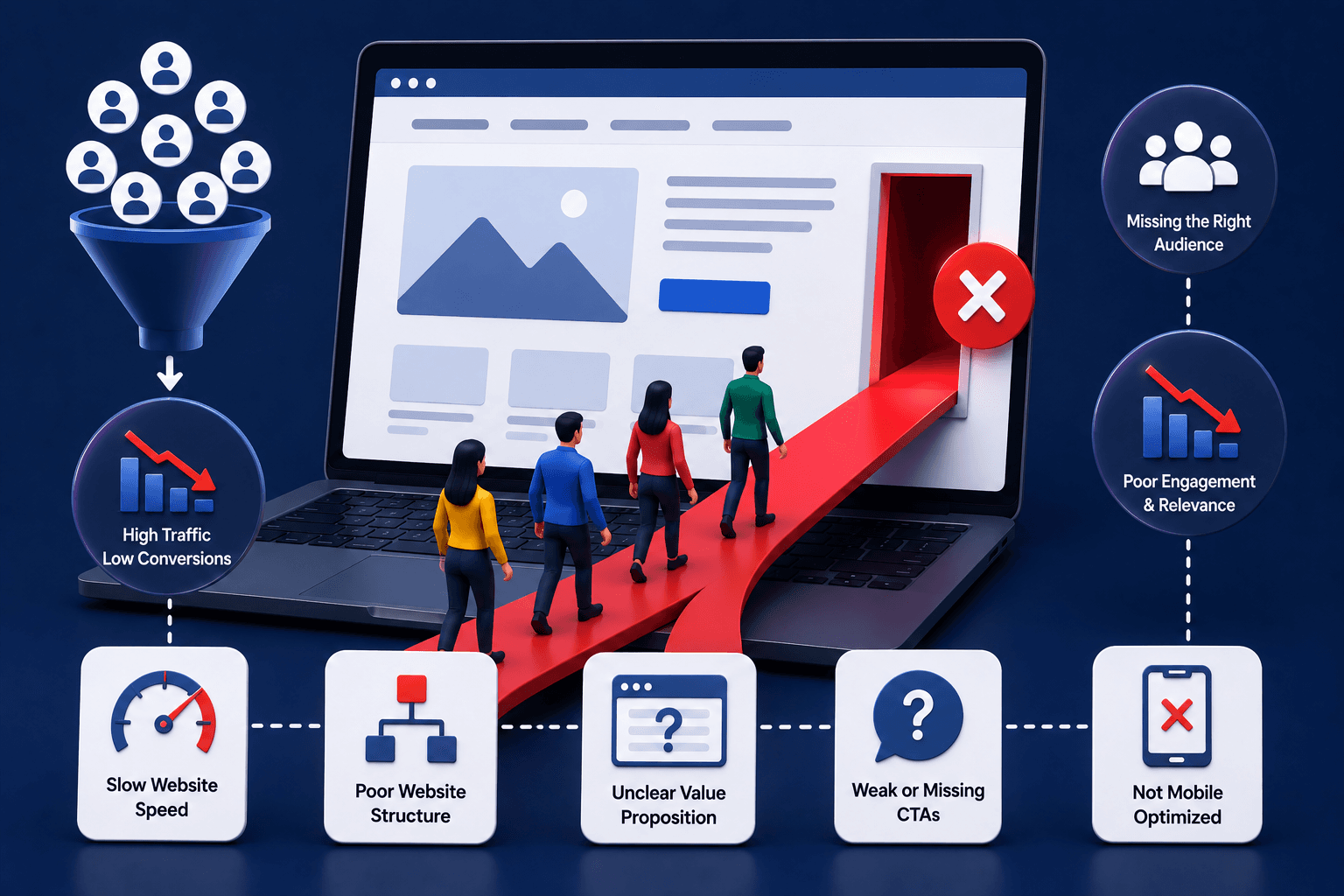
There’s a moment many businesses quietly experience after months of investing in SEO, paid ads, social media, or content marketing.
Traffic finally starts climbing.
The dashboards look encouraging.
Sessions increase.
Page views rise.
Reports become wonderfully colorful. And yet the leads barely move.
It’s one of the most common frustrations in modern marketing. Plenty of businesses attract attention online, but far fewer successfully turn that attention into meaningful conversions. Because traffic alone doesn’t build growth. Conversion does. And the gap between the two is usually much more strategic than technical.
Traffic Without Intent Rarely Creates Momentum
One of the biggest misconceptions in marketing is assuming all website traffic carries equal value. Someone casually browsing a blog post behaves very differently from someone actively searching for a solution, comparing providers, or evaluating services. Both users count as traffic. Only one is likely to become a lead. That distinction matters enormously.
Many businesses focus heavily on increasing visibility while spending far less time refining audience intent. As a result, websites attract visitors who are interested enough to click, but not aligned enough to convert.
This is where stronger targeting and smarter b2b digital marketing services often create meaningful improvements. When content, ads, and search intent align properly, traffic becomes more qualified naturally. And qualified traffic tends to convert far more efficiently. Not because there’s more of it. Because it’s more relevant.
Your Website Might Be Explaining Instead of Guiding
There’s another subtle issue that quietly affects conversion rates. Some websites provide information beautifully, but provide direction very poorly.
A visitor arrives curious, scrolls through the page, learns a few things, and leaves without taking action because the next step feels unclear. This happens more often than people realize.
Good websites don’t just inform users. They guide them. They create momentum. Every page should help visitors understand where they are, why the offer matters, and what they should do next.
Without that clarity, traffic drifts. And drifting rarely converts.
The strongest websites create a sense of progression. Messaging flows naturally. Calls-to-action feel contextual instead of abrupt. The experience feels intuitive rather than overwhelming. That’s usually where conversion improvement begins. Not through louder messaging. But through clearer direction.
Conversion Problems Often Start With Messaging
Here’s something many businesses underestimate: People don’t convert because a website exists. They convert because the messaging resonates.
Visitors make incredibly fast judgments online. Within seconds, they’re evaluating whether a business understands their needs, communicates value clearly, and feels trustworthy enough to continue exploring.
If messaging feels vague, generic, or disconnected from audience intent, conversion momentum slows immediately. This is why high-performing websites focus heavily on clarity.
Strong headlines.
Specific positioning.
Language that reflects how customers actually think.
The best-performing brands rarely sound like corporate brochures. They sound human.
Direct.
Helpful.
Confident. That’s what builds connection. And connection drives action.
Design Matters More Than Many Businesses Expect
People rarely describe website design as a conversion factor. But they absolutely react to it. A clean, intuitive design creates confidence almost instantly. Visitors stay longer, navigate more comfortably, and engage more naturally when the experience feels polished and friction-free.
On the other hand, cluttered layouts, confusing navigation, or overwhelming page structures quietly reduce momentum. Enough to influence whether someone continues exploring or exits the site altogether.
The interesting part is that good design doesn’t necessarily call attention to itself. It simply removes distractions between the visitor and the action you want them to take. Which is why the best-performing websites often feel surprisingly effortless.
Your Calls-to-Action Might Be Too Passive
This part gets overlooked constantly. Many businesses treat calls to action like decorative website furniture.
“Learn More.”
“Explore Services.”
“Read More.”
Strong conversion-focused websites create calls-to-action that feel relevant, timely, and connected to user intent. The goal isn’t aggressive selling. It’s creating a natural next step that feels valuable to the visitor. That’s an important distinction. Because people respond well when progression feels easy. A well-placed CTA can quietly transform how traffic behaves across an entire site.
Trust Signals Quietly Influence Conversion Decisions
Visitors evaluate credibility faster than many businesses expect. Reviews, testimonials, recognizable clients, case studies, certifications, and even consistent branding all influence how trustworthy a business feels within seconds. This matters because modern users are incredibly comparison-oriented. Before converting, they often validate businesses across multiple touchpoints.
A website that looks informative but lacks trust-building elements creates hesitation. A website that reinforces expertise and reliability creates confidence. And confidence shortens decision-making. This is one reason experienced providers offering digital marketing services often focus heavily on conversion trust layers rather than traffic acquisition alone. Because generating traffic is only part of the equation. The experience after the click determines what happens next.
Mobile Experience Shapes More Conversions Than Ever
A surprising number of websites still behave beautifully on desktop and awkwardly on mobile. Unfortunately, audiences don’t separate those experiences emotionally. They simply decide whether the site feels easy to use.
Mobile users expect fast load times, clean layouts, readable content, and friction-free navigation. When those elements align, conversion rates improve naturally because the experience feels seamless. And seamless experiences create momentum. This is especially important for B2B brands, where decision-makers increasingly research solutions during quick browsing sessions throughout the day. Convenience influences engagement more than many marketers realize.
More Traffic Isn’t Always the Goal
Sometimes businesses don’t actually need more traffic. They need better-performing traffic. That’s a very different objective.
When websites align audience intent, messaging clarity, trust signals, user experience, and conversion pathways effectively, even modest traffic increases can produce significantly stronger lead generation. This is where thoughtful optimization becomes incredibly powerful. Because conversion growth often comes from refinement rather than dramatic redesigns.
A clearer headline.
A stronger CTA.
A faster mobile experience.
Small improvements compound quickly. And compounding is usually where sustainable growth begins.
Conclusion
Website traffic alone doesn’t guarantee lead generation. Conversions improve when audience intent, messaging, user experience, and trust signals work together seamlessly. Businesses that focus on refining the full visitor journey, not just increasing traffic, often create stronger engagement, better lead quality, and more sustainable growth over time.
If your website is attracting visitors but not generating the momentum you want, this is a great opportunity to rethink how your traffic experience is guiding users toward action.
About Stellix:
Focused on delivering measurable results, Stellix helps brands scale through data-backed strategies that combine SEO, paid media, and conversion optimization. With deep expertise in performance marketing, technical SEO, and content strategy, Stellix builds sustainable growth engines that go beyond short-term wins. From high-intent traffic acquisition to full-funnel optimisation, the agency empowers businesses to maximise ROI and long-term profitability. Book a Strategy Call today to explore how our performance-driven strategies can accelerate your growth.