Introduction
Should you remove FAQ schema after Google ended FAQ rich results? For most websites, the answer is no. Although Google significantly reduced the display of FAQ rich results for the majority of sites, FAQ schema still helps search engines understand page content and can support a well-structured website. The focus has shifted from earning extra search result enhancements to creating clear, helpful content that improves the overall user experience.
If your business relies on B2B Digital Marketing Services, Professional SEO Services, or Website Development and SEO Services, understanding this update is important. Instead of viewing it as a reason to overhaul your SEO strategy, consider it an opportunity to prioritize high-quality content, strong site architecture, and meaningful user engagement. Search continues to evolve, and websites that consistently deliver value remain well-positioned for long-term visibility.
Key Takeaways
Google has significantly reduced FAQ rich results for most websites.
FAQ schema still helps search engines better understand page content.
User-first content remains the foundation of sustainable SEO.
Structured data should support content quality, not replace it.
A balanced SEO strategy continues to deliver long-term organic growth.
Table of Contents
What Changed with Google's FAQ Rich Results?
Why Google Reduced FAQ Rich Results
Should You Remove FAQ Schema?
Benefits of Keeping FAQ Schema
How This Update Affects SEO Strategy
Best Practices for Structured Data
Frequently Asked Questions
Conclusion
What Changed with Google's FAQ Rich Results?
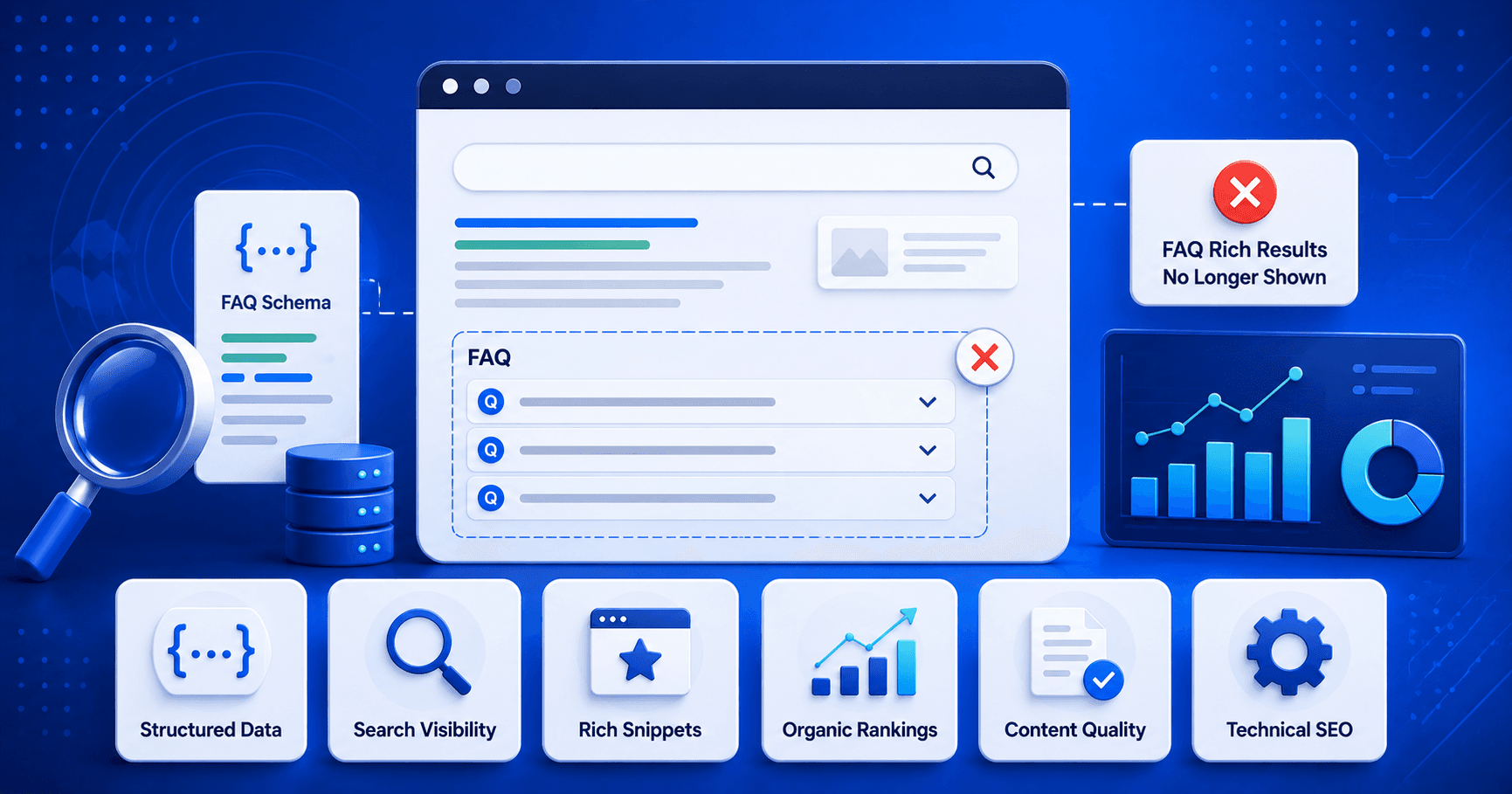
For several years, FAQ rich results helped websites occupy more space on Google's search results pages by displaying expandable questions and answers beneath listings. They became a popular way to improve search visibility and provide users with quick answers before they even clicked through to a website.
Google has since refined this feature by limiting FAQ rich results primarily to selected authoritative government and health-related websites. For most commercial websites, the familiar expandable FAQ listings no longer appear regularly in search results.
This adjustment reflects Google's broader goal of delivering cleaner, more relevant search experiences while reducing visual clutter. Rather than highlighting structured data alone, Google's search systems increasingly evaluate the overall quality, relevance, and usefulness of a webpage.
Businesses offering B2B Digital Marketing Services have embraced this change by focusing on comprehensive content, stronger topical authority, and improved user experience instead of relying on search result enhancements alone.
Why Google Reduced FAQ Rich Results
Google continually refines its search experience to help users find valuable information more efficiently. As FAQ schema became widely adopted, many websites implemented it across large numbers of pages, even when FAQs added minimal value for visitors.
By displaying FAQ rich results more selectively, Google encourages publishers to create content that genuinely answers user questions within the page itself rather than depending on enhanced search features to attract attention.
The update also aligns with Google's growing emphasis on helpful content, experience-driven expertise, and search intent. A well-written article that thoroughly answers readers' questions naturally creates a better experience than one designed primarily to generate additional search result elements. For businesses investing in Professional SEO Services, this shift reinforces an important principle: sustainable SEO comes from providing useful information, not from relying on individual SERP features.
Should You Remove FAQ Schema?
For most websites, removing FAQ schema simply because rich results appear less frequently isn't necessary.
Structured data continues to provide valuable context that helps search engines interpret page content more accurately. Even when users don't see FAQ rich results in search, the markup contributes to a clearer understanding of your website's information architecture.
If your FAQ section genuinely addresses customer questions, complements the primary content, and enhances the user experience, keeping the schema in place remains a sensible long-term practice. It also prepares your website for future search enhancements as Google's search systems continue evolving.
Businesses combining Website Development and SEO Services often maintain structured data as part of a broader technical SEO strategy. Alongside clean code, logical site architecture, optimized page speed, and high-quality content, structured data supports a website that is easier for both users and search engines to navigate.
Rather than asking whether FAQ schema should disappear, a more valuable question is whether every FAQ section genuinely helps your audience. When the answer is yes, the markup continues to support a well-optimized, user-focused website.
Benefits of Keeping FAQ Schema
Although FAQ rich results now appear for a much smaller group of websites, FAQ schema continues to play a valuable role in a modern SEO strategy. Structured data helps search engines interpret page content more effectively by providing additional context about the information presented on a webpage.
Think of FAQ schema as a well-organized table of contents inside a book. Even if readers don't immediately see it on the cover, it still helps them navigate the content more efficiently. Search engines work similarly. Clear, structured information makes it easier to understand relationships between questions, answers, and the main topic of a page.
Keeping FAQ schema also supports content organization. A thoughtfully written FAQ section answers genuine customer questions, improves readability, and encourages visitors to stay engaged longer. Whether someone is exploring your B2B Digital Marketing Services, comparing Professional SEO Services, or researching Website Development and SEO Services, relevant FAQs create a smoother user experience by addressing common concerns without interrupting the flow of the page.
Structured data also prepares your website for future search innovations. Google continuously refines how information is interpreted and displayed across Search, AI-powered experiences, and emerging search features. Maintaining accurate schema helps ensure your website remains technically prepared as these experiences evolve.
When FAQ Schema Still Provides Value
FAQ schema offers the greatest value when it supports meaningful content rather than existing simply for search visibility.
Service pages are a perfect example. Visitors often have practical questions before making a decision, such as project timelines, pricing approaches, implementation processes, or ongoing support. Answering these questions directly within the page improves clarity while helping search engines understand the page's purpose.
Educational resources also benefit from structured FAQs. Comprehensive blog articles that include relevant follow-up questions create a richer learning experience. Instead of forcing readers to search elsewhere for additional information, the page naturally anticipates their next question and provides a helpful answer.
Imagine a business publishing an in-depth guide about a technical SEO audit. After explaining Core Web Vitals, the article includes a concise FAQ covering implementation timelines, monitoring tools, and performance benchmarks. Even without displaying FAQ rich results, that section improves usability by keeping readers engaged and providing additional context around the topic.
Businesses delivering Professional SEO Services increasingly use FAQ sections to strengthen content quality rather than pursue individual search features. The result is content that serves both users and search engines in a balanced, sustainable way.
How the Update Affects SEO Strategy
Google's refinement of FAQ rich results highlights an important shift in SEO priorities. Success is becoming less about earning additional visual elements in search results and more about building websites that consistently satisfy user intent. This means investing more effort in comprehensive content, topical authority, technical optimization, and excellent user experience.
Instead of asking, "Will this create a richer search result?", successful SEO teams now ask, "Will this genuinely help our audience?" That subtle change in perspective often leads to stronger long-term outcomes.
For example, a software company previously added identical FAQ sections across dozens of pages solely to increase search result visibility. After Google's update, the company replaced generic questions with unique, customer-focused answers tailored to each service page. Visitors found more relevant information, engagement improved, and the overall website became a more valuable resource.
Organizations offering B2B Digital Marketing Services have embraced this approach by expanding educational content, strengthening internal linking, and building topic clusters that demonstrate expertise across related subjects. These improvements support search visibility regardless of whether specific SERP features are displayed.
Similarly, businesses combining Website Development and SEO Services recognize that clean site architecture, responsive design, fast-loading pages, and well-structured content work together to create an exceptional experience that aligns with Google's long-term search direction.
Best Practices for Structured Data in 2026
Structured data continues to deliver the greatest value when it accurately reflects high-quality content already visible on the page.
Every FAQ should answer a real question that visitors are likely to ask. Clear, concise responses improve readability while reinforcing topical relevance. The markup should always match the visible content exactly, ensuring consistency for both users and search engines.
Schema implementation should also remain technically accurate and regularly maintained. As content evolves, structured data should evolve alongside it so that every question and answer remains current and useful. It's equally important to view structured data as one component of a broader SEO strategy. Helpful content, logical site architecture, intuitive navigation, internal linking, mobile optimization, and fast page performance all contribute to stronger search visibility. Schema works best when it complements these elements rather than replacing them.
A good example is a B2B company redesigning its service pages. Instead of simply adding FAQ markup, the team rewrites each page around customer intent, improves page speed, strengthens internal links to supporting resources, and adds carefully crafted FAQs addressing genuine client questions. The structured data reinforces an already valuable page, creating a stronger overall experience for both visitors and search engines.
That balanced approach is where modern SEO continues to shine. Rather than focusing on individual ranking features, successful websites build trust through useful content, technical excellence, and thoughtful user experiences, qualities that remain valuable regardless of how Google's search results continue to evolve.
Frequently Asked Questions (FAQ)
1. Why did Google reduce FAQ Rich Results?
Google streamlined FAQ Rich Results to create a cleaner search experience and prioritize the most relevant information for users. Today, FAQ Rich Results are primarily shown for selected government and health websites, while other websites can still use FAQ schema to help search engines better understand their content.
2. Should I remove FAQ schema from my website?
For most websites, there's no need to remove FAQ schema. If your FAQ section answers genuine customer questions and enhances the page, keeping the markup is a smart long-term SEO practice. Structured data continues to support search engines in understanding your content, even when Rich Results are displayed less frequently.
3. Does FAQ schema still help SEO?
Yes. While it may not always generate an enhanced search listing, FAQ schema contributes to better content organization, supports semantic understanding, and complements a technically optimized website. It works best as part of a broader SEO strategy focused on quality content and user experience.
4. Where should FAQ schema be used?
FAQ schema is most effective on pages where visitors naturally have questions, such as service pages, product pages, knowledge hubs, and educational blog posts. Every FAQ should provide meaningful information that helps users make informed decisions.
5. What should businesses focus on instead of FAQ Rich Results?
Businesses should focus on publishing helpful content, strengthening topical authority, improving technical SEO, enhancing page experience, and building a logical internal linking structure. These elements create lasting value regardless of individual search features.
6. Is structured data still important in 2026?
Absolutely. Structured data continues to help search engines interpret website content more accurately and prepares websites for evolving AI-powered search experiences. Maintaining clean, accurate schema remains a best practice for modern SEO.
7. How can businesses adapt to Google's evolving search experience?
The most successful approach is to create content that genuinely answers user questions, keep technical SEO up to date, refresh evergreen resources regularly, and ensure every page delivers a smooth, engaging experience across desktop and mobile devices.
Conclusion
Google's decision to limit FAQ Rich Results marks an evolution in how search prioritizes content quality and user experience. Rather than viewing this change as a reason to remove FAQ schema, businesses should see it as an opportunity to strengthen the overall value of their websites. Sustainable search visibility continues to be supported by a combination of helpful content, intuitive website experiences, accurate structured data, and a strong technical SEO audit.
Whether you're enhancing B2B Digital Marketing Services, investing in Professional SEO Services, or improving Website Development and SEO Services, building a user-first strategy remains the most effective path to long-term organic growth. As search continues to evolve, websites that educate, inform, and solve real customer questions will remain well-positioned for continued success.
Is Your SEO Strategy Prepared for the Future of Search?
Google's search experience will continue to evolve, but a website built on quality content, technical excellence, and user-first optimization is always prepared for what's next. If you're looking to strengthen your online visibility with Professional SEO Services, expand your reach through B2B Digital Marketing Services, or combine technical expertise with Website Development and SEO Services, our team is here to help.
Let's build an SEO strategy that delivers sustainable growth today while preparing your business for tomorrow's search experience. Schedule a free SEO consultation today and discover how Stellix can help your business grow with future-ready search strategies.
About Stellix
Stellix is a performance-driven digital marketing agency helping businesses grow through SEO, content marketing, paid advertising, website development, AI-powered search optimization, and performance marketing. Our team combines strategic thinking, technical expertise, and data-driven insights to create digital experiences that improve visibility, attract qualified audiences, and generate measurable business results. From technical SEO audits to content strategies and complete digital growth solutions, Stellix helps brands build a stronger online presence with confidence.