Introduction
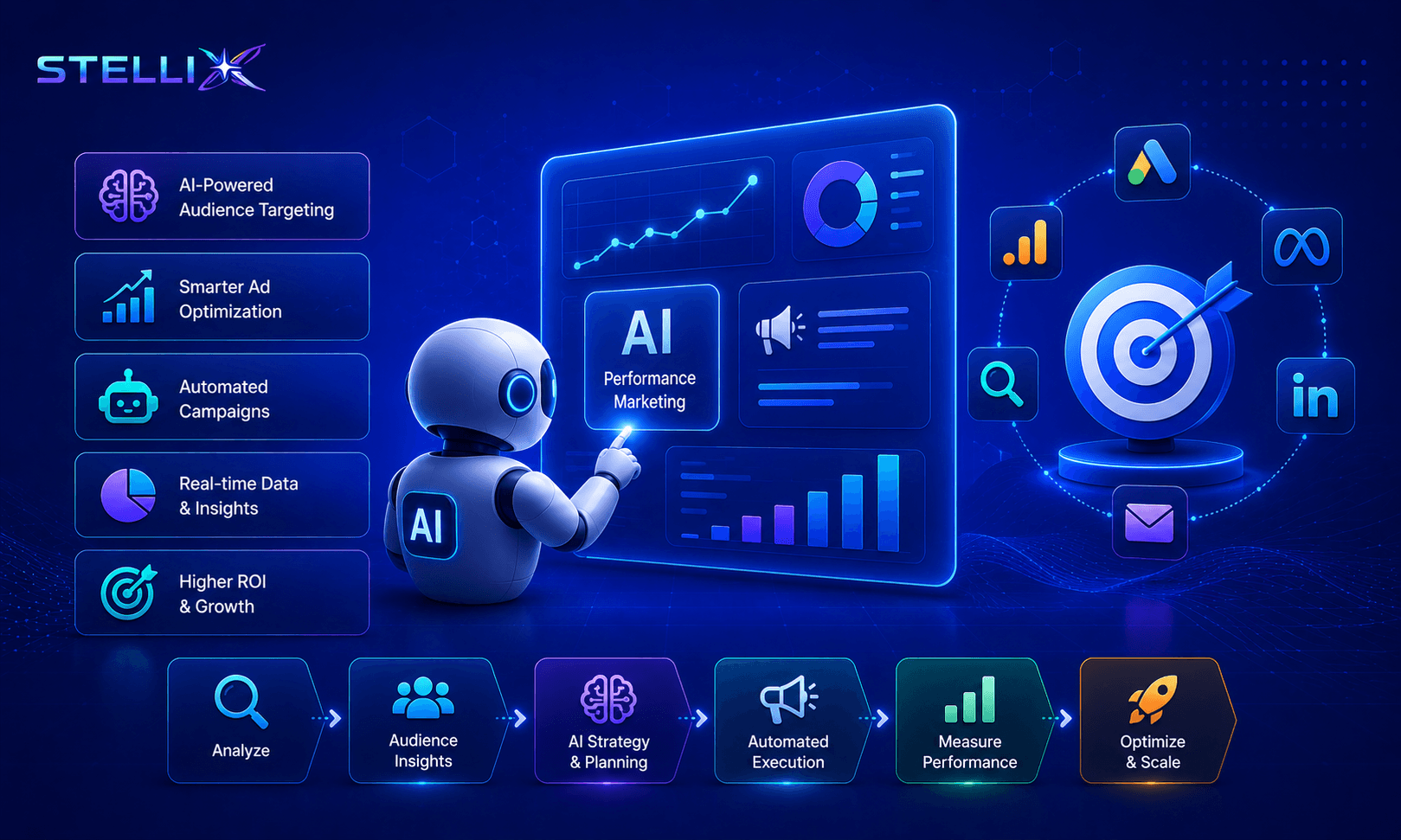
AI is changing how performance campaigns are planned, optimized, measured, and scaled. In 2026, marketers can use AI to process customer signals, identify valuable audiences, automate campaign tasks, generate creative variations, forecast outcomes, and connect advertising activity with business results.
The important shift is strategic rather than purely technical. A modern performance marketing strategy combines AI-powered automation with accurate data, strong creative thinking, clear objectives, and human oversight. AI can process patterns at remarkable speed, while marketers provide the business context and decide what the campaign should ultimately achieve.
For companies looking for the Best Digital Marketing Company in Mumbai or an SEO and Performance Marketing Agency, this creates an opportunity to connect paid media, SEO, content, analytics, and AI-powered search into a more unified growth strategy.
Table of Contents
What Is AI-Powered Performance Marketing?
Changes Shaping Performance Marketing in 2026
How to Build an AI-Powered Performance Marketing Strategy
How Marketers Can Prepare for AI-Powered Performance Marketing
Frequently Asked Questions
The Future of Performance Marketing Is AI-Powered
What Is AI-Powered Performance Marketing?
AI-powered performance marketing uses artificial intelligence and machine learning to support the planning, targeting, execution, analysis, and optimization of digital campaigns.
Performance marketing has always depended on data. AI expands what marketers can do with that data by identifying patterns across audience behavior, conversion activity, creative performance, search intent, and customer journeys.
Imagine a campaign receiving thousands of interactions every day. A human marketer can analyze the overall picture, but AI can process enormous volumes of signals and identify recurring patterns much faster. That makes AI particularly useful for tasks such as campaign optimization, audience analysis, creative experimentation, forecasting, and performance reporting.
However, AI doesn't replace strategy.
A successful campaign still needs a clear business objective, strong positioning, relevant messaging, reliable measurement, and a clear understanding of the customer. The most effective approach is therefore simple: use AI for scale and speed while using human expertise for direction and judgment.
Changes Shaping Performance Marketing in 2026
Campaign Automation Is Becoming More Strategic
Campaign platforms are increasingly capable of automating elements such as bidding, audience optimization, placements, budget allocation, and campaign delivery. This changes where marketers can spend their time. Instead of manually adjusting every campaign setting, teams can focus more closely on customer insights, creative direction, landing-page experiences, conversion strategy, and business objectives. For an SEO and Performance Marketing Agency, this also creates an opportunity to connect paid search insights with organic search behavior. Search queries, paid campaign performance, landing-page engagement, and content data can work together to reveal what customers care about and where demand exists.
Creative Testing Is Becoming Faster
AI can help marketers develop multiple versions of ad copy, headlines, visuals, video concepts, offers, and calls to action. The value isn't simply producing more creative. It is discovering which messages connect with specific audiences and customer needs. For example, a B2B software company could test messaging around productivity, operational efficiency, scalability, or cost savings. AI can help generate and organize variations, while the marketing team determines which proposition best represents the brand and its customers. This makes creative strategy an increasingly important part of a modern performance marketing strategy.
Predictive Insights Are Supporting Better Decisions
Performance marketing traditionally looks at what has already happened.
AI can help marketers identify patterns that indicate what may happen next.
A visitor who repeatedly views pricing information, downloads a product guide, and returns to a service page may demonstrate stronger purchase intent than someone who reads a single informational article.
When marketing, website, and CRM data are connected, these signals can help teams prioritize audiences and customer journeys more effectively. For B2B businesses, this can shift the conversation from lead volume toward lead quality, pipeline contribution, and revenue.
AI Visibility Is Becoming Part of Brand Discovery
Customers are also discovering businesses through AI-powered search and conversational experiences. A prospect may ask an AI tool to compare agencies, research a service, understand a technical topic, or find suitable providers. This creates another opportunity for brands to build visibility. An integrated strategy can combine traditional SEO, paid acquisition, content marketing, and AI Visibility Optimization so the brand can participate across multiple discovery journeys.
How to Build an AI-Powered Performance Marketing Strategy
Define Business Objectives
Start with the outcome you want to create.
A campaign might focus on qualified leads, sales, revenue, customer acquisition, consultation bookings, or product purchases. The objective determines which signals matter. For example, a B2B company may generate hundreds of enquiries, but qualified opportunities and closed revenue provide a much stronger indication of marketing value. A clear objective gives both marketers and AI systems a meaningful direction.
Identify High-Value Audiences
The goal isn't simply to reach the largest possible audience. It is to identify the people most likely to become valuable customers. Analyze customer behavior, purchase history, engagement, search intent, firmographic information, demographics, and conversion patterns to understand which audience segments contribute most to growth. AI can help identify patterns within these datasets and surface audience characteristics that deserve further attention.
Select Appropriate Channels
Every channel has a different role.
Google Ads can capture active search demand. LinkedIn can support B2B audience engagement. Meta can provide broad discovery and remarketing opportunities. YouTube can combine visual storytelling with reach. Your performance marketing strategy should select channels according to customer behavior, campaign objectives, buying journeys, and available data. The right channel mix is the one that connects your audience with the right message at the right stage.
Improve Data Quality
AI-powered optimization depends heavily on the quality of its inputs.
Review analytics implementation, conversion tracking, CRM integration, customer data, campaign attribution, and revenue information. For B2B organizations, connecting advertising platforms with CRM outcomes can provide a clearer view of which campaigns contribute to meaningful sales opportunities. Better data creates better decision-making.
Automate Repetitive Tasks
Automation is particularly valuable for repetitive activities.
Campaign monitoring, reporting, bid management, audience analysis, performance alerts, and creative variation can all benefit from automation. The time saved can then be invested in higher-value work such as strategy, customer research, creative development, content planning, and optimization. The objective isn't automation for its own sake. It is creating more time for meaningful marketing decisions.
Test AI-Powered Creative
AI can accelerate the creative testing process. Develop different versions of messaging around customer pain points, benefits, use cases, industries, offers, and stages of the buying journey. Then measure how those variations perform against the campaign objective.
Human marketers should continue to guide the brand voice, positioning, emotional direction, and quality of the final creative.
AI provides speed.
People provide perspective.
Measure Results
Performance marketing becomes more valuable when measurement connects campaigns with business outcomes. Metrics such as CTR, conversion rate, CAC, ROAS, qualified leads, pipeline value, customer lifetime value, and revenue can provide different perspectives on performance. The right metrics depend on the business model.
A campaign designed to generate qualified B2B opportunities should be evaluated differently from an e-commerce campaign designed to generate immediate purchases.
Measurement should reflect the actual objective.
Continuously Optimize
AI-powered marketing is an ongoing process.
Review audience behavior, creative performance, landing-page engagement, conversion activity, and revenue contribution regularly. Use those insights to refine campaigns, messaging, audiences, offers, budgets, and content.
A strong performance marketing strategy becomes increasingly useful as the team learns from every campaign cycle.
How Marketers Can Prepare for AI-Powered Performance Marketing
The priority is a strong data foundation.
Make sure analytics, conversion tracking, CRM information, campaign platforms, and revenue data are connected wherever appropriate. Next, identify repetitive processes that can benefit from automation. Reporting, campaign monitoring, audience analysis, and creative variation are practical areas to explore. Creative strategy should receive equal attention.
AI can produce variations quickly, but customers still respond to relevance, clarity, credibility, and strong positioning. Give AI clear brand guidelines and customer context, then use human judgment to shape the final message.
Measurement should also move closer to commercial outcomes. Instead of focusing solely on clicks and impressions, connect campaign performance with qualified leads, opportunities, revenue, and customer value. Finally, maintain human oversight.
AI can identify patterns and execute tasks at impressive speed. Human marketers provide context, creativity, strategic judgment, brand understanding, and commercial direction. That combination is the real opportunity for 2026. For businesses evaluating the Best Digital Marketing Company in Mumbai, an integrated partner can bring paid media, SEO, content, analytics, website optimization, and AI-focused search strategy together.
Frequently Asked Questions
What is AI-powered performance marketing?
AI-powered performance marketing uses artificial intelligence and machine learning to support campaign planning, audience analysis, targeting, bidding, creative optimization, forecasting, personalization, and performance measurement.
How is AI changing performance marketing in 2026?
AI is making campaign management more automated and data-driven. Marketers can use AI to analyze customer signals, identify audience patterns, accelerate creative testing, automate repetitive tasks, and optimize campaigns toward meaningful business outcomes.
How does AI improve paid advertising?
AI can analyze large volumes of campaign and audience signals to support bidding, targeting, budget allocation, creative testing, and campaign delivery.
Can AI optimize advertising campaigns?
Yes. AI and machine learning can support optimization across bidding, audience signals, placements, creative variations, and campaign delivery when appropriate conversion and business data are available.
How does AI improve ad targeting?
AI can analyze behavioral, contextual, demographic, firmographic, and conversion signals to identify patterns associated with valuable customer actions.
Will AI replace performance marketers?
AI can automate many repetitive campaign tasks, while human expertise remains essential for strategy, positioning, creativity, customer understanding, brand direction, and business decisions.
What are the benefits of AI-powered performance marketing?
AI-powered performance marketing can help businesses accelerate analysis, automate repetitive work, improve audience insights, expand creative testing, strengthen measurement, and create more efficient optimization workflows.
The Future of Performance Marketing Is AI-Powered
Performance marketing in 2026 is becoming more intelligent, automated, predictive, and connected. The strongest performance marketing strategy isn't simply one that uses the most AI tools. It combines AI with excellent data, relevant audiences, compelling creative, reliable measurement, and strong human judgment.
AI can process information at scale.
Automation can handle repetitive tasks.
Predictive analysis can uncover valuable patterns.
Human marketers provide the strategy and direction.
For businesses working with an SEO and Performance Marketing Agency, this creates an opportunity to connect paid acquisition with SEO, content marketing, website experience, analytics, and AI-powered search.
Ready to turn AI-powered marketing into measurable growth?
Stellix combines performance marketing, SEO, content, paid media, website strategy, and AI-focused search solutions to help ambitious businesses build smarter acquisition strategies. Book a Strategy Call with Stellix and explore how AI can strengthen your next performance marketing campaign.
Key Takeaways
AI is making performance marketing more automated, predictive, and data-driven.
Strong business objectives and conversion signals give AI better direction.
Audience quality matters more than simply maximizing reach.
AI can accelerate creative testing while human marketers shape positioning and brand voice.
Accurate first-party data and reliable measurement are essential for AI-assisted optimization.
Performance marketing increasingly connects with SEO, content, AI visibility, and customer experience.
Human oversight remains central to strategy, creativity, and business decision-making.
About Stellix
Stellix is a performance-driven digital marketing agency helping ambitious brands grow through SEO, paid media, content marketing, website development, performance marketing, and AI-focused search strategies. By combining data-backed insights, technical expertise, and creative thinking, Stellix develops customized marketing solutions designed to increase visibility, attract high-intent audiences, and deliver measurable business results. Whether you're expanding locally, growing nationally, or building a global digital presence, Stellix creates strategies designed for sustainable growth.