Introduction
Imagine investing thousands in marketing every month but not knowing which campaigns are actually driving revenue. That's the reality for many businesses that focus on surface-level metrics like clicks, impressions, or social media likes instead of the numbers that truly matter.
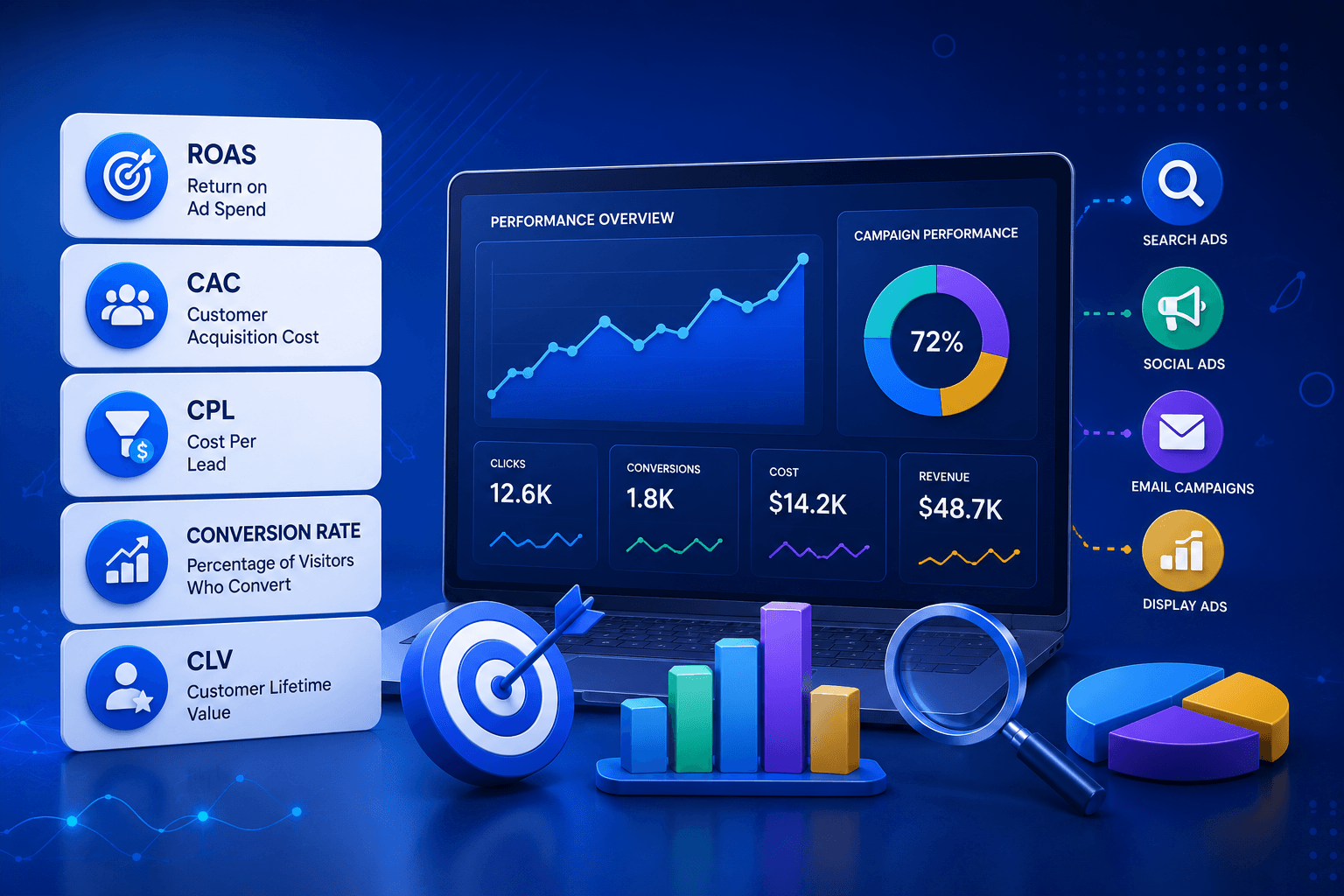
Performance marketing isn't just about generating traffic; it's about achieving measurable business results. Whether your goal is to generate qualified leads, increase online sales, or improve your return on investment, tracking the right Performance Marketing KPIs (Key Performance Indicators) helps you understand what's working and where you can improve. Instead of relying on guesswork, successful businesses use data to make smarter decisions, optimize their budgets, and scale campaigns with confidence.
In this guide, we'll explore the performance marketing KPIs every business should track in 2026, explain why they matter, and show you how they can help you build more profitable marketing campaigns.
Key Takeaways
Performance marketing KPIs measure real business growth, not just campaign activity.
Revenue-focused metrics are more valuable than vanity metrics.
The right KPIs help you optimize marketing budgets and improve decision-making.
Reviewing performance regularly leads to smarter long-term growth.
Combining SEO and performance marketing creates a stronger digital strategy.
What Are Performance Marketing KPIs?
Performance Marketing KPIs are measurable metrics that show how effectively your marketing campaigns contribute to your business goals. Unlike general marketing statistics, these indicators focus on outcomes that matter: qualified leads, customer acquisition, revenue, and profitability.
Think of KPIs as the dashboard in your car. Your speed tells you one thing, but fuel level, engine health, and navigation work together to help you reach your destination efficiently. Marketing works the same way. Looking at a single metric rarely tells the whole story. For example, a campaign may generate thousands of website visits, but if very few visitors become customers, the campaign isn't delivering meaningful business value. That's why successful marketers track multiple KPIs instead of relying on one number.
Businesses investing in Performance Marketing Services in Mumbai often build reporting dashboards around carefully selected KPIs that align with specific business objectives. Every metric should answer an important question: Is this helping the business grow?
Why KPIs Matter More Than Vanity Metrics
It's exciting to see a campaign receive thousands of impressions or hundreds of likes. While these metrics can indicate growing brand visibility, they don't always tell you whether your marketing is generating revenue.
Now imagine two campaigns.
The first reaches one million people but generates only a handful of enquiries.
The second reaches a much smaller audience but consistently delivers high-quality leads that convert into paying customers.
Which campaign is more successful?
For most businesses, the answer is obvious. The second campaign creates measurable business value, even with fewer impressions. That's why experienced marketers focus on KPIs like ROAS, Conversion Rate, Customer Acquisition Cost (CAC), and Customer Lifetime Value (CLV) rather than celebrating numbers that look impressive but don't contribute to business growth.
Whether you're working with the Best Digital Marketing Company in Mumbai, investing in Performance Marketing Services in Mumbai, or strengthening your online presence through B2B SEO Services Mumbai, tracking meaningful KPIs helps you make informed decisions, improve campaign performance, and maximize every marketing investment.
The 7 Most Important Performance Marketing KPIs
Every successful marketing campaign tells a story, and each KPI reveals a different part of it. Looking at one metric in isolation can lead to misleading conclusions. However, when these KPIs are analyzed together, they provide a clear understanding of how efficiently your marketing budget is generating leads, customers, and revenue.
1. Return on Ad Spend (ROAS)
If you're investing in paid advertising, Return on Ad Spend (ROAS) is one of the first metrics you should monitor. It measures how much revenue your ads generate for every rupee you spend. For example, if your business spends ₹1,00,000 on Google Ads and earns ₹5,00,000 in sales, your ROAS is 5:1. This means every rupee invested generated five rupees in revenue.
A consistently healthy ROAS indicates that your campaigns are performing well and may be ready to scale. On the other hand, a declining ROAS could signal the need to refine your targeting, messaging, or landing pages.
2. Customer Acquisition Cost (CAC)
Winning new customers is essential, but knowing how much it costs to acquire them is equally important. Customer Acquisition Cost (CAC) measures the total marketing and advertising spend required to gain one new customer. A lower CAC generally improves profitability, but context matters. If customers stay with your business for years and continue making purchases, a slightly higher CAC can still deliver excellent long-term returns. Instead of trying to reduce CAC at any cost, focus on balancing acquisition costs with the value each customer brings over time.
3. Cost Per Lead (CPL)
For businesses that rely on enquiries rather than immediate online purchases, Cost Per Lead (CPL) is one of the most practical performance metrics. CPL shows how much you're spending to generate each qualified lead. However, don't fall into the trap of chasing the lowest CPL. A campaign producing fewer but highly qualified leads often delivers better business results than one generating hundreds of low-quality enquiries. Quality always outperforms quantity.
4. Conversion Rate
Driving traffic to your website is only half the battle. What truly matters is how many visitors take action. Your Conversion Rate measures the percentage of visitors who complete a desired action, whether that's filling out a contact form, booking a consultation, downloading a resource, or making a purchase. Even small improvements can have a significant impact. Imagine increasing your conversion rate from 2% to 4% without spending more on advertising; you've effectively doubled your leads using the same traffic. That's why optimizing landing pages, improving page speed, simplifying forms, and writing stronger calls to action should always be part of your marketing strategy.
5. Customer Lifetime Value (CLV)
The most successful businesses don't just think about today's sale; they think about the lifetime value of every customer. Customer Lifetime Value (CLV) estimates the total revenue a customer is likely to generate throughout their relationship with your business. When CLV is high, businesses can invest more confidently in acquiring new customers because they know those customers will continue generating value over time. Instead of asking, "How much did this campaign cost?", ask, "How much long-term revenue will these customers generate?" That shift in thinking often leads to smarter marketing decisions.
6. Click-Through Rate (CTR)
Your Click-Through Rate (CTR) reveals how compelling your marketing messages are.
Whether it's a Google Search result, Meta ad, email campaign, or LinkedIn advertisement, CTR measures how often people click after seeing your content. A strong CTR usually means your headline, meta title, ad copy, or creative resonates with your audience.
If your CTR is low, experiment with:
Writing more benefit-driven headlines.
Creating stronger calls to action.
Improving ad creatives.
Better matching user search intent.
Higher CTR often leads to increased traffic and stronger campaign performance.
7. Return on Investment (ROI)
While ROAS focuses on advertising revenue, Return on Investment (ROI) provides the bigger picture. ROI considers every marketing cost, including advertising, creative production, software tools, and campaign management, to determine whether your marketing efforts are genuinely profitable.
Ultimately, ROI helps answer the question every business owner cares about:
"Is our marketing helping the business grow?"
How to Choose the Right KPIs
Not every business should measure success in the same way. A startup launching a new product may prioritize reach, CPL, and Conversion Rate to build awareness and generate early leads.
An e-commerce business is more likely to focus on ROAS, ROI, and CLV to maximize profitability. Meanwhile, B2B strategies often pay closer attention to qualified lead generation, CAC, and customer lifetime value because their sales cycles are longer and involve multiple decision-makers. Rather than tracking every available metric, identify the KPIs that align with your current business objectives. Reviewing a focused set of meaningful metrics makes decision-making simpler and more effective.
Measuring and Optimizing Marketing Performance
Tracking KPIs is only the first step. Real growth happens when you use those insights to improve future campaigns. Start by establishing realistic benchmarks using your own historical data instead of relying solely on industry averages. Review campaign performance regularly and look for trends rather than one-off results.
If your CTR is high but conversions are low, your landing page may need improvement.
If your CAC is increasing while CLV remains strong, you may still have room to scale profitably.
Small improvements made consistently, whether through A/B testing, audience refinement, or better content, often produce the biggest long-term gains. The strongest marketing strategies combine SEO, paid advertising, content marketing, and conversion rate optimization to create sustainable growth instead of relying on a single channel.
Frequently Asked Questions
What are performance marketing KPIs?
Performance marketing KPIs are measurable metrics that show how effectively your marketing campaigns contribute to business goals such as generating leads, acquiring customers, increasing revenue, and improving profitability.
Which KPI is the most important?
The answer depends on your objectives. Businesses commonly prioritize ROAS, ROI, Conversion Rate, CAC, and CLV because they directly measure marketing effectiveness and business growth.
How often should I review my KPIs?
Monitor campaigns weekly and conduct a detailed monthly review to identify trends, optimize budgets, and improve campaign performance.
What's the difference between ROAS and ROI?
ROAS measures revenue generated from advertising spend alone, while ROI evaluates the overall profitability of your marketing after accounting for all related costs.
Why is Customer Lifetime Value important?
CLV helps businesses understand the long-term value of every customer, making it easier to determine how much they can confidently invest in customer acquisition.
How can I improve my conversion rate?
Focus on faster-loading pages, compelling calls to action, user-friendly landing pages, and clear messaging that aligns with user intent.
Which tools help track marketing KPIs?
Popular tools include Google Analytics 4, Google Ads, Meta Ads Manager, Looker Studio, and CRM platforms that consolidate marketing and sales data.
Can small businesses benefit from performance marketing KPIs?
Absolutely. Even small businesses can use KPIs to improve marketing efficiency, optimize budgets, and make more informed decisions.
Conclusion
Successful marketing isn't about tracking every available metric; it's about measuring the ones that move your business forward. By focusing on ROAS, CAC, CPL, Conversion Rate, CLV, CTR, and ROI, you'll gain a clearer understanding of what's working, where your budget is delivering results, and how to optimize future campaigns with confidence. Whether you're running paid advertising, investing in SEO, or building a long-term digital marketing strategy, these KPIs provide the insights needed to make smarter decisions and achieve sustainable business growth.
About Stellix
Stellix is a performance-driven digital marketing agency that helps businesses grow through strategic SEO, performance marketing, paid advertising, website development, content marketing, and AI-ready search optimization. We combine data, creativity, and technology to build marketing strategies that don't just increase traffic; they generate qualified leads, improve conversions, and drive measurable business growth. From startups and growing businesses to established brands, our team creates customized digital marketing solutions tailored to your goals. Whether you want to improve your search rankings, maximize your advertising ROI, or strengthen your online presence, Stellix focuses on delivering sustainable, long-term results backed by data and continuous optimization. Ready to grow smarter? Book a strategy call with Stellix and transform your digital marketing into a reliable engine for business growth.
Related Articles: