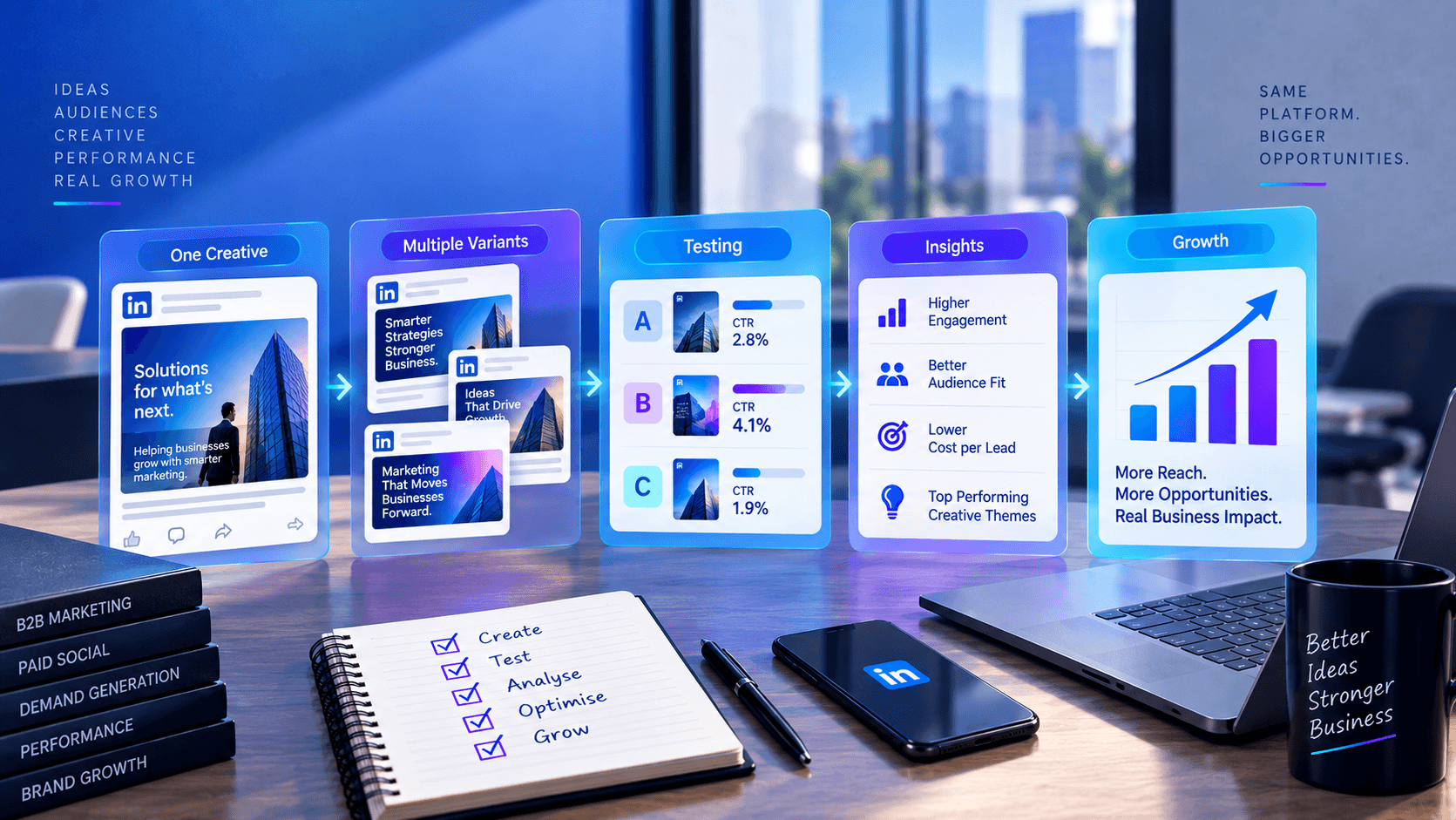
LinkedIn Ads is becoming less about building one polished ad and more about creating, testing, and learning from multiple versions. That is the important takeaway from LinkedIn’s latest advertising changes.
In 2026, LinkedIn introduced a new set of creative tools inside Campaign Manager, including Brand Kit, AI-assisted ad drafting, AI ad variants, flexible ad creation, and advertising personalization. The platform says these tools are designed to help marketers create more variations while keeping campaigns aligned with brand guidelines. For B2B brands, that matters because the challenge is rarely having one campaign idea. The bigger challenge is turning that idea into enough relevant creative to learn what resonates with different audiences.
LinkedIn is now making that process faster. The question for marketers is what to do with that extra creative capacity.
What Has LinkedIn Changed?
LinkedIn’s new creative tools are designed to support the journey from the first ad concept to multiple campaign variations.
Brand Kit lets advertisers define brand elements such as colors, fonts, logos, tone, and key messages.
AI-assisted drafting can create an initial ad based on a URL, campaign goal, and other business information.
AI ad variants can generate additional creative versions from an existing headline or introduction.
Flexible ad creation lets marketers provide multiple images, videos, and copy variations so LinkedIn can test combinations within campaigns.
The common thread is simple: more creative options with less manual production time. That changes how B2B teams can approach campaign testing. Instead of spending most of the campaign cycle preparing one perfect ad, teams can create a stronger starting set, launch, learn, and refine. And yes, that means the humble ad headline now has a little more company.
Why This Matters for B2B Advertising
B2B buying journeys are rarely built around one message.
A CFO may care about business impact.
A marketing leader may care about pipeline.
A technical buyer may care about integration.
A founder may care about speed and scalability.
The product has not changed.
The audience perspective has. That makes creative variation especially useful for B2B campaigns.
LinkedIn says its internal analysis found that advertisers running five or more ad variants achieved more than 20% higher CTR compared with advertisers running a single ad. This is LinkedIn’s own analysis, so marketers should treat the figure as platform-reported evidence rather than a universal performance benchmark. The larger lesson is more useful than the number itself:
Creative testing gives marketers more information about what connects with an audience.
From One Ad to a Creative System
For years, many B2B campaigns followed a familiar pattern.
Create a headline.
Add an image.
Write supporting copy.
Launch.
Wait.
Review.
Create the next campaign.
LinkedIn’s new tools encourage a different rhythm.
A marketer can start with one core proposition and develop several creative directions around it. For example, a B2B software company promoting a lead-generation platform could build messaging around pipeline growth, sales productivity, reporting, integration, or customer experience. Each version speaks to a different business priority.
The campaign then produces more useful signals about which messages attract attention. This is where creative testing becomes part of strategy rather than simply a production task.
Brand Consistency Becomes More Important
More creative can create more variety. It can also create more opportunities for a brand to look inconsistent. LinkedIn’s Brand Kit is designed to address that issue by allowing marketers to define brand elements once and use them as a foundation for new creative.
For established B2B brands, this is particularly useful.
Your logo should look familiar.
Your visual language should feel connected.
Your messaging should sound like the same company across different campaigns. That consistency matters because B2B buyers often see a brand several times before they actively engage.
One ad introduces the company.
Another explains the problem.
A third shares proof.
A fourth presents the next step.
The creative can change while the brand remains recognizable.
AI Can Speed Up Creative, But Strategy Still Leads
The word “AI” appears prominently in LinkedIn’s latest creative tools. But the most useful way to view these features is as production support. AI can help generate variations. It cannot replace the need for a strong campaign idea. If the positioning is vague, generating 20 versions of it simply gives you 20 variations of a vague message.
Start with the audience.
Understand the problem.
Define the value.
Choose the proof.
Then use creative tools to expand the message into different formats and angles. That keeps the human strategy in charge while technology handles more of the repetitive production work.
What B2B Brands Should Test
The most useful testing approach is not changing everything at once. Keep the core offer consistent and vary one meaningful element.
A campaign could test a direct business outcome against a problem-led message.
Another could compare a customer story with a product-focused creative.
A third could test a short video against a static image. The aim is to learn which combination of audience, message, format, and offer creates stronger engagement. That learning can then influence the next campaign. Over time, paid social becomes a source of audience insight rather than simply a distribution channel.
LinkedIn Ads Are Moving Further Into Full-Funnel Marketing
LinkedIn has also continued expanding its measurement and event advertising capabilities in 2026. Its new measurement tools include Conversion Lift Testing and refreshed Brand Lift Testing, giving marketers additional ways to examine campaign impact beyond basic attribution.
The platform has also introduced new event features covering promotion, lead capture, analytics, and post-event content. Taken together, these changes point toward a broader direction for LinkedIn advertising.
The platform is becoming more useful across the buyer journey.
A brand can build awareness.
It can promote thought leadership.
It can generate leads.
It can support events.
It can test creative.
It can measure business impact.
For B2B marketers, that creates a stronger connection between brand activity and demand generation.
What the September 2026 Targeting Change Means
There is another technical update B2B advertisers should know about. LinkedIn says that from August 31, 2026, it will stop supporting Legacy Geo for Ads Targeting. Campaigns using the old geographic targeting approach need to use Bing-geo instead. For advertisers, this is mainly a campaign-management consideration.
Teams managing location-based B2B campaigns should review their targeting setup and make sure current geographic targeting methods are being used. This matters particularly for companies running campaigns across cities, regions, or international markets.
A campaign aimed at Mumbai, for example, should have its location targeting reviewed as part of regular campaign maintenance.
What This Means for B2B Marketing Teams
The practical shift is bigger than a collection of new buttons inside Campaign Manager. LinkedIn is giving advertisers more tools to create and test creative at scale. That means campaign planning should also evolve.
Instead of asking, “What is our ad?”
Ask:
“What is our core message, and how many useful ways can we communicate it to the people we want to reach?”
That small change can improve the way teams think about paid social. It moves creative from a one-time asset toward an ongoing learning system. For companies investing in B2B Digital Marketing Services, this creates a natural opportunity to connect LinkedIn Ads with SEO, content, website experience, analytics, and other demand-generation channels.
LinkedIn Ads and Performance Marketing
LinkedIn should not operate as a standalone campaign island. A prospect may first encounter a brand through an organic LinkedIn post.
Later, they see a sponsored ad.
They search the company on Google.
They read a blog.
They return through another campaign.
Eventually, they visit a service page and submit an enquiry. That is why Social Media Marketing Agency Services can play a broader role in connecting paid social with landing pages, analytics, conversion tracking, retargeting, and the wider customer journey. The strongest campaign is not necessarily the one with the flashiest creative. It is the one that fits naturally into the journey that happens before and after the ad.
What B2B Brands Should Do Next
The latest LinkedIn Ads update gives B2B marketers more room to experiment. The opportunity is to use that flexibility thoughtfully.
Build a clear campaign proposition first.
Create several meaningful creative directions.
Keep brand elements consistent.
Test audience-specific messages.
Review CTR alongside deeper campaign signals.
Connect advertising data with website engagement and leads. Then use what you learn to improve the next campaign. That creates a simple cycle:
Create → Test → Learn → Refine → Scale
The tools may change, but that marketing discipline remains useful.
Frequently Asked Questions
What is LinkedIn’s latest Ads update?
LinkedIn introduced new creative capabilities in Campaign Manager, including Brand Kit, AI-assisted ad drafting, AI ad variants, flexible ad creation, and personalization features designed to help advertisers create and test more creative.
What does the update mean for B2B brands?
It gives B2B marketers more ways to create creative variations, test different messages, maintain brand consistency, and learn which approaches connect with their audiences.
Does LinkedIn’s AI create the entire campaign?
The new tools can assist with creative development, but campaign strategy, audience understanding, positioning, offer selection, and final review still require marketer input.
Should B2B brands create multiple LinkedIn ads?
Testing multiple meaningful variations can provide more performance signals than relying on one creative. LinkedIn reports stronger CTR among advertisers using five or more ad variants in its internal analysis.
What happened to LinkedIn’s legacy geographic targeting?
LinkedIn says Legacy Geo for Ads Targeting stopped being supported on August 31, 2026, with advertisers and partners required to use Bing-geo instead.
How should businesses measure LinkedIn Ads?
Look beyond clicks alone. Consider CTR, engagement, leads, conversion activity, brand impact, website behavior, and where appropriate, incrementality testing and lift measurement.
Key Takeaways
LinkedIn’s latest Ads changes put more emphasis on creative variety, testing, personalization, and measurement.
The biggest opportunity for B2B brands is not simply creating more ads.
It is creating more useful variations that help teams learn what resonates with specific audiences.
Brand Kit can help maintain consistency while creative tools can speed up production.
LinkedIn’s measurement updates also give marketers more ways to connect advertising activity with broader business impact.
For B2B teams, LinkedIn Ads is becoming increasingly connected to the full customer journey rather than functioning only as a lead-generation channel.
Conclusion
LinkedIn’s latest advertising updates point toward a simple change in B2B marketing: creative testing is becoming easier to scale. That gives marketers more room to test ideas, understand audiences, and build campaigns around what the data reveals. The opportunity is not to let AI produce endless variations for the sake of volume. It is to combine strong positioning, useful creative, audience insight, and smart measurement.
For brands investing in B2B Digital Marketing Services, that means LinkedIn Ads can become one part of a connected growth strategy spanning paid media, content, SEO, social, analytics, and website conversion. If you want to turn LinkedIn advertising insights into a broader B2B growth strategy,
Stellix can help connect your paid campaigns with the content, website, analytics, and conversion journey behind them. Ready to make your LinkedIn Ads strategy work harder? Let’s talk.