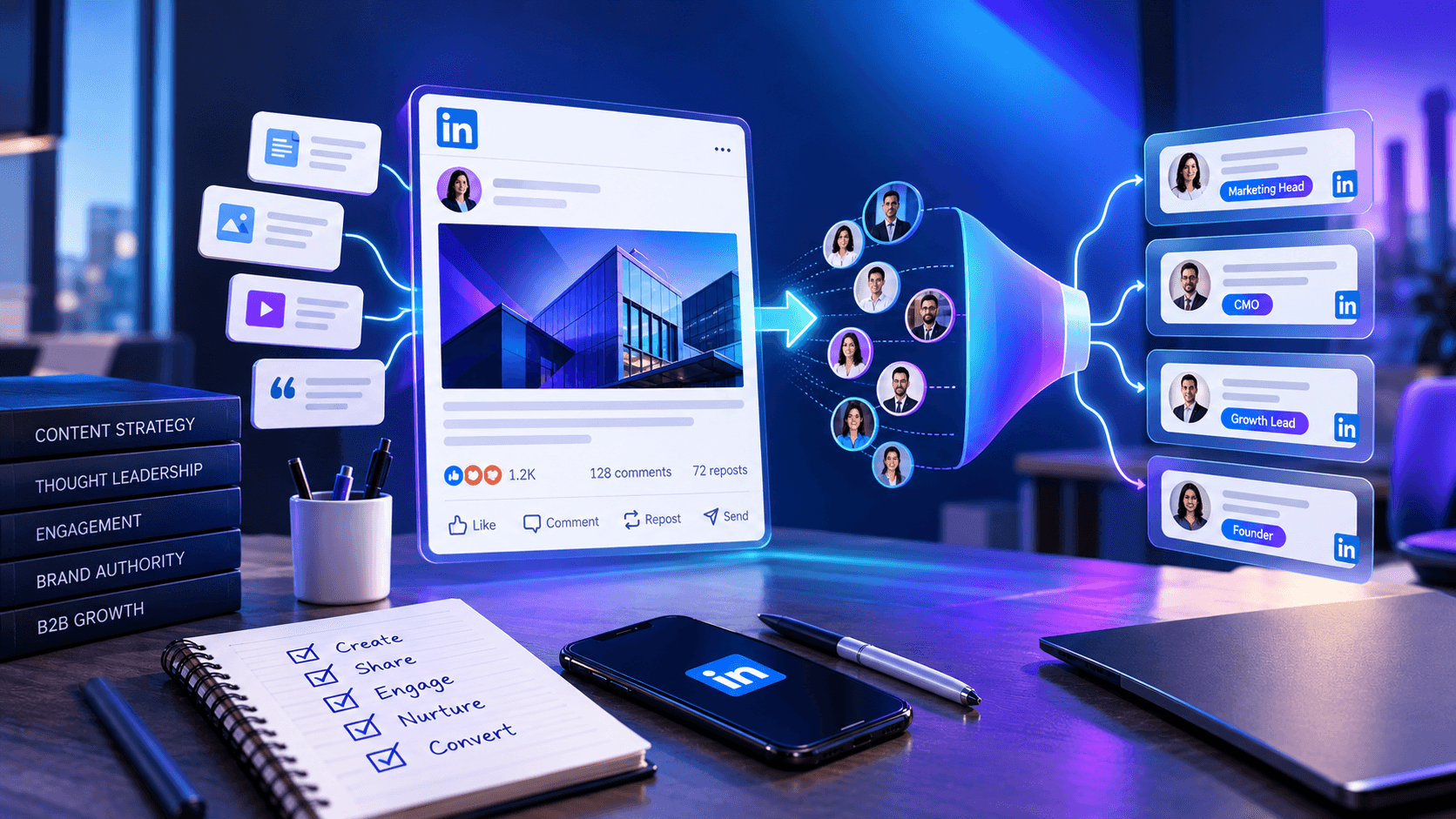
A LinkedIn post gets 20,000 impressions.
Another gets 2,000.
The second generates three conversations with potential buyers. The first mostly collects reactions.
Which one actually did more for the business?
That is the part of LinkedIn lead generation worth paying attention to.
Reach creates visibility. Relevance creates demand.
For B2B brands, LinkedIn can be much more than a place for company announcements, recruitment updates, and polished posts that somehow manage to say very little.
Used well, it can help a brand demonstrate expertise, stay visible throughout a longer buying journey, and create conversations before someone ever fills out a form.
The difference starts with one simple question:
What should our audience understand, question, or explore after seeing this?
Not:
“What should we post today?”
That shift is where content starts becoming a demand-generation tool.
LinkedIn Leads Don't Start With a Lead
One of the easiest mistakes in B2B marketing is assuming demand begins when someone submits a form.
Usually, it starts much earlier.
Someone might see a LinkedIn post today.
A week later, they read an article from the same company.
Then they notice a founder sharing a useful perspective. Later, they visit the website, compare services, and eventually decide it is worth starting a conversation.
The journey looks more like:
Content discovery → Topic interest → Brand recognition → Website research → Solution evaluation → Conversation
It is less dramatic than “one post generated 47 leads overnight.”
It is also much closer to how B2B buying works.
The job of content is not to force every reader into an immediate conversion. It is to create enough useful interactions that the right audience keeps moving closer to the brand.
Start With Audience Questions, Not the Content Calendar
The fastest way to make LinkedIn content repetitive is to begin with frequency.
“Three posts this week.”
“Five posts next week.”
“Something for Thursday.”
That is scheduling.
It is not strategy.
A stronger approach begins with the audience.
Ask:
What decisions are potential customers making?
What questions appear before they contact a provider?
Which problems keep coming back?
What industry developments affect their priorities?
What would they actually discuss with a colleague?
Those questions produce much stronger content ideas than simply looking for another topic to fill a publishing slot.
For example, “Why High-Impression Pages Still Get Few Clicks” speaks to a recognisable business problem.
“5 SEO Tips for Better Rankings” could have been written by approximately half the internet.
Strong B2B content starts with a problem people already understand.
Create Content That Builds Demand
Not every LinkedIn post should have the same job.
Trying to make one post educate, entertain, demonstrate expertise, generate leads, and close a sale at the same time is a reliable way to make the message do none of those things particularly well.
At the beginning of the journey, content needs to earn attention.
Industry observations, relevant news, original insights, research, practical lessons and expert commentary can give the right person a reason to stop scrolling.
Once someone recognises the brand, deeper content can demonstrate expertise.
That might be:
LinkedIn articles
Strategy breakdowns
Case studies
Research
Practical frameworks
Data-led commentary
Expert analysis
At that point, the question changes.
It is no longer:
“Who are these people?”
It becomes:
“Do they actually understand this problem?”
That is where expertise needs to become visible. And when someone is actively evaluating a solution, the next step should become clearer. That could be a service page, case study, consultation, audit, or strategy call.
The CTA should match the reader's intent.
Someone discovering your brand for the first time may want another useful article.
Someone already comparing providers may be ready to talk.
The same CTA rarely works equally well for both.
Build a Content Journey, Not a Collection of Posts
Good B2B content should connect.
A LinkedIn post can introduce an idea.
That idea can become a longer article.
The article can support search visibility.
Search traffic can lead to a service page.
The service page can create a conversion opportunity.
The journey becomes:
LinkedIn post → Article → Search visibility → Website visit → Service interest → Sales conversation
This is where Social Media Marketing Agency Services need to go beyond publishing.
The same idea can also become a carousel, newsletter, video, founder post, or paid campaign.
The message stays consistent.
The format changes.
That gives one strong idea several opportunities to reach and educate the right audience. It also saves marketers from inventing an entirely new worldview every Monday morning.
Your LinkedIn Profile and Website Are Part of the Funnel
A good post creates curiosity.
The next click may be to the author's profile or company page. That means the profile is not simply a branding exercise. It is part of the funnel.
A visitor should quickly understand:
Who do you help?
What do you do?
Why does your expertise matter?
Where should I go next?
If the post is sharp but the profile is vague, the journey loses momentum.
The same applies to the website.
When someone arrives from LinkedIn, the landing page should make the next step feel obvious.
Content creates curiosity.
The profile and website should answer it.
Your landing page has a surprisingly small window to convince someone they are in the right place. No pressure.
Use Paid Distribution to Amplify Good Content
LinkedIn Ads can extend the reach of content and help brands distribute it to selected professional audiences. But paid promotion should support good content, not replace it.
If the message is unclear, increasing the budget simply helps more people see the unclear message.
Very efficient.
Not particularly useful.
A stronger approach connects:
Organic content + Paid distribution + Audience insight + Landing-page relevance + Measurement
This is where Performance Marketing Agency in Mumbai support can become valuable for B2B brands that want social activity connected with wider performance goals.
Paid media can create more exposure.
The content still needs to give people a reason to care.
Measure the Journey, Not Just the Post
Impressions and reactions are useful signals.
They are not the entire story.
A stronger LinkedIn lead generation strategy also looks at:
Which topics attract the right audience
Which posts generate profile visits
Which content sends people to the website
Which themes attract decision-makers
Which articles generate repeat engagement
Which topics lead people toward service pages
Which content contributes to meaningful conversations
If several posts around the same subject repeatedly attract relevant people, that tells you something.
If a particular topic consistently sends people to the website, that tells you something too.
The report should not simply sit in a monthly presentation. It should influence what you create next.
At Stellix, We Look at LinkedIn Demand Slightly Differently
At Stellix, the goal of LinkedIn content is not simply to “generate leads.”
That phrase can be too narrow.
The bigger opportunity is to create the conditions that make a valuable sales conversation more likely.
Think:
Attract → Educate → Build Trust → Engage → Convert → Nurture
Attract: Use relevant ideas to reach the right audience.
Educate: Explain the problem clearly.
Build Trust: Show expertise through useful analysis, proof, and consistency.
Engage: Create conversations rather than simply collecting reactions.
Convert: Offer a relevant next step when intent increases.
Nurture: Stay useful to people who are interested but not ready to buy yet.
That last part matters.
Not every good prospect is ready today.
Good B2B content gives them a reason to remember you when they are.
The Practical Takeaway
If LinkedIn is part of your B2B growth strategy, start by changing the question.
Instead of asking:
“What should we post this week?”
ask:
“What does our audience need to understand next?”
Then connect that answer to the wider journey.
Create content around real business questions.
Give each piece a clear role.
Use comments as audience intelligence.
Connect LinkedIn with your website, SEO, and paid media.
Measure what happens beyond impressions. That is how Digital Marketing Consulting Services can move from content production toward a more connected demand-generation strategy.
The real value of B2B content is not simply being seen. It is becoming the company people remember when they are ready to solve the problem you understand. And that is where LinkedIn lead generation becomes less about posting and more about building demand intelligently.
Frequently Asked Questions
How does LinkedIn generate B2B leads?
LinkedIn can support B2B lead generation by helping brands build visibility, demonstrate expertise, engage relevant audiences and guide interested prospects toward deeper content, website pages or conversations.
Does every LinkedIn post need to generate a lead?
No. Different posts can have different purposes. Some build awareness, some demonstrate expertise, while others support consideration or create a direct next step.
What type of content works for B2B LinkedIn marketing?
Industry insights, practical expertise, research, customer problems, brand perspectives, case studies, and useful analysis can all contribute to a stronger B2B content strategy.
Should every LinkedIn post include a website link?
No. A link works best when it gives the reader a logical next step. For some posts, creating discussion or profile interest may be more appropriate.
What should businesses measure for LinkedIn lead generation?
Look beyond impressions and reactions. Profile visits, website traffic, relevant engagement, service-page visits, repeat interactions, and meaningful business conversations can provide a clearer view of content performance.
Can paid LinkedIn campaigns replace organic content?
Paid campaigns can extend distribution, but they do not replace strong positioning and useful content. Paid media works best when the audience, message, content, and landing-page experience are aligned.
Ready to Turn LinkedIn Content Into Demand?
Your LinkedIn presence should do more than keep the content calendar busy. It should create recognition, demonstrate expertise, and give potential buyers a clear reason to continue the conversation. If you want to connect social media marketing consulting services, content strategy, paid distribution, and performance marketing into one connected B2B growth approach, talk to Stellix.
Related Stellix Reading
For more search, paid media, and digital marketing insights, explore the Stellix Blog.