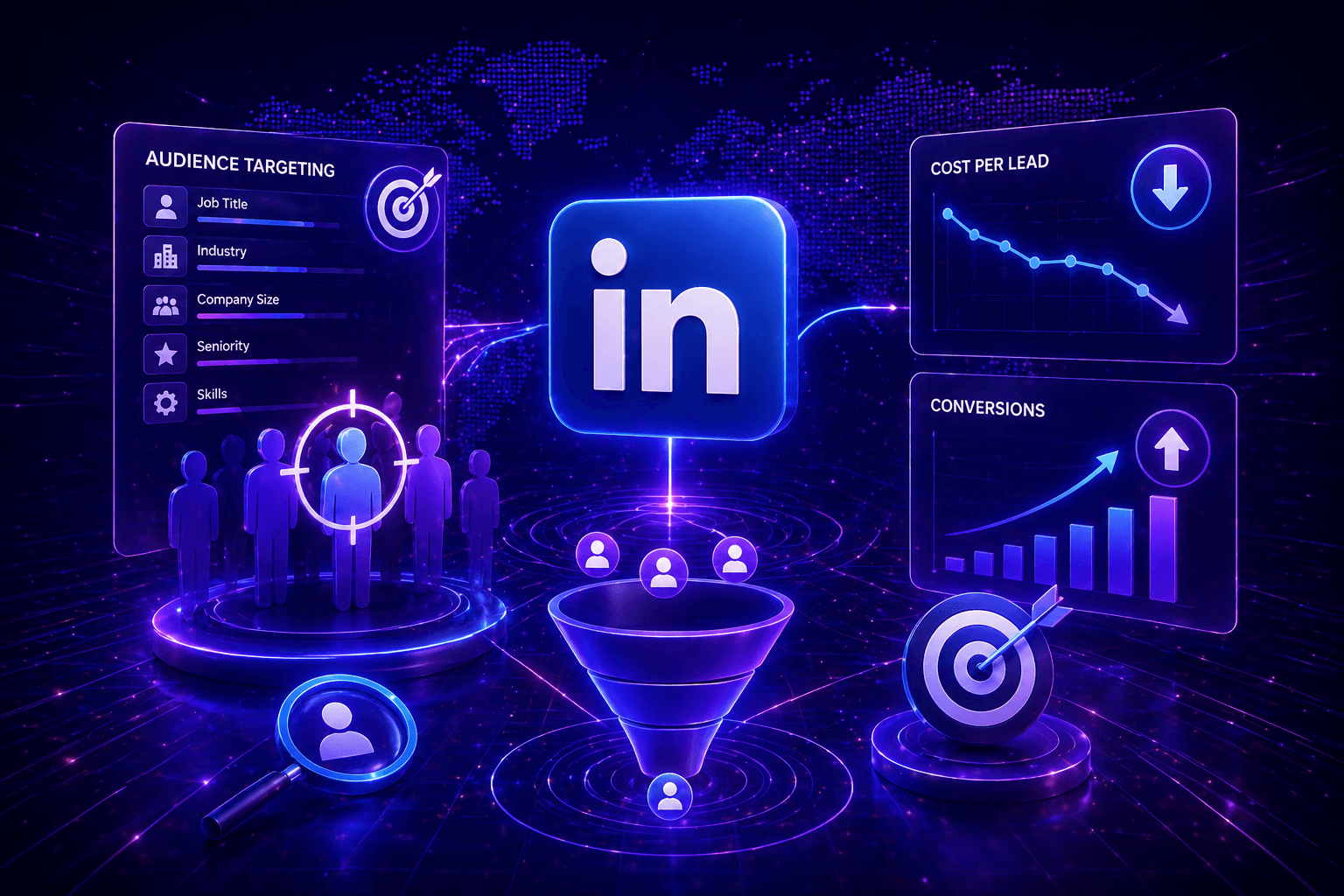
When Better Targeting Quietly Fixes Everything
There’s a moment in every LinkedIn Ads account where performance starts asking better questions. Leads are coming in, campaigns are active, dashboards look busy enough, but cost per lead feels heavier than it should, and conversions seem like they could be doing more. That’s usually when marketers realize something important. It’s not the platform. It’s the targeting.
LinkedIn doesn’t struggle with reach. It offers one of the most precise audience datasets available anywhere in digital advertising. The real advantage lies in how that precision is used.
When targeting becomes sharper, campaigns become lighter, faster, and far more efficient. And that’s where the real work begins, not in launching campaigns, but in refining who actually sees them.
Why Cost Per Lead Is Really a Targeting Conversation
Cost per lead often gets framed as a budget issue or a bidding issue. In reality, it’s frequently a targeting issue wearing a different label.
When campaigns reach audiences that are only partially aligned, engagement may happen, clicks may come through, but conversion intent feels slightly out of sync. That gap shows up as higher CPL.
Refining targeting closes that gap. It brings your message closer to people who are already thinking in the direction your offer supports. And when alignment improves, conversion friction naturally reduces. Which means CPL doesn’t need to be forced down. It simply adjusts. That’s a much better outcome.
Moving Beyond Job Titles Into Real Buyer Signals
One of LinkedIn’s biggest advantages is also where many campaigns stop too early.
Job titles. They’re useful, of course. They offer a quick snapshot of the role and responsibility. But B2B decisions rarely happen because of titles alone. They happen because of context.
A Head of Marketing at a fast-scaling startup behaves very differently from one at a global enterprise. A founder exploring growth strategies has a different mindset than someone optimizing an existing funnel.
Refined targeting begins when campaigns start accounting for those differences. Company size, industry, growth stage, seniority, and even functional alignment begin to shape a more accurate picture of the audience. And once that picture becomes clearer, messaging becomes more relevant. That’s where conversions start improving. Not because reach increased. Because alignment did.
Precision Often Outperforms Scale
There’s something comforting about large audience sizes. They suggest opportunity, visibility, and momentum. Yet LinkedIn tends to reward focus.
Smaller, well-defined audiences frequently deliver stronger results because they reduce dilution. The message resonates more clearly. The offer feels more relevant. Engagement becomes more intentional.
This is often where refined targeting starts lowering CPL. Fewer impressions, but better ones.
Fewer clicks, but more meaningful ones. And ultimately, stronger conversion rates.
Many brands working with advanced linkedin ads services notice this shift quickly. It’s not about reaching everyone. It’s about reaching the right group with precision. That shift changes performance in a very tangible way.
Layering Signals to Build Smarter Audiences
Refinement on LinkedIn rarely comes from one targeting parameter. It comes from layering.
Job function provides direction. Seniority adds decision-making context. Company size introduces scale. Industry adds relevance. When combined thoughtfully, these layers create audiences that feel far more aligned with your offering. And alignment is what improves efficiency.
It allows messaging to become more specific, which improves engagement. It allows offers to feel more relevant, which supports conversions. It allows campaigns to perform with more consistency.
The difference is subtle at first.
Then noticeable.
Then measurable.
That’s usually when marketers realize targeting isn’t just a setup task, it’s a growth lever.
Content and Targeting Are Always in Conversation
Refining targeting without refining messaging rarely unlocks full performance. The two work together. An audience of senior decision-makers responds to a different tone than a group of specialists focused on execution. A company exploring new solutions reacts differently from one that optimizes existing processes.
When targeting becomes more precise, content needs to follow.
That’s where cohesive social media management services play an important role. They ensure that messaging evolves alongside audience refinement, keeping campaigns aligned and relevant over time. Because targeting attracts attention. Content converts it. And when those two elements move together, performance tends to improve naturally.
Data Turns Targeting Into a Living System
One of the most valuable aspects of LinkedIn Ads is how quickly performance data begins revealing patterns. Certain industries engage more actively. Specific roles convert more consistently. Some company sizes align better with your offer. These signals are more than insights; they’re direction.
Refined targeting treats data as a feedback loop. Campaigns evolve based on what’s working, not assumptions about what should work. Audiences become sharper. Messaging becomes clearer. Budgets shift toward higher-performing segments. Over time, this creates a system that improves itself. And that’s where CPL begins to stabilize at a more efficient level.
Retargeting Strengthens Conversion Momentum
Initial targeting introduces your brand. Retargeting builds familiarity. On LinkedIn, this becomes especially effective because the audience already operates within a professional mindset. When someone interacts with your content or visits your site, they’ve shown intent within a business context. That’s valuable.
Retargeting allows you to reconnect with that audience in a more focused way. Messaging can become more direct. Offers can feel more relevant. The conversation continues instead of restarting. And that continuity often supports higher conversion rates. Which, naturally, contributes to lowering CPL over time.
Why Refinement Is an Ongoing Advantage
Refining LinkedIn Ads targeting isn’t a one-time adjustment. It’s an ongoing process. Audience behavior evolves. Campaign data reveals new opportunities. Market conditions shift. Each of these creates room for improvement.
The strongest campaigns stay responsive.
They test.
They learn.
They refine.
Over time, this creates consistency. Not through guesswork, but through iteration. And that consistency is what drives sustainable performance.
Lower CPL becomes a result of better alignment.
Higher conversions result from clearer messaging.
Everything starts working together.
Conclusion
Refining LinkedIn Ads targeting is one of the most effective ways to improve campaign efficiency and increase conversions. When audiences are defined with precision, messaging becomes more relevant, engagement improves, and cost per lead naturally becomes more efficient. Over time, this creates a system that supports consistent, scalable B2B growth.
If you’re looking to sharpen your targeting, improve lead quality, and build LinkedIn campaigns that perform with greater clarity and confidence, this is a great time to connect and explore the next step forward.
About Stellix
Stellix is a performance-driven digital marketing agency helping businesses grow through SEO, PPC, website development, content marketing, and social media marketing. We combine data-backed strategies with creative execution to increase visibility, generate qualified leads, and drive measurable business growth. Ready to scale your digital presence? Contact our team to discuss your growth goals and discover how Stellix can help your business achieve sustainable success.
Related Articles:
Continue exploring digital marketing strategies with these resources: