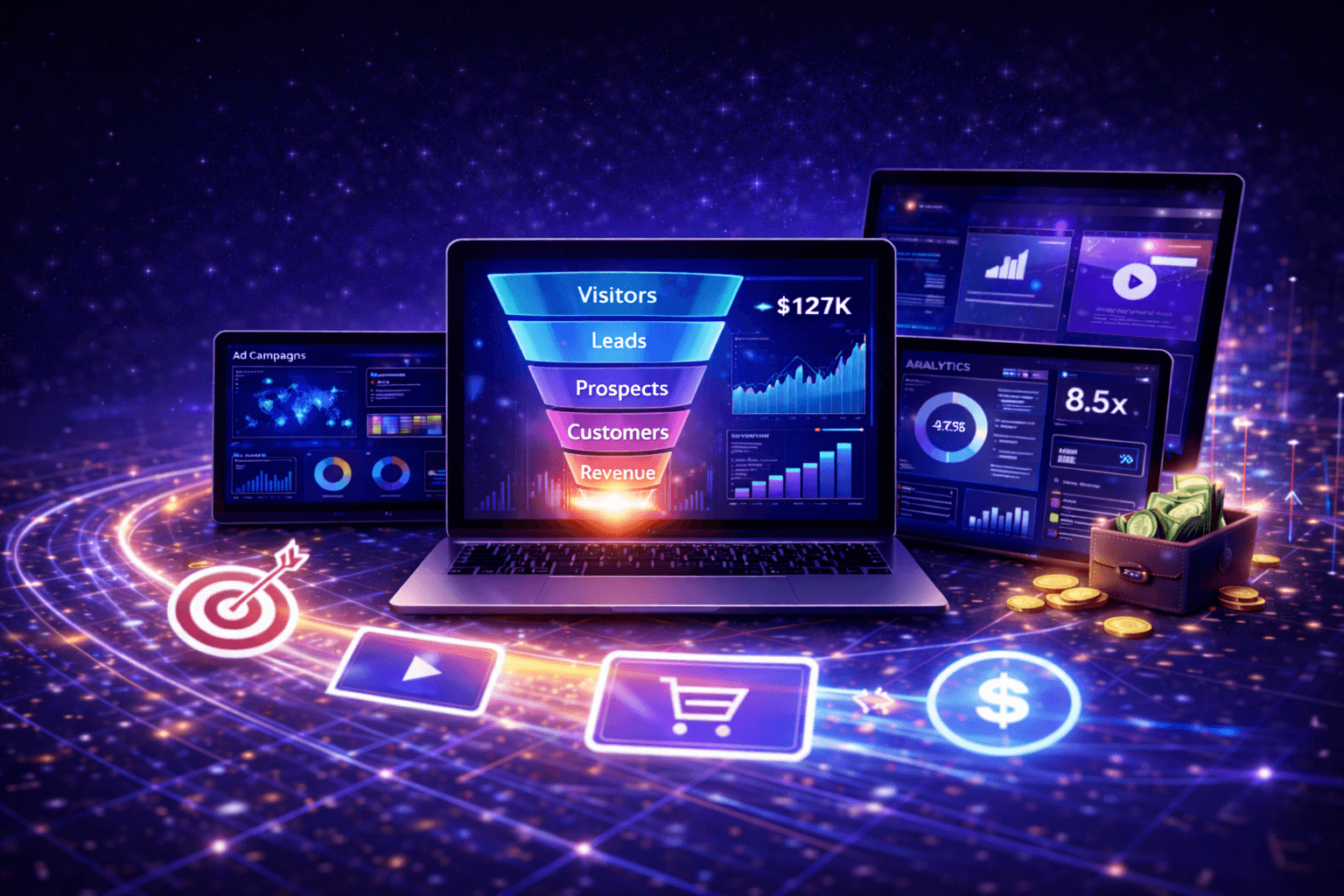
Getting traffic is easy. Converting it isn’t
Turning that traffic into revenue? That’s where most brands fail.
Every day, businesses invest heavily in ads, SEO, and social media campaigns. Clicks go up. Impressions grow. Traffic looks impressive on dashboards.
But conversions?
Flat. Inconsistent. Unpredictable.
Here’s the reality:
Clicks don’t build businesses; conversions do.
If your marketing efforts aren’t translating into measurable outcomes, you don’t have a growth engine; you have a leakage problem.
This is where a performance marketing strategy built around the full funnel becomes critical.
In this SEO-optimised article, we’ll break down how to move beyond vanity metrics and build a scalable system that consistently converts traffic into revenue.
What Is a Full-Funnel Performance Marketing Strategy?
A performance marketing strategy focuses on measurable outcomes: clicks, leads, sign-ups, and revenue.
But a full-funnel approach goes deeper.
It aligns your marketing across every stage of the customer journey:
Awareness
Consideration
Conversion
Retention
👉 Instead of chasing isolated wins, you build a system where every stage supports the next.
Why Most Marketing Strategies Fail
Most brands operate with a fragmented approach:
Paid ads drive traffic
SEO brings visitors
Landing pages exist somewhere
But there’s no alignment.
Common Mistakes
Optimising for clicks instead of conversions
Ignoring user intent
Weak landing page experience
No retargeting strategy
Lack of funnel visibility
👉 The result?
Traffic comes in, but doesn’t convert.
🔍 Understanding the Full Funnel
To build a scalable system, you need to understand how users move through the funnel.
Top of Funnel (TOFU): Awareness
This is where users discover your brand.
Channels:
SEO
Paid social
Display ads
Content marketing
Goal: Attract attention and generate interest
Middle of Funnel (MOFU): Consideration
Users are evaluating options.
Channels:
Blog content
Email marketing
Retargeting ads
Case studies
Goal: Build trust and educate
Bottom of Funnel (BOFU): Conversion
Users are ready to act.
Channels:
Landing pages
Conversion-focused ads
Offers and incentives
Goal: Drive action (sign-up, purchase, deposit)
Post-Funnel: Retention
Often ignored but critical.
Channels:
Email sequences
Push notifications
Loyalty programs
Goal: Increase lifetime value
👉 A strong performance marketing strategy connects all these stages seamlessly.
Step-by-Step: Building a Scalable Full-Funnel Strategy
1. Start With Intent, Not Traffic
Not all traffic is equal.
High-performing funnels start with understanding:
What the user wants
Where are they in the journey
What problem are they trying to solve
👉 Example:
Searching “what is performance marketing” → Awareness
Searching “best performance marketing agency” → Conversion intent
2. Align Channels With Funnel Stages
Each channel has a role.
Top Funnel:
SEO blogs
Paid social campaigns
Video content
Middle Funnel:
Comparison pages
Retargeting ads
Lead magnets
Bottom Funnel:
High-converting landing pages
Strong CTAs
Limited-time offers
👉 Misalignment kills performance.
3. Build Conversion-Optimised Landing Pages
Your landing page is where clicks turn into conversions.
Key Elements
Clear headline
Strong value proposition
Social proof (reviews, testimonials)
Fast loading speed
Mobile optimisation
Clear CTA
👉 Even small improvements here can dramatically increase ROI.
4. Use Data to Optimise Continuously
A scalable performance marketing strategy is data-driven.
Track Metrics Like:
Cost per acquisition (CPA)
Conversion rate (CVR)
Customer lifetime value (LTV)
Funnel drop-off points
👉 The goal is simple:
Identify what works and scale it.
5. Leverage Retargeting
Most users don’t convert on the first visit.
Retargeting helps you bring them back.
Effective Retargeting Includes:
Abandoned cart reminders
Offer-based ads
Personalised messaging
👉 This is where many conversions actually happen.
6. Focus on Creative + Messaging
Your funnel is only as strong as your messaging.
Winning Ads Typically Have:
Clear benefits
Emotional triggers
Strong hooks
Relevant targeting
👉 Great creative improves both CTR and conversion rate.
Clicks vs Conversions: The Real KPI Shift
Let’s be clear:
Clicks = Interest
Conversions = Value
Many brands celebrate high traffic numbers.
But without conversions, traffic is just a cost.
👉 The shift you need to make:
From:
“How many clicks did we get?”
To:
“How much revenue did we generate?”
Scaling What Works
Once you find a winning funnel:
Scale It Strategically
Increase ad budgets gradually
Expand to new audiences
Replicate across channels
Build supporting SEO content
👉 Scaling blindly leads to wasted spend.
👉 Scaling intelligently drives exponential growth.
The Role of SEO in Performance Marketing
SEO plays a critical role in a full-funnel strategy.
Why SEO Matters
Drives high-intent traffic
Reduces dependency on paid ads
Improves long-term ROI
Supports every funnel stage
👉 SEO + paid ads together create a powerful growth engine.
Common Pitfalls to Avoid
Ignoring Funnel Gaps
If users drop off between stages, conversions suffer.
Over-Reliance on Paid Ads
Paid traffic alone is expensive and unsustainable.
Weak Offer
Even the best funnel fails without a compelling offer.
Lack of Testing
No testing = no optimisation.
The Future of Performance Marketing
Marketing is evolving.
Privacy changes are limiting tracking
Ad costs are increasing
Users are more selective
👉 This means:
Only well-structured funnels will survive and scale.
Final Thoughts
Building a scalable performance marketing strategy isn’t about driving more traffic.
It’s about building a system that converts consistently.
The Winning Formula
Understand user intent
Align channels with funnel stages
Optimise landing pages
Use data to improve performance
Focus on conversions, not clicks
Because at the end of the day:
Traffic is just the beginning. Conversions are what drive growth.
Stellix is a performance-driven digital marketing agency specialising in iGaming, affiliate marketing, and high-growth industries. Focused on delivering measurable results, Stellix helps brands scale through data-backed strategies, combining SEO, paid media, and conversion optimisation. With deep expertise in performance marketing, technical SEO, and content strategy, Stellix builds sustainable growth engines that go beyond short-term wins. From high-intent traffic acquisition to full-funnel optimisation, the agency empowers businesses to maximise ROI and long-term profitability. Get in touch today to explore how our performance-driven strategies can accelerate your growth.