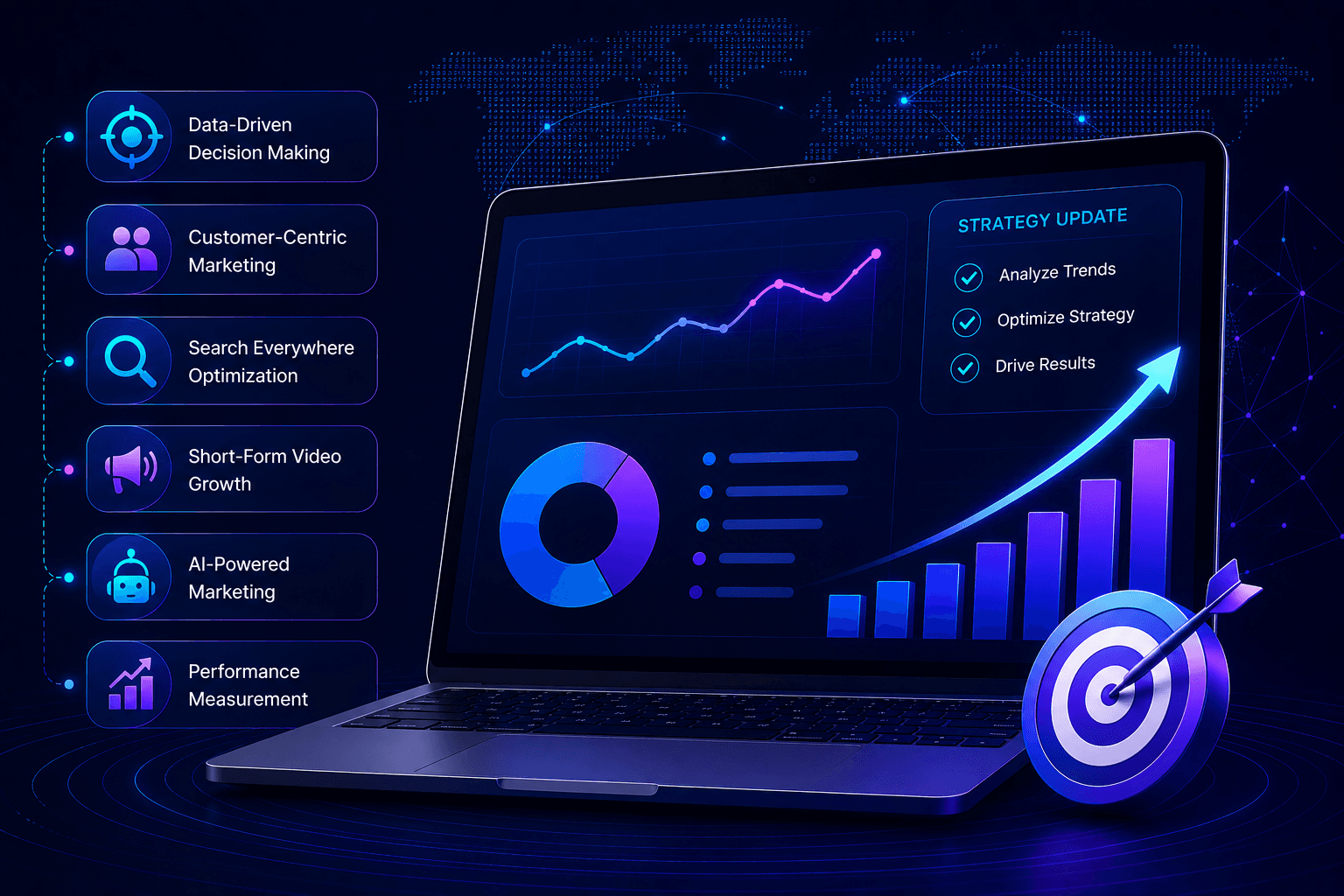
Digital marketing has entered a new operational phase. This is not a minor update cycle. It is a structural reset.
Search behavior has shifted. AI systems now influence information flow. Advertising economics have tightened. Privacy standards have strengthened. Buyers are more informed, more selective, and less linear in their decision-making.
If your strategy has not evolved with these shifts, performance gaps are inevitable.
At stellix.io, we analyze digital performance across sectors to identify what is materially changing and what organizations must do to remain competitive. This roundup outlines the critical developments shaping the current landscape and the strategic adjustments required to respond effectively.
1.Search Is Becoming AI-Interpreted, Not Just Indexed
What Has Changed
Search engines are increasingly delivering synthesized answers instead of ranked lists. AI-generated summaries and conversational interfaces are reshaping how users gather information.
Users now expect direct answers, comparisons, and contextual insights often without visiting multiple websites.
Traditional ranking metrics still matter, but discoverability now depends on how clearly search systems interpret your content.
What You Should Do
Produce structured, in-depth content that demonstrates expertise.
Implement schema markup to clarify relationships and entities
Strengthen topical authority through comprehensive coverage
Monitor how your brand appears in AI-driven summaries Focus on clarity and credibility rather than keyword repetition.
Search visibility now requires interpretability, not just optimization.
2.Attention Has Become the Primary Currency
What Has Changed
Audiences are overwhelmed by content volume. Algorithms across platforms reward retention, interaction, and engagement not simply frequency.
Organic reach is increasingly limited to content that drives meaningful interaction. Transactional posts and repetitive promotional messaging are deprioritized.
What You Should Do
Publish insight-led, value-driven content
Integrate short-form and visual formats
Encourage discussion and commentary
Build executive-level thought leadership
Prioritize quality over posting cadence
Digital channels now reward relevance and depth over activity.
3.Advertising Efficiency Is Under Pressure
What Has Changed
Competition has increased across paid channels. Cost-per-click and cost-per-acquisition metrics continue to rise in most industries.
At the same time, privacy-driven restrictions have reduced granular tracking precision, making optimization more complex. Simply increasing the budget no longer guarantees growth.
What You Should Do
Prioritize high-intent targeting strategies
Optimize landing page performance rigorously
Strengthen retargeting sequences
Align ad messaging with buyer stage
Conduct systematic A/B testing on creative and offers
Paid media now requires disciplined optimization at every stage of the funnel.
4. Data Governance Is Now a Strategic Priority
What Has Changed
The deprecation of third-party tracking mechanisms has shifted responsibility toward first-party data collection.
Organizations that lack centralized data systems are facing attribution challenges and targeting limitations.
Marketing performance increasingly depends on owned audience intelligence.
What You Should Do
Consolidate customer data into unified CRM environments
Invest in consent-based data collection
Build robust email and subscriber ecosystems
Align sales and marketing analytics
Develop internal reporting frameworks
Data maturity is no longer a differentiator. It is a baseline requirement.
5. Authority Has Become a Ranking Signal
What Has Changed
Search engines and AI platforms are increasingly prioritizing content that demonstrates expertise, credibility, and depth.
The widespread adoption of automated content tools has led to content saturation. As a result, surface-level material struggles to perform.
Authority signals such as original research, expert commentary, and case-based evidence are influencing visibility outcomes.
What You Should Do
Develop cornerstone content with substantial depth
Incorporate data-backed insights
Showcase industry expertise
Maintain content freshness through updates
Strengthen internal linking architecture
Visibility now favors expertise over output volume.
6. Video Integration Is No Longer Optional
What Has Changed
Short-form and explanatory video formats continue to dominate engagement metrics across platforms.
Audiences prefer visual summaries of complex topics. Platforms prioritize video distribution.
Video now influences brand credibility, engagement rates, and even paid campaign performance.
What You Should Do
Incorporate short educational videos into content strategies
Repurpose written insights into visual explainers
Use video within landing pages to increase clarity
Optimize titles and descriptions for discoverability
Video strengthens comprehension and trust both essential for conversion.
7. Customer Journeys Are Fragmented
What Has Changed
Modern buyers interact with multiple digital touch points before making decisions. They consume blog content, engage with social posts, evaluate AI-generated summaries, and review third-party opinions.
Linear funnel assumptions are increasingly inaccurate.
What You Should Do
Map cross-channel engagement pathways
Align messaging across platforms
Use marketing automation to nurture consistently
Measure performance through pipeline contribution
Implement retargeting strategies that reflect buyer stage
Integrated messaging builds continuity. Disconnected efforts dilute trust.
8.Conversion Efficiency Determines ROI
What Has Changed
With rising acquisition costs, inefficient funnels directly reduce profitability. Minor improvements in conversion rate now produce significant financial impact.
Organizations that neglect optimization leave measurable revenue unrealized.
What You Should Do
Refine headline clarity and value propositions
Reduce friction in lead capture forms
Strengthen trust indicators such as testimonials and case studies
Improve load speed and mobile usability
Continuously test variations of key conversion elements
Conversion optimization is a core growth lever not a secondary initiative.
9. AI Is Increasing Execution Speed
What Has Changed
AI-powered tools are streamlining content production, analytics interpretation, and campaign optimization.
Marketing teams are expected to move faster and operate more efficiently. However, automation without strategic oversight risks uniformity and reduced differentiation.
What You Should Do
Use AI to enhance productivity, not replace strategy
Maintain editorial and brand oversight
Preserve originality and voice consistency
Automate repetitive operational tasks
Focus leadership attention on strategic planning
AI is a force multiplier not a substitute for expertise.
Strategic Imperatives for the Year Ahead
Given these developments, organizations must prioritize:
Structured, entity-focused SEO
First-party data ownership
Paid media efficiency
Authority-driven content ecosystems
Multi-channel integration
Continuous conversion testing.
Activity alone will not deliver sustainable growth. Architecture will.
What This Means for Your Organization
Digital marketing has transitioned into a performance-centered discipline.
Visibility without authority is insufficient. Traffic without conversion is inefficient. Data without integration is unusable.
Organizations that respond decisively will strengthen market position. Those that delay will experience rising costs and diminishing returns.
At Stellix.io, we build structured digital ecosystems designed for measurable revenue impact aligned across search, paid media, content, and data systems.
If your current marketing approach lacks cohesion, the solution is not more campaigns. It is strategic restructuring.
Conclusion
Digital marketing has evolved in meaningful ways.
Search is AI-interpreted.
Privacy is reshaping targeting.
Acquisition costs demand efficiency.
Authority influences visibility.
Optimization drives profitability.
The central question is no longer which channel to prioritize.
It is how to build an integrated system that transforms attention into predictable revenue.
The environment has changed.
Your strategy must evolve accordingly.
At Stellix, we are dedicated to transforming visions into impactful solutions. Our mission is to empower startups and businesses with a combination of cutting-edge tools, innovative design, and strategic marketing. Whether you need a robust product, a scalable MVP, or the tools to grow, we are your trusted partner every step of the way. Explore more.