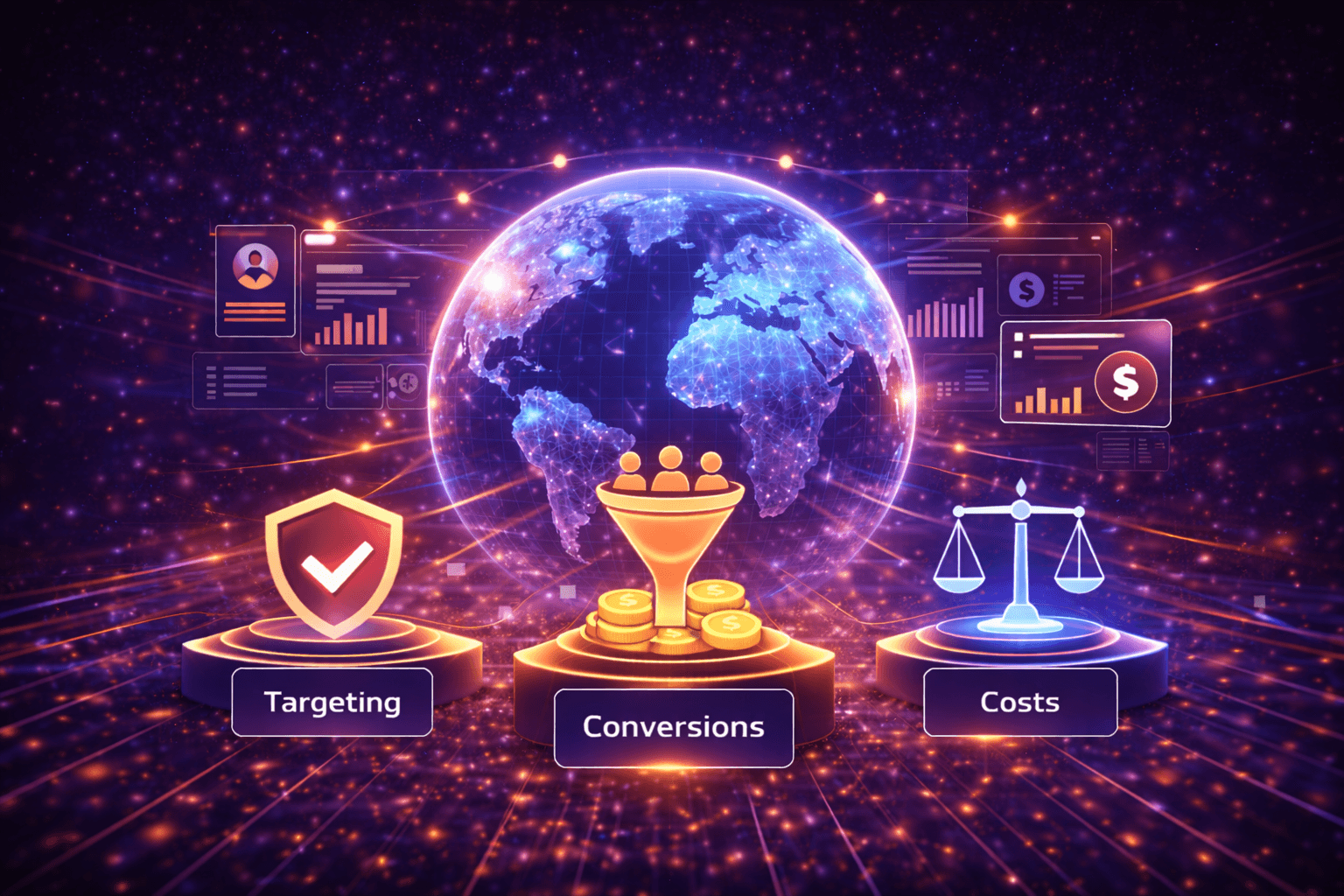
Performance marketing is no longer just about running ads; it’s about running intelligent systems.
In today’s digital ecosystem, rising customer acquisition costs, fragmented user journeys, and increasing competition have made traditional campaign strategies less effective. Marketers who rely on manual targeting, static creatives, and guesswork are quickly falling behind.
Enter Artificial Intelligence (AI)
AI is transforming performance marketing into a data-driven, self-optimizing engine, one that delivers smarter targeting, higher conversions, and significantly lower costs. For brands looking to scale efficiently, this isn’t a trend; it’s a necessity.
Let’s explore how AI is reshaping performance marketing and why it’s becoming the backbone of modern growth strategies.
1. Smarter Targeting Through Predictive Intelligence
One of the biggest challenges in performance marketing has always been identifying the right audience at the right time. Traditional targeting methods, based on demographics, interests, or basic behavior, are no longer sufficient.
AI changes this completely.
How AI enhances targeting:
Predictive analytics identifies users most likely to convert
Behavioral modeling analyzes patterns across multiple touchpoints
Lookalike expansion becomes more accurate and scalable
Real-time data processing adapts targeting dynamically.
Instead of targeting broad segments, AI enables micro-segmentation, allowing brands to reach high-intent users with precision.
The result:
Reduced wasted ad spend
Higher engagement rates
Improved conversion probability.
For businesses leveraging advanced performance marketing services, AI-driven targeting is unlocking entirely new levels of efficiency.
2. Automated Optimization: Campaigns That Learn and Improve
Manual campaign optimization is time-consuming and often reactive. AI introduces automation with intelligence, where campaigns continuously learn and improve without constant human intervention.
What AI can optimize:
Bid strategies (CPC, CPA, ROAS)
Ad placements across platforms
Audience segmentation
Budget allocation.
Real impact:
AI algorithms analyze thousands of data points in real time, something no human team can match.
This means:
Budgets are shifted instantly to high-performing segments
Underperforming ads are paused automatically
Campaign performance improves continuously
Example:
Instead of manually adjusting bids, AI can automatically increase bids for users with higher conversion likelihood and decrease spend on low-value audiences.
Outcome: Better results with less effort.
3. Creative Intelligence: Data-Backed Ad Performance
Creative has always been a major driver of performance, but historically, it relied heavily on intuition.
AI is now bringing data into the creative process.
How AI improves creatives:
Identifies top-performing formats (video, carousel, static)
Tests multiple variations simultaneously (A/B/n testing)
Analyzes user engagement patterns
Suggests improvements based on performance data.
Key shift:
Creative is no longer subjective; it’s measurable and optimizable.
What brands gain:
Faster iteration cycles
Higher-performing ad creatives
Better alignment with audience preferences.
AI ensures that every creative decision is backed by real user data, not assumptions.
4. Lower Customer Acquisition Costs (CAC)
One of the most compelling advantages of AI in performance marketing is its ability to reduce costs while improving results.
How AI lowers CAC:
Eliminates inefficient spend
Improves targeting accuracy
Optimizes bidding strategies
Enhances conversion rates.
As campaigns become more efficient, brands can achieve:
Higher return on ad spend (ROAS)
Lower cost per acquisition
Better profitability margins
Why this matters:
In competitive industries, even a small reduction in CAC can significantly impact overall revenue and scalability.
AI doesn’t just improve performance; it protects your margins.
5. Full-Funnel Optimization: Beyond Clicks to Conversions
Traditional performance marketing often focuses on top-of-funnel metrics like clicks and impressions. AI shifts the focus to end-to-end funnel performance.
AI-driven funnel optimization includes:
Identifying drop-off points in the user journey
Personalizing messaging across stages
Retargeting users based on behavior
Predicting conversion likelihood.
The result:
Higher conversion rates
Improved user experience
Increased lifetime value (LTV)
AI connects the dots between awareness, consideration, and conversion, creating a seamless, data-driven funnel.
6. Real-Time Decision Making at Scale
Speed is a competitive advantage in performance marketing.
AI enables brands to make decisions in real time, based on live data.
What this looks like:
Instant campaign adjustments
Dynamic budget reallocation
Real-time audience targeting updates
Instead of waiting for weekly reports, marketers can now:
Respond immediately to performance changes
Capitalize on high-performing trends
Minimize losses quickly
This level of agility is critical in today’s fast-moving digital environment.
7. The Future: AI + Human Strategy
While AI is powerful, it’s not a replacement for human expertise; it’s an amplifier.
The winning combination:
AI handles data, automation, and optimization
Humans focus on strategy, creativity, and decision-making.
Brands that successfully integrate both will:
Scale faster
Optimize more efficiently
Build sustainable growth systems
AI provides the engine, but strategy determines the direction.
Challenges to Consider
Despite its advantages, AI in performance marketing comes with challenges:
Dependence on data quality
Learning curve for implementation
Platform limitations and transparency issues.
However, these challenges are manageable and far outweighed by the benefits when executed correctly.
Final Thoughts
AI is not just enhancing performance marketing, it’s redefining it.
From smarter targeting to automated optimization and lower acquisition costs, AI is enabling brands to move from manual execution to intelligent growth systems.
In a landscape where efficiency determines success, AI gives marketers the ability to:
Do more with less
Scale faster
Drive better results consistently.
The question is no longer whether to adopt AI, but how quickly you can integrate it into your strategy.
🚀 Ready to Scale Smarter with AI?
If you’re looking to:
Improve targeting precision
Increase conversions
Reduce acquisition costs
It’s time to leverage AI-driven performance marketing strategies.
Let’s build a smarter, more efficient growth engine for your business.
Stellix is a performance-driven digital marketing agency specialising in iGaming, affiliate marketing, and high-growth industries. Focused on delivering measurable results, Stellix helps brands scale through data-backed strategies that combine SEO, paid media, and conversion optimisation. With deep expertise in performance marketing, technical SEO, and content strategy, Stellix builds sustainable growth engines that go beyond short-term wins. From high-intent traffic acquisition to full-funnel optimisation, the agency empowers businesses to maximise ROI and long-term profitability. Get in touch with us today to explore how our performance-driven strategies can accelerate your growth.